
“Civil Society Spotlight” is a series aiming at highlighting and contextualising the voices of Syrian civil society organizations, activists, journalists, and people who advocate for positive solutions, human rights, democratic values, and social justice.
The Context
Another tragedy has struck Syria over the past two weeks, this time in southern Syria.
On July 11, a Druze merchant was tortured by armed Bedouin tribes near the Damascus-Suwayda road. This sparked clashes that expanded within two days between the tribes and local Druze factions. The Syrian government later announced that it would intervene directly through "units of the Ministry of Interior forces, in coordination with the Ministry of Defense" in order to "resolve the conflict, stop the clashes, and impose security".
However, Sheikh Hikmat al-Hijri, the spiritual leader of the Druze community in Syria and a hardliner of the transitional government in Damascus, refused its intervention, and demanded immediate international protection.
On July 14, with the entry of government forces into Sweida, military tensions escalated between Bedouin tribal groups and personnel from the Ministries of Defense and Interior, on the one hand, and, on the other hand, local armed Druze factions. The clashes caused a mass exodus from different villages and rural areas.
Simultaneously, Israel launched airstrikes on Syrian army positions near Damascus, then targeted strategic sites in the heart of the capital, such as the Ministry of Defense, the General Staff Command Building, and the surroundings of the presidential palace.
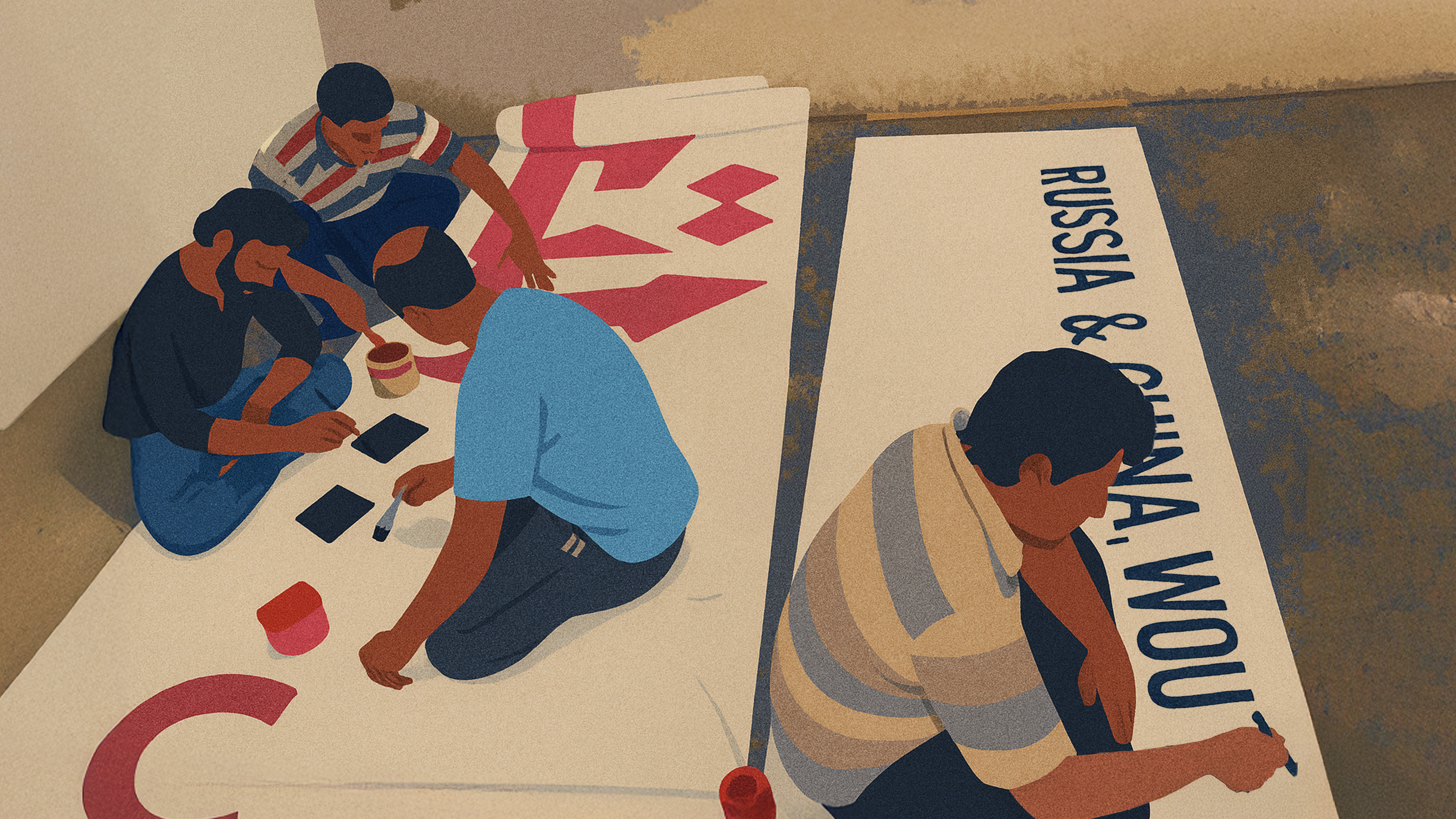
For Five Days, Sweida’s Soul Was Crushed—Its People, Homes, Crops, and Livestock... and So Was Mine, Trapped in Berlin
04 August 2025
The bombings were allegedly intended to pressure interim President Ahmed al Sharaa to withdraw from Sweida, which happened on July 16. One day later, al Sharaa announced that "local factions" and Druze sheikhs were now responsible for maintaining security in Sweida.
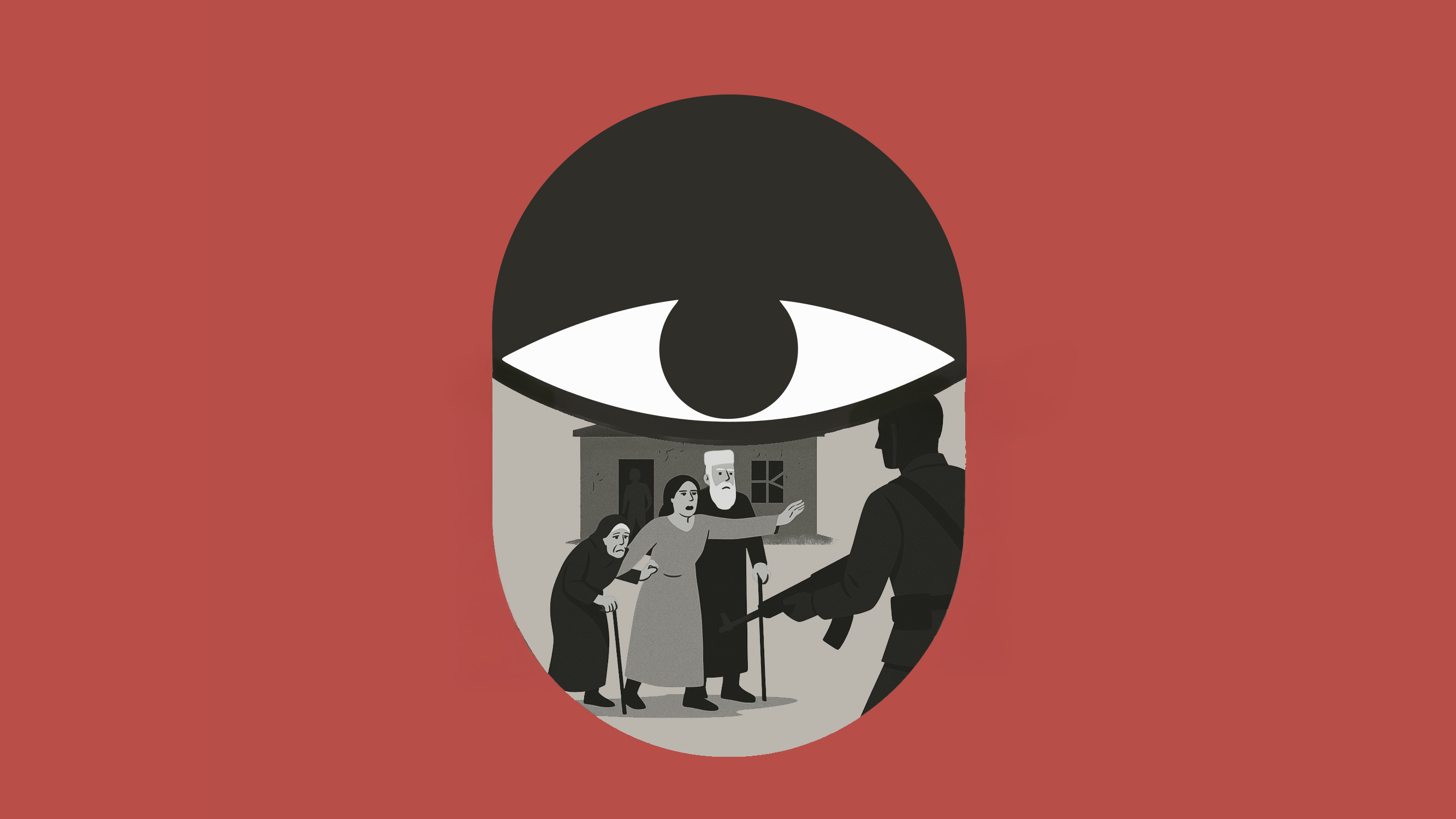
The government forces left a catastrophic situation, with corpses lying still on the streets, as mentioned by Rayan Maarouf, the director of the local media outlet Sweida 24, and as confirmed by many other news reports.
Also violations committed by local Druze factions against Bedouin families were recorded, and many have been consequently displaced, fearing further retaliatory attacks.
In this context, the tribes declared a general mobilization and clashes resumed, before another US- and Arab-brokered ceasefire agreement was reached on July 19.
According to data collected by the SOHR (26 July), the massacre in Sweida resulted in the deaths of 1,420 people, including 250 women and children.
Criticism of the government discourse
Al Sharaa's second speech on the events in Sweida lacked any explicit condemnation of the violations committed by his forces, including field executions documented by local networks. He instead used repetitive, politicized phrases accusing Druze groups of seeking "separatism" and "external support."
Syrian writer Rima Flihan criticized the speech in a post on Facebook, saying that al Sharaa "praised a party that committed war crimes and commended its support for the state (the Bedouin tribes), while placing an entire Syrian community (the Druzes) in the dock, even if he tried to mitigate the situation by saying 'some of them”. According to Flihan, these statements can be considered "clear incitement."
Journalist and writer Manahel Alsahoui, who lost family members among the victims, tells Untold: "The authorities' discourse is weak and evasive. It's no different from what we've seen during the coastal massacres or the church bombing, and it doesn't stray far from the discourse of Bashar al-Assad's regime at the height of its repression. It's a discourse based on a recurring equation (outlaw groups - decisive government intervention - mobilization of its base of supporters)".
She also noted that "The repeated massacres and violations have revealed that the authorities still lack the most basic elements of governance, relying instead on tribal mobilization as a means of crisis management. The tacit approval, and even the clear facilitation, of some tribes' access to the city to carry out killings under the pretext of ‘achieving justice’ revealed a systematic management of repression through militia arms.While the authorities reject the proliferation of weapons in the hands of the people of Sweida, they turn a blind eye to the weapons in the hands of the Bedouin tribes, leaving them the duty of dealing with what they consider intractable cases".
Similarly, in an interview with Untold, Lawyer Ayman Sheib al Din, who resides in Sweida, considered that the recent events amount to "systematic war crimes" and are not isolated incidents. "What happened”, he says, “was not just the burning of one or two homes, but rather widespread destruction, especially in the western Sweida countryside”.
Sheib al Din, who works with several activists in Sweida, noted that the complete blackout of communications and the internet, along with the deployment of security forces, the army, and allied tribal factions, constituted a major obstacle to documenting violations and accessing information.
He believes that government forces arrived under the pretext of "dispersing the conflict between the Druze and the Bedouins", but in reality, they "came to subjugate the Druze by force, disarm them, and humiliate and degrade them," referring to video clips showing violations such as mustache trimming and the chanting of offensive phrases such as "Druze are traitors" and "Druze are pigs".
While clashes were raging in Sweida, statements by some members of the Supreme Committee for the Preservation of Civil Peace in Syria sparked a wave of criticism and condemnation after they publicly expressed their support for the Bedouin tribes allied with the government against the Druze.

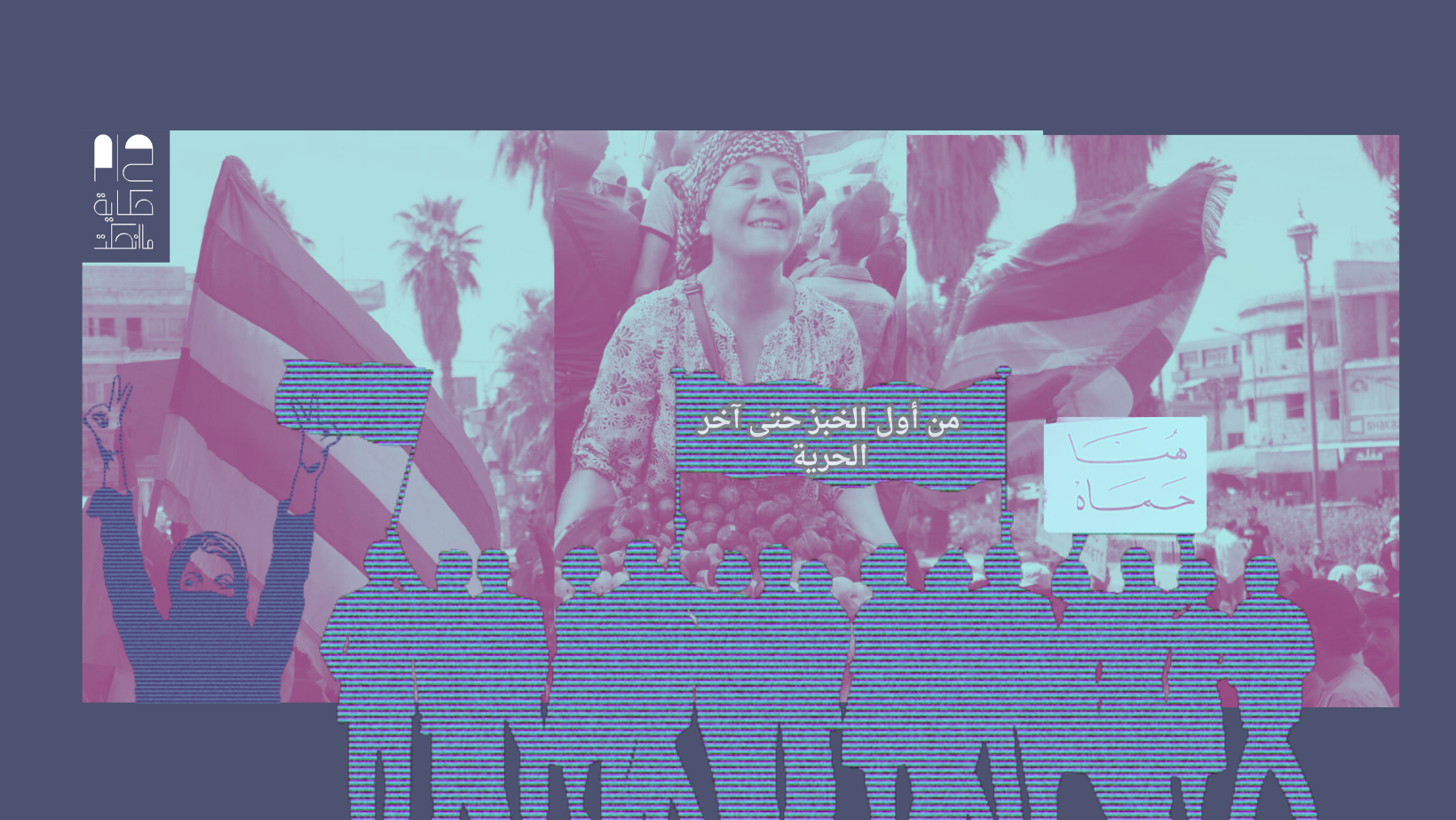
Sweida before 17 August… I Was There
13 September 2024
Anas Ayrut, one of its members, wrote a post on his X account on July 18 in which he praised the intervention of the tribes, describing the event as "a call to support the oppressed and to help the distressed". After a wave of criticism, the post was deleted.
The same day, 57 civil society organizations expressed their grave concern regarding the escalation in Sweida. The joint statement called for an immediate end to the violence and the protection of civilians, and condemned all violations, including the recent Israeli attacks. It also demanded the transitional authorities to open transparent investigations into violations, protect civilians and medical facilities, initiate an all inclusive national dialogue, and allow international organizations into the Sweida Governorate.
Other civil society organizations issued similar statements. On July 15, Madaniya called on the Syrian government to assume its responsibilities to protect civilians. The Access Center for Human Rights also condemned the violence, denouncing the government's "politically biased" stance and its inability to protect civilians.
At the same time, civil activist and executive director of Madaniya, Sawsan Abou Zeinedin, points out that the scene in Sweida is inherently complex. First, the civil movement there started more than one year and half before the fall of the regime. Second, the local militias have a complex relationship with one another and with the civil movement itself. Third, the last year saw the growing influence of religious figures, and specifically Sheikh Hikmat al Hijri, who also received support from the international community, which treated him as the main gateway to the local civil movement. This, Abou Zeinedin maintains, was very problematic, as it happened at the expense of other civil organizations, and it is not true that al Hijri was a unifying authority for the Druze. Fourth, after the massacres, most of the civil voices today developed a shared hostility towards the government of Damascus, and now it is quite difficult to imagine it can have a role in finding a political solution.
Calls for civil peace, dialogue, and unity
Various areas across Syria witnessed civil solidarity movements, affirming the unity of Syrians and rejecting violence and sectarian polarization. In Aleppo, journalist Mohammed Wesam took to Saadallah al-Jaberi Square, holding a sign reading, "A military solution means more bloodshed... From Aleppo to Sweida".
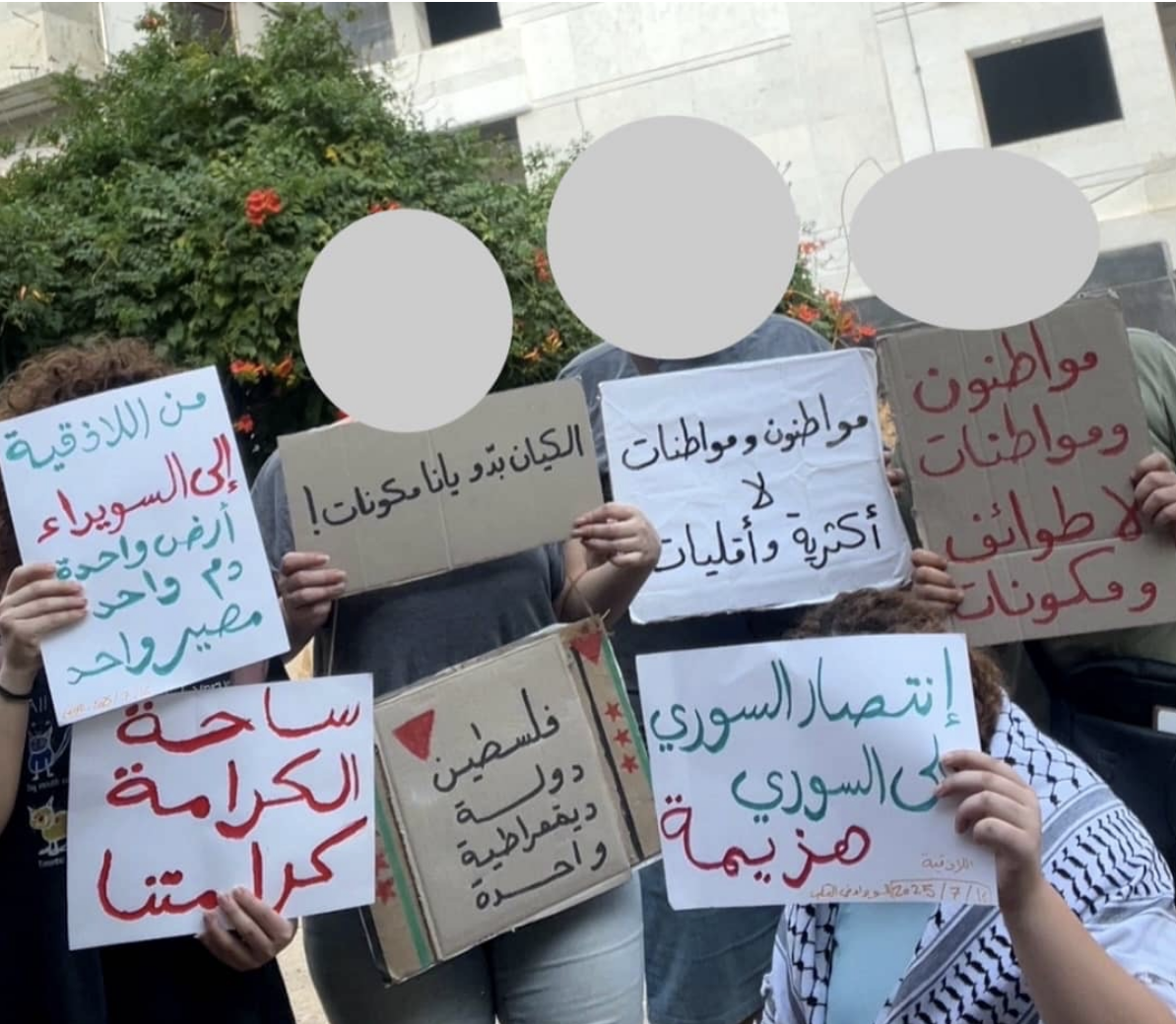
On July 16, a civil campaign organized by activists in Latakia launched a protest in support of civil peace and in solidarity with the people of Sweida. During the protest, they raised slogans against sectarianism and the Israeli attacks. The participants decided to hide their faces, fearing for their safety and the possibility of random reprisals.
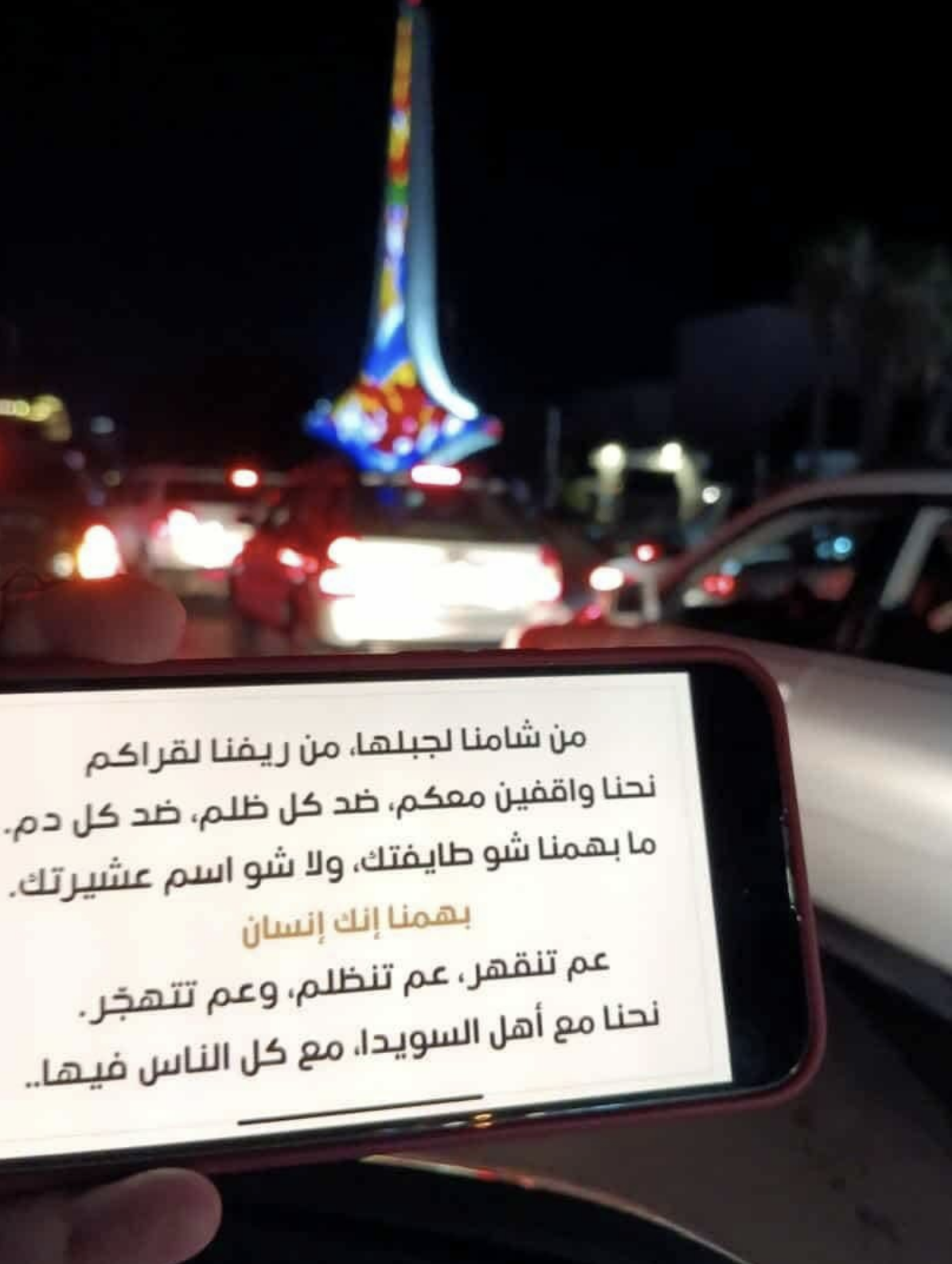
Different solidarity mobilisations took place also in Damascus. Paper flyers appeared in the streets, carrying a clear message of solidarity: "From our Levant to our Mountain, we stand with you against all injustice, against all bloodshed. We don't care what your sect is, what matters is that you are a human being. We are with the people of Sweida".
A number of civil society activists also condemned the violations targeting Bedouin civilians in Sweida. Lawyer and human rights activist Mohammed al Abdallah said in a post that "cases of forced displacement targeting Bedouins have been documented, with video clips showing local fighters firing on their homes". Al Abdallah reiterated his condemnation of "any act of violence targeting any civilian by any party, without accepting any justification for acts of violence and aggression".
Journalist Rasha Al Naddaf expressed her regret at the same problem, writing: "My heart breaks, my people...My heart breaks that you no longer feel safe around us," stressing her determination to "fight for their return to their homes and lands".
HTS’ strategy to Consolidate its power in Syria
28 July 2025
Meanwhile, civil activist Yamen Hussein expressed his rejection of any demographic change: "I oppose any forced displacement operations, from the Alawite villages in northeastern Hama, through Arzeh, which was violated and occupied and its name changed to 'New Khattab', all the way to the Bedouins of Sweida".
In Qamishli, located in areas controlled by the Syrian Democratic Forces (SDF), a series of civil activities were organized on July 25. Participants carried banners reading: "Our solidarity is the last bastion before collapse", "We want justice, not revenge", and "We want a state, not a jungle".
A number of Syrian political, human rights, and civil society figures launched an initiative on July 18 titled "Syrian National Salvation", pushing for a comprehensive and serious national dialogue to prevent the risk of another civil war.
Similarly, the "Syrian Centenary Initiative" was launched as a national rescue initiative for the centenary of the Great Syrian Revolution of 1925. According to the initiative's organizers, it came in response to what they described as a "national catastrophe" that recently struck Syrian society, threatening its fabric and unity. In the statement, the organisers blame the interim authority's mismanagement of the crisis and its resort to "militarization and panic" instead of "state reason and national accord."
Repression of the protests
Unfortunately, the mobilisations to denounce the events in Sweida and to express solidarity were met with episodes of repression and intimidations.
On July 16, a sit-in demanding an end to the bloodshed in Syria was organized, but it was attacked with sticks by a group of government supporters and allied parties. Journalist and activist Zeina Shahla, who was participating in the sit-in, was verbally abused and physically assaulted. Consequently, the sit-in, which was supposed to take place daily in front of the People’s Assembly in Damascus, was suspended until further notice.
Zeina Shahla, a former political prisoner in the Assad regime's prisons and now an advisor to the Damascus-based Committee for Missing Persons, describes in a post: "Today, as we were walking toward the end of the sit-in, a group of people armed with wooden sticks attacked us. One of them insulted me and hit me with a stick on my hand, then slapped me in the face. Most of the accusations were that we were 'collaborators and traitors".
She emphasized the need for Syrians to have "clear and deterrent laws against hate speech”.
Commenting on this, journalist Reema Naissah writes: "What happened is not just a personal attack, but an attack on what remains of our social fabric, and an attempt to thwart any dream of building a state based on pluralism, partnership, justice, and equality".
At the same time, activist Rita Suleiman notes there despite the repression there are brave acts of resistance. She writes in a post: "A few days ago, in Idlib, in an environment that stifles women's voices, a group of women stood in front of the Health Directorate and raised banners reading: 'The blood of a Syrian is sacred to another Syrian”. According to Suleiman, these women "did not just raise their voices, but confronted the authorities and society. They were summoned for investigation and subjected to harassment and threats, simply because they spoke the truth at a time when their voices were weak". The Idlib Health Directorate later issued a statement condemning the protest and threatening legal and punitive action against them.
Calls to lift the siege
The events in Sweida have displaced approximately 176,000 people from Sweida, Daraa, and the Damascus countryside.
Since the outbreak of the clashes, Sweida has witnessed a near-total disruption of vital services, from water, electricity, communications, and healthcare. Hospitals are operating at minimal capacity, amid a severe shortage of medicines and medical supplies, leading to the suspension of essential medical services.
UN organizations, including the United Nations Office for the Coordination of Humanitarian Affairs (OCHA) and the World Health Organization (WHO), reported increasing difficulties in delivering humanitarian aid to the population due to the deteriorating security situation. They also noted that health facilities are under tremendous pressure, with health workers operating in extremely difficult conditions, and access to healthcare remains a challenge.
Despite the entry of limited relief convoys from the Syrian Red Crescent and the World Food Programme, the aid provided remains far below the scale of the need and the tragedy.
Alongside this, local initiatives and organizations have begun to take action. The Kurdish Red Crescent organized a campaign to collect financial donations to support those affected in southern Syria.
Other campaigns to collect money have been organised in Kobane/Ayn al-Arab; an emergency online campaign was organised by Basmeh and Zeytooneh, and another one by Bidayetna.
The Minister of Social Affairs and Labor, Hind Kawabat, appeared in a video on July 19, saying that they had intended to bring relief aid into Sweida, but that Israeli aircraft prevented this. This claim was echoed by Minister of Health, Musaab al Ali, who said that a government delegation, including ministers and the governor of Sweida, accompanied the convoys, but that Sheikh Hikmat al-Hijri refused to receive them.
Following repeated local claims that the Syrian authorities had imposed a siege on Sweida, the spokesperson for the Syrian Ministry of Interior, Noureddine al Baba, reiterated this position on July 30, denying the existence of any siege, and describing the circulating accusations as "pure lies and misinformation". Al Baba accused armed groups in Sweida of "using allegations of a siege to promote irregular crossings into and out of the country, with the aim of reviving the arms and Captagon smuggling".
Kawabat’s statements sparked a wave of criticism. Activist and digital security expert Alaa Ghazal commented: "You are not being truthful, Hind. What prevented you is that you are part of the authority that attacked and is killing the people of Sweida".
In this interview with Untold, lawyer Ayman Sheib al Din confirmed that the entry of humanitarian aid convoys from the Syrian Red Crescent is welcomed by the residents, but only if they are not accompanied by any official affiliated with the regime. He told us that "the people of Sweida categorically refuse any visits from any representatives of the regime. They cannot be received after they participated in the killing or remained silent about it".
He adds that figures like Hind Kawabat and Mustafa Bakour, the newly appointed governor, are viewed in Sweida as "unwelcome figures".
Meanwhile, political activist Alice Mufrej observed: "No one is opposing the entry of humanitarian aid convoys. The real fear is that the convoys will be targeted with gunfire, and that local factions will be held responsible for attacks on the convoys or the accompanying delegation of General Security and ministers, which could be used as justification for a counterattack".
On July 20, the first aid convoy from the Syrian Red Crescent entered Sweida, a day after the ceasefire was declared. However, aid remains limited and only meets a fraction of the needs of shelters amid the ongoing stifling siege.
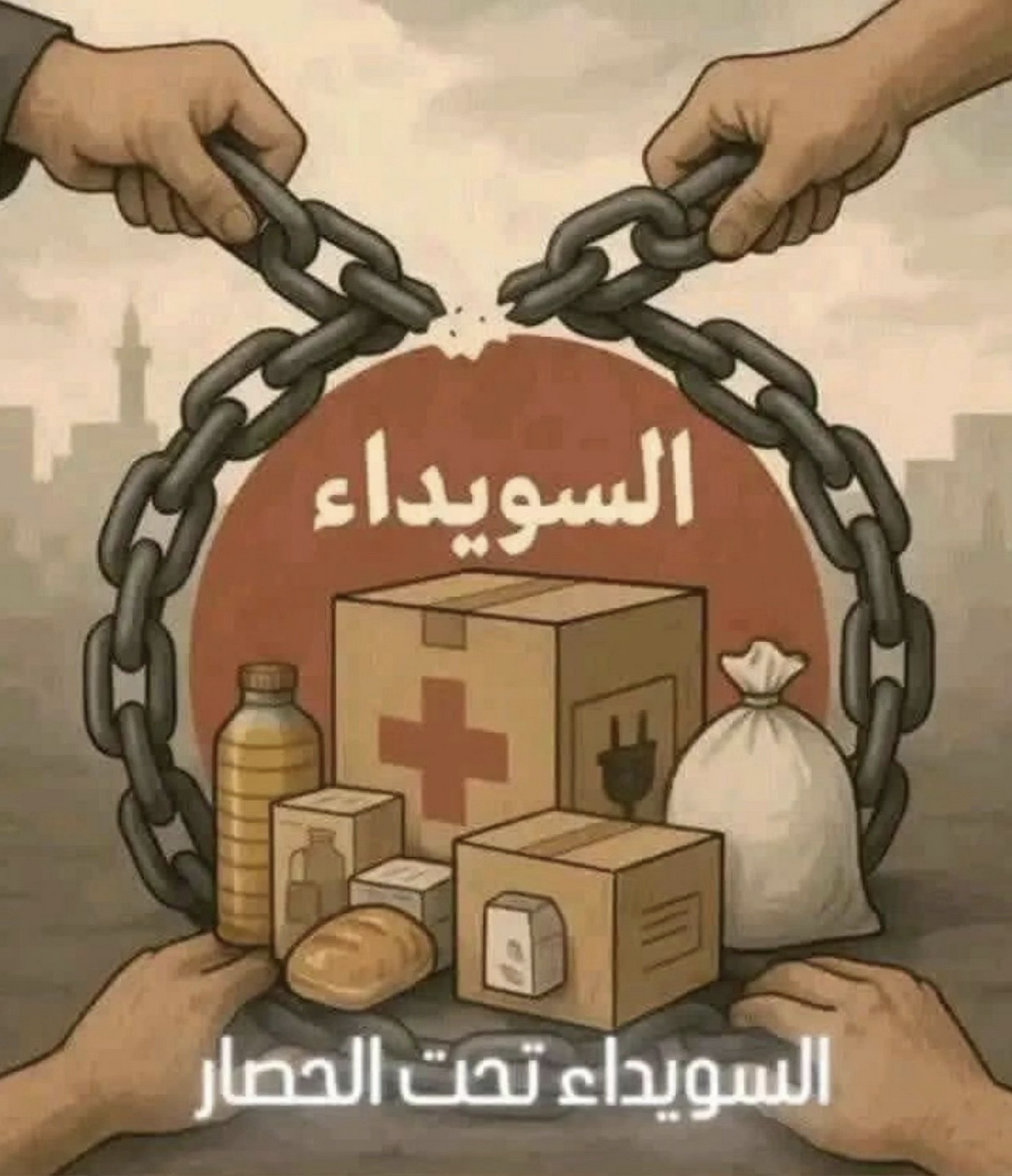
Meanwhile, a number of activists, journalists, writers, and civil society members, including media personality Alma Antabli and journalist Aws Mubarak, are accusing the Syrian authorities of imposing a siege on Sweida. This prompted them to launch a hashtag campaign #فكوا_الحصار_عن_السويداء (#Lift_the_Siege_On_Sweida). Journalist Alaa Amer launched a signature campaign titled "Bread and Medicine Statement" to lift the siege, and writer Mamdoh Azzam published an urgent humanitarian appeal.
List of civil society organizations and key activists included in this article:
Access Center for Human Rights
Syrian Observatory for Human Rights (SOHR)
Mohammed al Abdallah (Lawyer and human rights activist)
Rima Flihan (Human rights and gender equality activist)
Alaa Ghazal (Activist and digital security expert)
Alice Mufrej (Political activist)