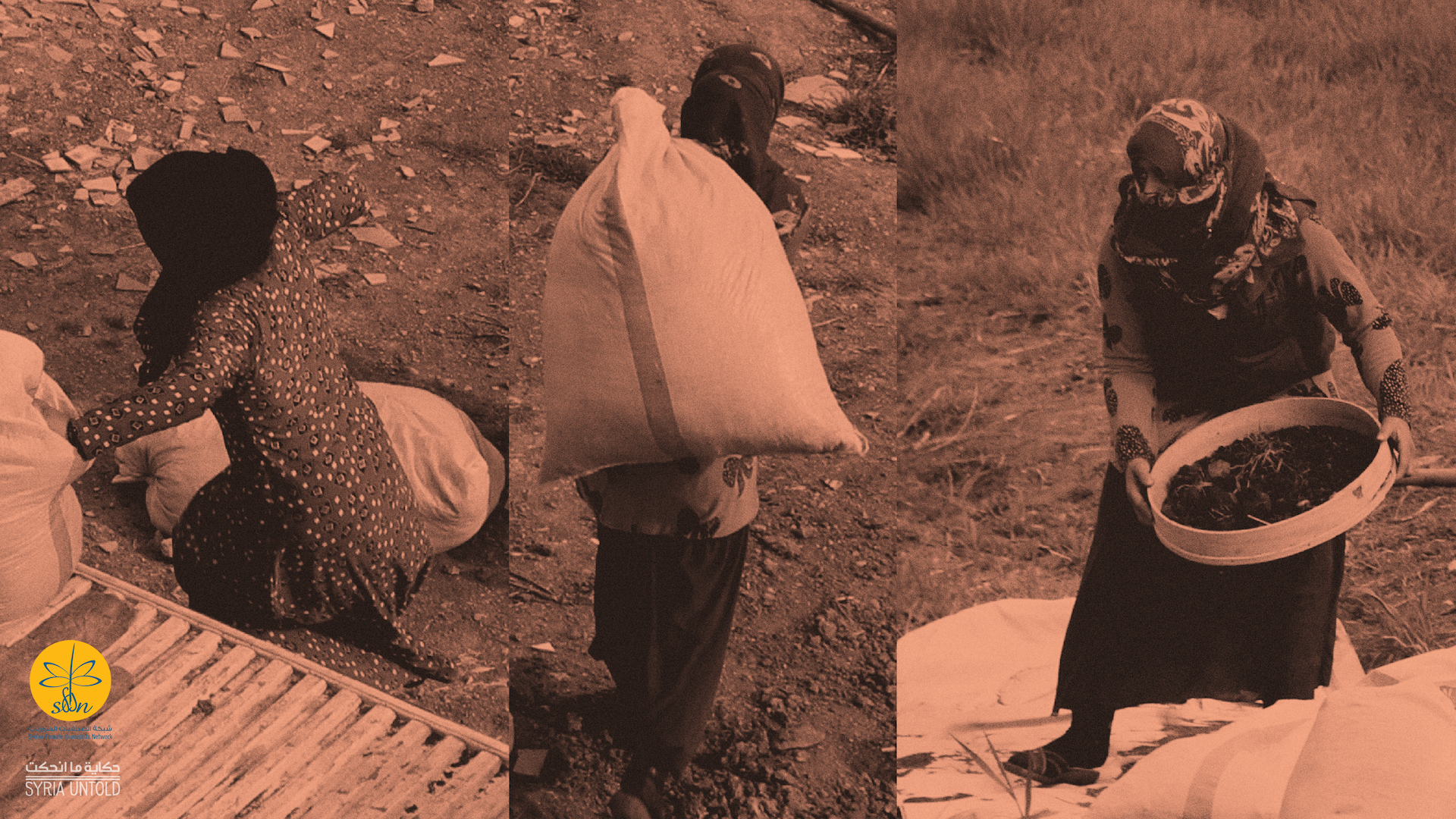


“Everyone with a well uses it, and nearly all farmers in areas far from the Euphrates have wells,” says Abdulrahman Al-Abdulaziz, an activist working for a local organisation supporting agriculture in Deir ez-Zor. Modernising irrigation methods remains challenging and slow, according to him, particularly in the drought-stricken regions such as the semi-arid rural areas of eastern Deir ez-Zor province in northeast Syria.
A previous article titled “The Ugly Face of the Transition to Renewable Energy in the Agricultural Sector of Northeast Syria” addressed the rapid shift from diesel to solar energy in the agricultural sector. It focused on groundwater-based irrigation, revealing how solar-powered systems make groundwater extraction almost cost-free, thereby increasing pressure on the region's fragile groundwater resources. Based on this, the transition to solar energy may threaten groundwater sustainability if not accompanied by modern irrigation techniques to optimize water use.
Made of Clay and Water
Groundwater irrigation began in Deir ez-Zor during Syria’s agricultural renaissance in the 1970s and 1980s, with State support. In the 1990s, the government implemented strict groundwater usage regulations. It limited new well permits and set annual cropping plans based on allowable quantities per crop, according to Mohammad Al-Hussein, head of the Farmers' Union in Deir ez-Zor. Flood irrigation, which involves saturating fields with water, has been the predominant method since the start. It was proven that it wastes water and damages crops and soil, yet most farmers in the area continue to rely on it, seemingly ignoring the severe water poverty crisis in northeast Syria. So, what explains its resistance to change?
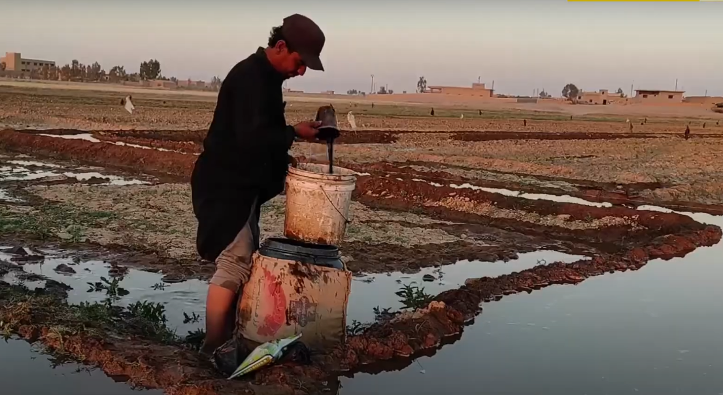
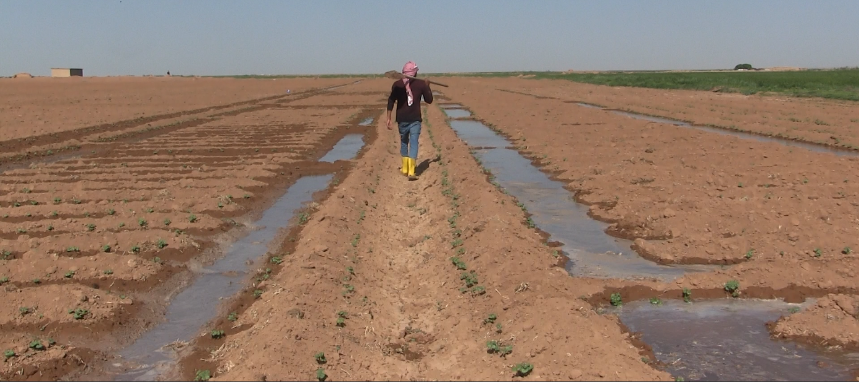
No infrastructure, advanced equipment, nor specialized skills are required by this prevailing technique. “All you need is clay and water,” says Asaad Al-Ashmakh, a farmer and agricultural development activist in rural Deir ez-Zor. “Flood irrigation is a deeply rooted practice in the community, and almost everyone knows how to do it. Modern irrigation, in contrast, remains an unknown, expensive, and unreliable alternative for locals.” Flood irrigation can be broken down into four stages:
- Water Source: The water source is primarily farmers’ private wells, which have proliferated during the years of conflict. Some studies highlight the critical groundwater situation in Syria, particularly in the northeast, where droughts are recurrent. Abdulrahman Al-Abdulaziz notes, “Everyone with a well uses it, and nearly all farmers in areas far from the Euphrates have wells. There’s no government oversight on how these wells are exploited.”
- Extraction: Traditionally, diesel-powered pumps have been used to extract water from wells. In recent years, solar energy has become increasingly popular, with more than one-third of farmers now using solar energy, according to Al-Hussein. “The shift to solar energy represents the need for agricultural modernization”, Asaad comments, “but it stops there. Very few farmers try new crops or modernize irrigation methods or cultivated crops.”
- Storage: Water is stored in open ponds—four raised earthen walls—without any construction work. These ponds cause significant water loss through evaporation, especially in summer, and absorption by the earthen walls, according to local experts like Asaad. Despite these drawbacks, the ponds remain a functional part of the flood irrigation system, which relies on gravity to transport water to fields without pumping.
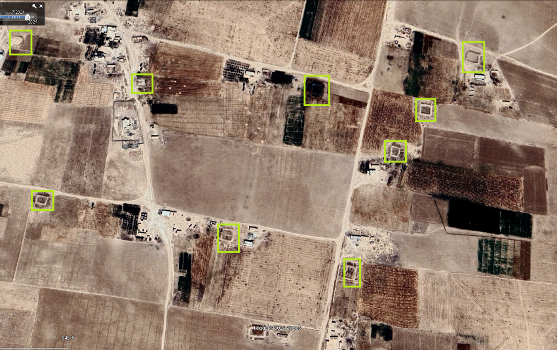
Using Google Earth, one can observe the widespread use of these ponds in areas like Abu Khashab, where almost every agricultural project has at least one pond.
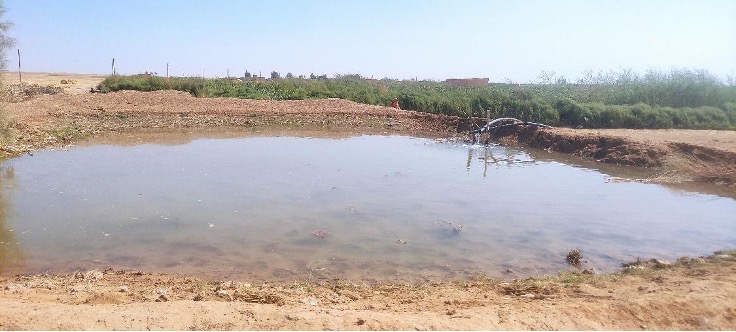
Water is stored in open ponds (Author’s Archive, 2023) - Watering: Water is transported from the ponds to the fields through open earthen canals, some stretching hundreds of meters. Water flows until it inundates the entire field, exposing it to evaporation and soil absorption. “We divide the land into square plots and long canals”, Ragheb Al-Khalaf, a 34-year-old local farmer in Rweished, explains. “We release water into one plot after another until they’re all filled. Depending on the field size and water flow, each watering session can take several days.”
In summary, each of the four stages of flood irrigation introduces significant water losses. Water expert Ibrahim Al-Adham, director of the Syrian Environmental Protection Agency, says, “Switching to modern irrigation methods could save up to 60% of the water consumed. Closed reservoirs, specialized pipes, and drip or sprinkler irrigation can replace earthen ponds, canals, and flooding.” But what are the main obstacles hindering this vital transformation?
“Farmers are disillusioned”
Interviews with farmers and technicians reveal that installing a drip irrigation system for a 10-dunam plot in rural Deir ez-Zor costs about $1,140. For local farmers, whose average landholding is 100 dunams, this investment is prohibitive. External support to drive change is needed. “Some farmers in neighboring Hasakah use drip irrigation, growing vegetables and earning good profits. But this requires money we don’t have, and we’re not sure it would work on our land,” says Asaad. He adds that the local agriculture directorate lacks the resources to provide technical, financial or other forms of support. Some local and international NGOs occasionally implement agricultural support programs, but their impact is limited.
Farmers’ unfamiliarity with modern irrigation poses another challenge. As flood irrigation is deeply ingrained in local traditions, few farmers have the skills to use and maintain modern systems. “Local expertise in modern irrigation is very limited,” Asaad points out. “There are no agricultural extension centres or research facilities conducting experiments in modern irrigation under local conditions to guide farmers.”
The psychological barrier is another factor. “Farmers are disillusioned with improving the situation. Many have abandoned agriculture as their primary livelihood, making them less motivated to invest in it,” Asaad explains. “Currently, those who can afford it invest in solar energy to avoid diesel costs, but few go further to modernize irrigation after making water essentially free.”
This dynamic exemplifies the “Tragedy of the Commons,” where individual exploitation of shared resources leads to their depletion, ultimately harming the entire community. Amid drought, farmers maximize groundwater extraction without prioritizing efficient water use, threatening groundwater reserves. According to the theory, a collective understanding among resource users is necessary to prevent such crises.
A More Sustainable Energy Transition?
Building upon the solar energy transition in Deir ez-Zor and northeast Syria is the right step to foster agricultural recovery and sustainable development. The unstable political situation—marked by disagreement between the Autonomous Administration in northeast Syria and the interim government in Damascus, must push local actors such as farmers’ associations, NGOs, and municipal bodies to initiate grassroots change at the village and rural community levels.
By strengthening local actors' abilities to impact knowledge and technology in the current agricultural system, international organisations can aid in these initiatives. A key component of technical transformation is altering dominant views about the environment and the limits of natural resources. If modern irrigation and agriculture are successfully demonstrated, additional farmers may be inspired to adopt similar practices.
Easier access to funds, equipment, and knowledge can help this transition. Additionally, a conducive agricultural environment must be established to address the area's ecosystem disruption and give farmers a means of subsistence. As Asaad aptly concludes, “People want the best for themselves, their families, and their communities. But they need someone to show them what 'best' looks like and help them achieve it.”