

In the file ‘Year Zero After Assad,’ SyriaUntold takes a look back at this past year, with steps forward punctuated by painful setbacks. We look at how elements of the former regime experienced the unimaginable collapse of a system they believed would last forever. We observe the positive spaces opened up by the fall of the security state, the role of writers at this stage, and attempts to rise from the rubble, both civically and culturally, without overlooking the massacres on the Coast and in Sweida, the faltering transitional justice process, and concerns about the country's changing identity.
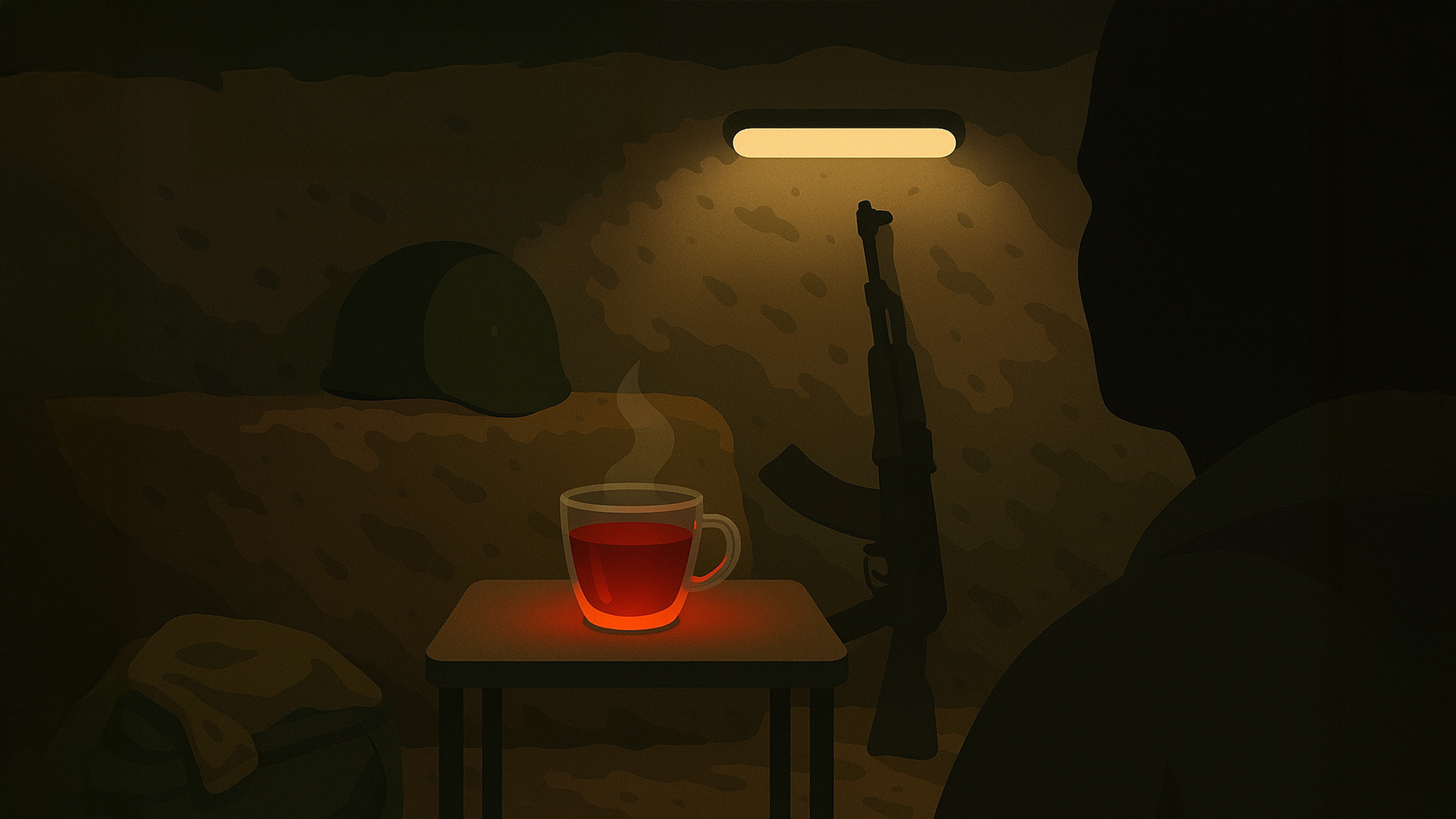
Midnight, 26 November 2024. A red teacup glows in the light of a single lamp in a hut that juts out of the ground and stretches a few metres near a nearly dark hill. The 50 year-old man counts the number of mobile phone network coverage signals: two out of five. Things are fine, then, and there is no interference on the network.
The man rubs his eyes gently. It is a quarter to one in the morning of the next day, his daughter Samah's birthday. From the opening of the dugout, the guard posts appear motionless, surrounded by the ghosts of soldiers moving cautiously. Colonel Daoud, a Syrian army officer, smokes his last cigarette before going to sleep in his military uniform and handing over the watch to his sleeping colleague. The entire army is on high alert and there is no time to waste getting dressed. At that moment, he remembers to send a message to his daughter. He does so, then covers his eyes with a black cloth.
To the left of the bunker stands Sergeant Abu Khalil, his massive frame swaying from side to side. This giant returned last week from a trip to Aleppo, where he bid farewell to his brother leaving for Germany. This military post belongs to the 47th Regiment of the 30th Division, deployed between the provinces of Aleppo and Idlib on the front lines between the armed Syrian opposition forces and the Syrian army, as Daoud told us. The bunker itself is located on Tal al-Drijat hill between the villages of Qubtan al-Jabal and Sheikh Aqil, northwest of Aleppo, on the front line that has been stable since 2020 when the fighting stopped.
Daoud has information from the military command that the opposition will launch an attack on the Idlib-Aleppo axis and everyone is prepared to face this attack. He added that “the army has exhausted itself with the mobilisations that took place before the attack, spending ten days on alert, waiting day and night”.
At 7:23am on 27 November, Daoud heard a buzzing sound above his head. He looked up at the grey sky. It was suicide drones manufactured by “the militants”, as he called them, later to be known as “Al-Shaheen”. Seeing them in real life was something completely different. “To your positions!” Daoud shouted, but his voice was lost in the roar of explosions. A nearby guard post turned into a ball of fire, killing two soldiers. Suddenly, he heard the sound of engines. They were not heavy tank engines, but motorcycles equipped with machine guns mounted on tripods, emerging from side passages near the hill. Fire was coming from all directions, while the marches continued to bombard the positions.
Daoud raised his rifle and fired at one of the approaching motorcycles, then pickup trucks began to rush in, carrying gunners firing short bursts. He heard a scream beside him. Abu Khalil had fallen to the ground, clutching his chest after a bullet pierced his protective vest. “Withdraw, withdraw!”
On the morning of 27 November, the opposition, led by Hayat Tahrir al-Sham, announced the launch of Operation Deterrence of Aggression. Fierce battles ensued between the Syrian army and Hayat Tahrir al-Sham, which carried out a surprise attack on towns and villages in the western countryside of Aleppo province, including Tal al-Drijat. Within hours, it had taken control of 32 villages and checkpoints and continued its advance towards the city of Aleppo, where it arrived two days later and raised its flag over the gate of its Citadel.
As he was trying to organise the withdrawal of his men, a nearby shell exploded, knocking him to the ground. He felt a sharp pain and then lost consciousness. When he woke up hours later, darkness had fallen and silence reigned over the hill. Daoud continues his account of those decisive hours in his life. “I looked around and saw the bodies of my men scattered about, their military equipment strewn everywhere. I heard distant voices and assumed that the ‘terrorists’ were continuing their advance after winning the battle for the hill. They had probably left me behind, thinking I was dead”.
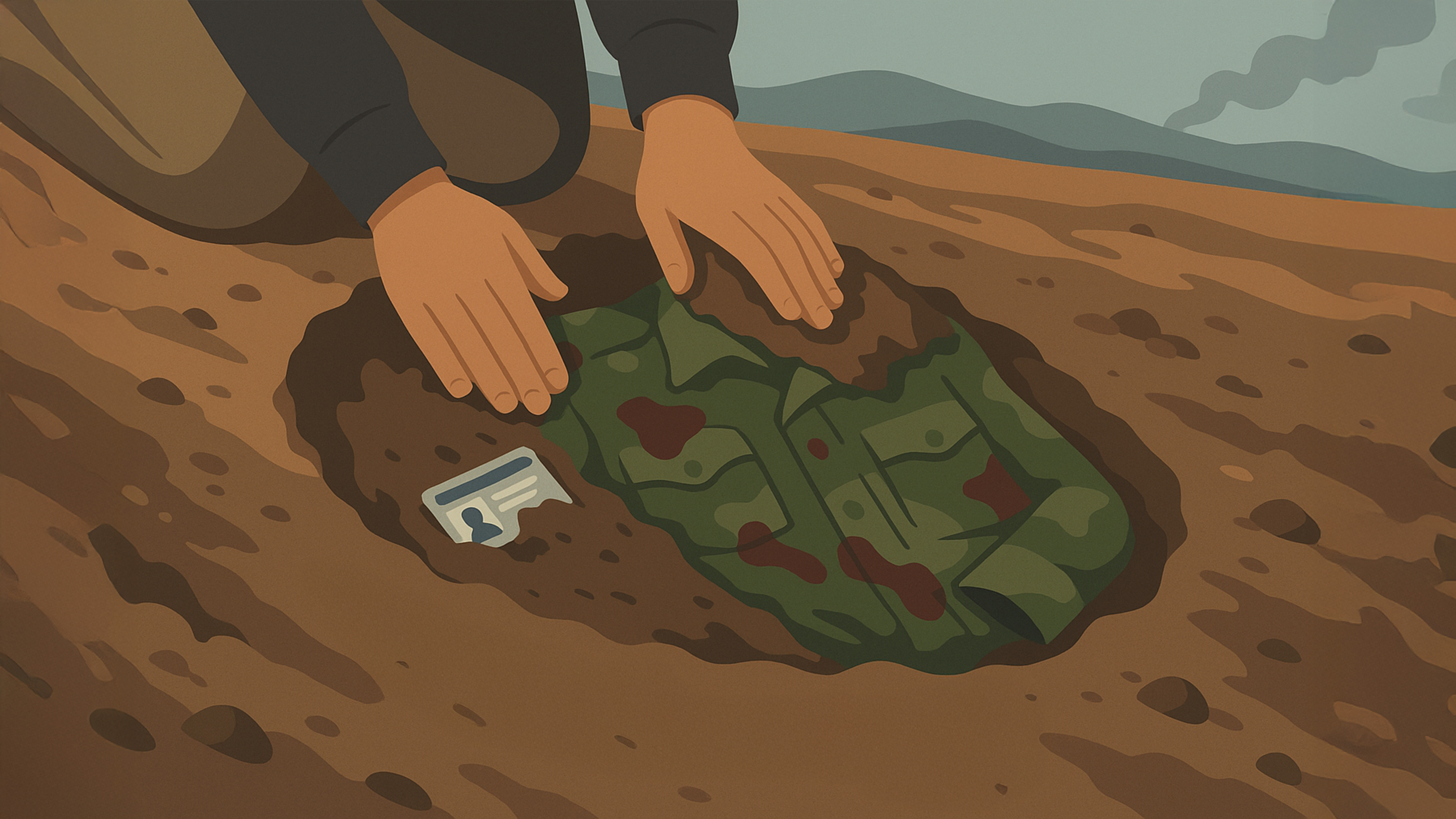
Daoud got up and walked towards the half-destroyed shelter. He took off his bloodstained suit and put on the pyjamas that were there. With tears streaming down his face, he recounts: “I threw my suit and military ID into a shallow hole and covered them with dirt. At that moment, I was burying myself alive in the dirt where I had spent years working to prevent this moment from happening”.
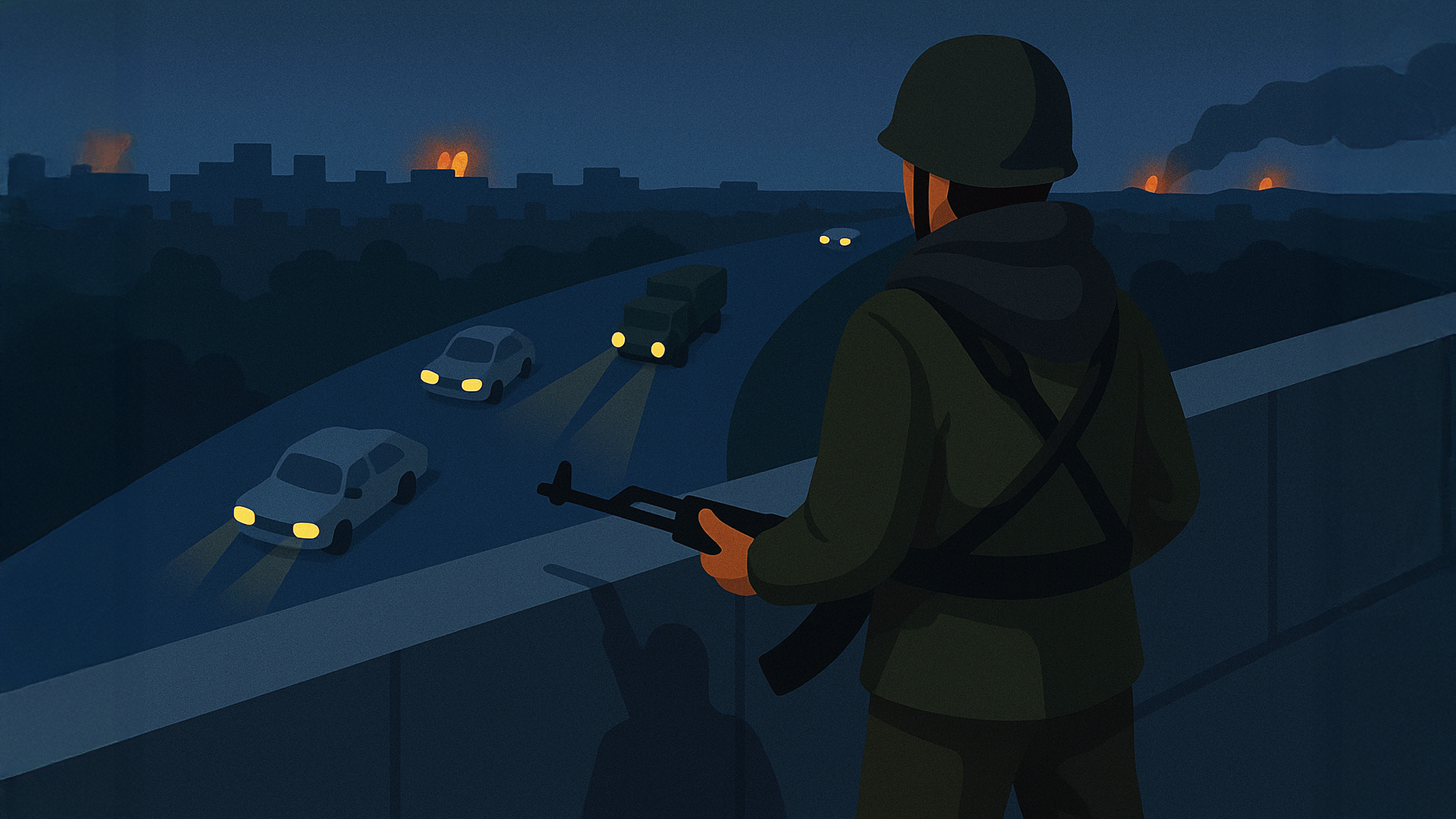
From his home on the Syrian Coast, Daoud recounts the story of his last two days in the army, where he spent the prime of his life: “I walked, guided by my intuition, parallel to the M5 international highway, hiding from the Toyota cars bearing the opposition's emblem and the Dushka crossing the road at high speed. I took refuge in destroyed houses. Food and drink were the least of my concerns; every step I took on my injured foot reminded me of the fall from the hill”.
Over the next two days, he covered about 50 kilometres. He hid in the basement of a destroyed house in the village of Al-Zerba. He slept from exhaustion. In the light of day, he heard a local farmer tell his neighbour: “I heard them say Aleppo is finished, it's in the hands of the Authority”. That was the first time he heard details of what had happened after the battle. Aleppo had not yet fallen completely, but rumours were spreading. At nightfall, he left and resumed his journey south.
On the outskirts of Ma'ar Zeita, his feet stopped. The scene was like Judgment Day: loaded cars and families fleeing the area, soldiers in civilian clothes carrying their light individual weapons. Tanks stood motionless at the side of the road. On the roadside were burning or destroyed military vehicles.
Daoud walked, his only goal being to reach the National Hospital in Al-Suqaylibiyah. He stopped when a military vehicle picked him up from the M5 road. “When he arrived at the hospital”, he said, "I stayed for a few hours and then they transferred me to the National Hospital in Hama in a private car to complete my treatment. All I remember from that trip is the driver talking about the opposition forces' advance and saying, “We have won after 15 years of patience”.
Since arriving at his home in Latakia on 3 December 2024, Daoud has been watching his mobile phone screen, waiting for a change or a call to return to the fighting. The change came, but not on his side.
Before recounting the events of the night of 7–10 December, he says: “I believed in the institution to which I had devoted my life, and many values were destroyed because of a foolish person who left the country in ruins. My tension reached its peak when I saw Israeli aircraft bombing Syrian army positions from the coast to Aleppo. That moment almost killed me with a heart attack, had it not been for my wife, a doctor, who took care of me. She gave me blood thinners and painkillers until I calmed down and fell asleep, forced to ask myself: ‘Was all this an illusion? I have no certainty except that I survived death, but my soul is buried in a shallow grave on the hill of Olives”.
When the Air Force disappeared from the air
At Hama Hospital, Daoud met Lieutenant Ali, 35, from Homs, a helicopter pilot who arrived at the hospital after being shot in the thigh while trying to escape from Hama Military Airport. Daoud helped us contact Ali, currently living in Homs, away from prying eyes. Ali recounts: "In the early hours of 30 November, I received a call on my mobile phone telling me to go quickly to Kweiris Airport. I covered the distance from my home in the Al-Hadir neighbourhood to Hama airport in ten minutes. From there, I travelled to Kuweires by helicopter. From the air, I saw a scene that I don't think will ever be repeated: hundreds of cars, vehicles and people flooding the runways filled with helicopters. There were eight helicopters there, and everyone seemed to be in a hurry".
“When I landed, a brigadier general came to the helicopter and immediately asked me ‘Are you Lieutenant Colonel So-and-so?’ I replied yes, ignoring the traditional way of introducing military names. The brigadier general replied, ‘Don't worry about it. In a few minutes, they will come to take you to Hama immediately’”. On that day, 30 November 2024, on the opposite side of Aleppo, Hayat Tahrir al-Sham and its allies entered the city. Ali recounts: "On that day, a Syrian warplane took off from Kweiris and returned to the airport after a while. I noticed that the pilot stopped his plane, changed his clothes and left in a private car. At around the same time, I learned from people at the airport that this aircraft had bombed the western outskirts of Aleppo with several missiles”. Ali confirms: “This was one of the last sorties by the Syrian Air Force. Its operations in Kuweires ceased, and we and the helicopters remained".
That sortie caused a massacre that killed 16 civilians, including children, women and medical personnel, and wounded 70 others, according to the Syrian Observatory for Human Rights, adding that the death toll since the factions began their attack in the area had reached at least 327 people. Ali comments: “This pilot did not want to leave a good memory and refrain from his crime, knowing - perhaps - that those at the roundabout were civilians”.
"As news of the massacre spread, I watched the leaders scramble for seats in the helicopters. The governor of Aleppo and police and security branch leaders arrived at the airport”, Ali says. “Later, ten people boarded, some of whom I recognised. Among them were the head of the security committee in Aleppo, two officers from the combat units, and a woman I did not know. The priority was to transport them to Hama. Until that moment, I did not understand what was happening, except that western Aleppo, including the citadel, had fallen into the hands of the militants”.
One of them closed the helicopter door and gave Ali the order to take off. From the air, the pilot saw the suffocating congestion on the Athriya-Khanaser road towards Palmyra and from there to Homs: thousands of cars, trucks, armoured vehicles and individuals walking, most of them military personnel.
“After about two-thirds of an hour of flying, we landed at Hama Military Airport. Everyone got out and hurried to their cars, leaving me alone in the helicopter for a few minutes. I headed to my house and found my family waiting to leave the suburb. Most of the people in my neighbourhood are military personnel linked to the former regime. I didn't wait long. I put them all in a minibus and sent them to my family's house in Homs. I returned to the airport because I had received another request for transport from Kweiris from the commander of one of the combat units. When I arrived at the airport, I heard gunfire, cars and cheering".
Between 30 November and 5 December 2024, the airport, which includes the main runway and hangars for MiG-21 and MiG-29 aircraft, witnessed a frantic evacuation of operational aircraft to bases on the Syrian Coast, while disabled aircraft and ammunition depots were left to their fate. On that day, Ali lost his helicopter after it was shot down by opposition fighters who were trying to storm the airport. A bullet pierced his thigh as he tried to escape the unknown barrage. He got into his car and drove to the nearest hospital. “Perhaps it was this bullet that saved me from an unknown fate and led me to meet Daoud later in the hospital”.
In the hospital, Ali reviewed his life since entering the Air Force Academy in Aleppo up to the present. Ali was not one of those who dropped barrels on Syrians, but he transported hundreds of officers across the front lines for years. “How foolish and stupid this regime was. I have a difficult new journey ahead of me”. He couldn’t flee the country at this moment because his family was waiting for news of his safety. After hundreds of calls he received and did not answer, he picked up his mobile phone and called his worried father. His father reassured himself about his son before hanging up, thinking: What next? Ali left the hospital after the vanguard of Hayat Tahrir al-Sham arrived in Hama and spread throughout the city. He hid his identity in a pocket inside his civilian clothes and drove to Homs.
From Homs to Tartus
On the college wall, six metres above the guardhouse facing the Al-Wa'er neighbourhood, Ahmed stood with his automatic rifle, wrapped in a woolen shawl his mother had given him to protect him from the cold, waiting for the unknown. Ahmed was a third-year cadet at the college from the city of Banias.
Ahmed recounts the events of the five hours between his life and his possible death at that time, saying: "Two days had passed and we were still fighting, and every two hours news arrived that the army was evacuating areas near Hama and Homs. We were on high alert. They divided us students into support groups to guard the college. When the air force came and bombed Al-Rastan, the fighting stopped for a short time and they declared a truce. Motorcycles arrived at the college gate and started shooting at us".
The state of independent Syrian media after the regime change
07 December 2025
Students were not allowed to withdraw from their positions, according to Ahmed. “Time passed from midnight until 3am when we students discovered that all the senior leaders at the college had fled. That moment marked the beginning of our collapse. I was standing guard with my rifle, wondering: ‘Who are we without leaders? I remembered the day I entered the military academy and how we stood and took the oath. We thought we had joined a family, an institution, a homeland. But that night, I discovered that we were just numbers in records, abandoned at the first sign of crisis”.
The young man, who now lives in his village in the countryside of Banias, continues to collect and sell firewood: “We no longer depend on anyone, and the atmosphere is that they have withdrawn. The junior officers began to say that such-and-such an officer had withdrawn and no one was left”.
At that moment, Ahmed says: “We were more than just defeated soldiers; we were symbols of a collapsed regime, reminders of an era that had ended, and targets of pent-up anger. We were not only fleeing the battle, we were fleeing the gaze of a people divided between those who mourned us and those who awaited our downfall”.
Ahmed was among those who left the college at around 4am after rumours and reports of the fall of Hama and Homs began to spread. He says: "We left the college near the military hospital and gathered in Al-Wa'er, armed. We walked a long way with buses leaving Homs, and with the terrible traffic, we got off and stood on the Homs-Tartus motorway at the Homs refinery”.
He continues: "We stood on the side of the road, groups of military students who had withdrawn from various colleges, along with soldiers, officers and civilians flooding the road. We watched as people's eyes moved between us. Women looked at their lost sons, glancing at us with pity mixed with blame, their eyes saying: 'Where were you and what did you do?’ On the other hand, there were those who gloated over us. I heard one of them shout: "Look what has become of Assad's army!” His eyes gleamed with bitter triumph, a triumph that had come at a high price throughout the years of war”.
According to Ahmed, "The road was terrible, with many accidents. Those who died on the road were picked up and thrown aside, so that the world could escape from it and from the congestion. People left their cars and walked, people left everything they owned and walked because the traffic was deadly and there were so many accidents on the road. There were no ambulances. The opposite lane was empty, and the situation was very tense”.
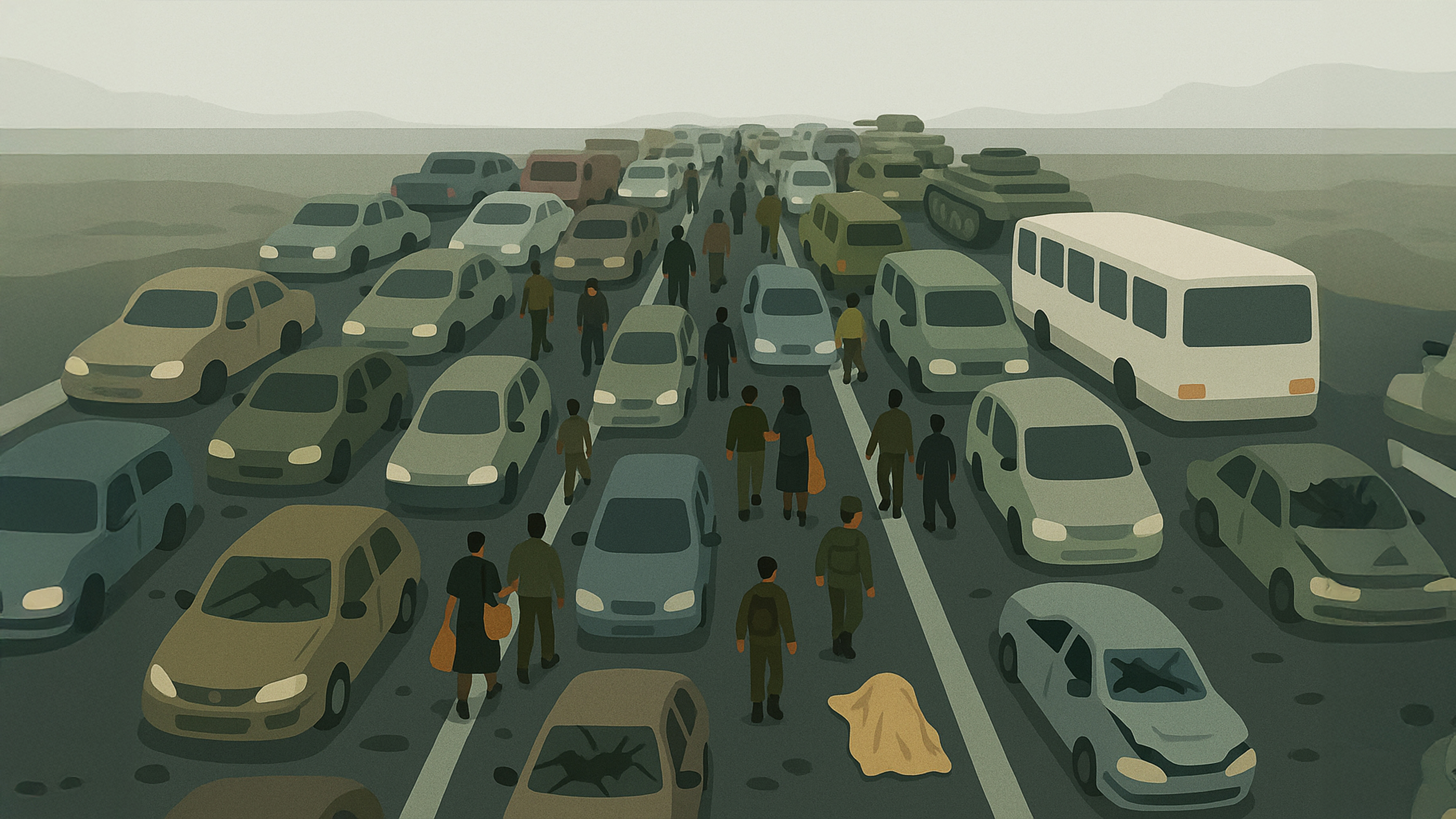
At night, on the motorway, cars and tanks were travelling together, carrying thousands of civilians and military personnel. "You can't walk, we've come a long way, let's keep going, you say, um, um, walking on the road. When we got close to Tartus, the lights came on. In front of us were checkpoints set up by factions and public security forces affiliated with the interim government (as indicated by their licence plates). After the Kartou village junction in Tartus, everyone took off their weapons when we reached them, even our military uniforms. When we arrived, we were only wearing our underwear despite the freezing cold."
“They were telling the world to run from here immediately, we are not responsible for what might happen to you. So we ran away from the checkpoint.
We were flying…”
Near Damascus... where opposites meet
Until 7 December, while news of the fall of Hama was leaking into Damascus and the Defence Minister was announcing a “tactical withdrawal followed by an attempt to regroup the retreating forces in Homs”, Brigadier General Hussein, 55, watched the radar screen turn from green to red. “I watched the dots disappear one by one” said the officer, who preferred to use a pseudonym.
Hussein explained why: “As the opposition forces advanced, army units withdrew from their positions, ignoring or deliberately disabling the radar equipment behind them. Some deliberately disabled their equipment so that it would not fall into enemy hands, while others left it running and fled. What was happening was the collapse of an entire system”, he said.
Hussein served for many years in rural Damascus (Al-Qatifa) as commander of an air defence battalion, and his military command was extended twice after “the start of the events of 2011”, as he put it. He told SyriaUntold in a phone call that in the last weeks of November 2024, he sent his questions to the commanding officers, including himself, seeking an explanation for what happened in Aleppo, Hama and Homs, without receiving any response: "We saw things collapsing around us without understanding why. I received calls from colleagues in other provinces. We were all equally confused: Why weren't we receiving clear orders? Why were cities falling so quickly? Where was the president, the commander of the army and armed forces? Where were the defence minister and the chief of staff? Where were they all? We didn't know if we were on alert or what."
On the night of 6-7 December 2024, things had literally “gone haywire”. All around us, the world was in turmoil, with soldiers abandoning their posts and fleeing with their weapons. The officers were confused, and some were fleeing in their cars. At that time, I was a battalion commander. All the phone numbers I dialled in search of an answer or clarification were unsuccessful. I looked at the remaining soldiers around me, shivering from the cold and fear. I am half a century old and have spent two-thirds of my life in the army, and all I have is a worn-out Russian Jeep military vehicle. What kind of life was this?"
The officer in charge of the weapons (Pantsir) added: "I made my own decision. I ordered the recruits to hand over their ID cards and return to their homes. I told them: 'Trust in God. If I had money, I would distribute it among you all. After they left, we senior officers remained, and other officers from neighbouring units arrived. It was a painful scene: all of us with high ranks, waiting for a statement that would never come and never did”.
Some called their relatives, and others offered to drive us in their private cars, but I refused to move from my place. It was 6:30am on 8 December when radio, television and all platforms reported that Assad had left Syria and his regime had fallen. “That lunatic did it in a despicable way”. When we heard the news, we all stood there stunned. Some of us denied the news. Some of us cried. One of them went outside and started firing shots into the air from a Russian rifle he had with him.
Amidst the chaos and turmoil, “I remembered something important”, says Hussein. "I remembered the warehouse that was under my responsibility: the Pantsir missile warehouse. I walked towards the low concrete building and opened the gate. There were two T-72 tanks, three missile vehicles, and piles of ammunition boxes. But my gaze fell on the laptops for the Pancer defence systems lying on the shelves, while their original vehicles were left out in the open on the nearby hills. I locked the gate firmly, making sure it was secure. I placed a few empty barrels near the door. These weapons were not mine to abandon. They once belonged to the Syrian people. I learned through my life in the army that formal handover is the difference between order and chaos”, he said.
"I arrived at my home in the suburb of Qudsaya. I sat on the balcony wearing my military uniform despite the bitter cold. I refused all my family's calls to come inside. I needed to stay there, watching the country that had let me down. Two days later, as I sat in silence, I heard the sound of terrifying explosions. I jumped to my feet. Israeli strikes were destroying every trace of the army I had spent my life in. It wasn't just disappointment that expressed what was happening around me, but oppression in every sense of the word".
What happened to the brigadier general afterwards is recounted by his daughter in a phone call: “Hearing the sounds of those strikes, my father realised that his battalion's ammunition depot had been completely destroyed. So had his battalion and all its weapons. He suffered a heart attack and we took him to the hospital. Thank God he survived, but to this day he sits alone”.
The brigadier general is not the only one still living in shock. Most of the remaining soldiers of the former regime now spend their days among the fighters who once fought against them. Senior officials and officers leave, while those who remain pay the price for the decisions they made or fled. Perhaps the first anniversary of the fall of the regime will be even more bitter for them, with the spread of old, leaked videos of the fugitive ‘Commander-in-Chief of the Army and Armed Forces,’ Bashar al-Assad, mocking even his own soldiers and their kissing of his hand, along with his advisor, Luna al-Shibl.