

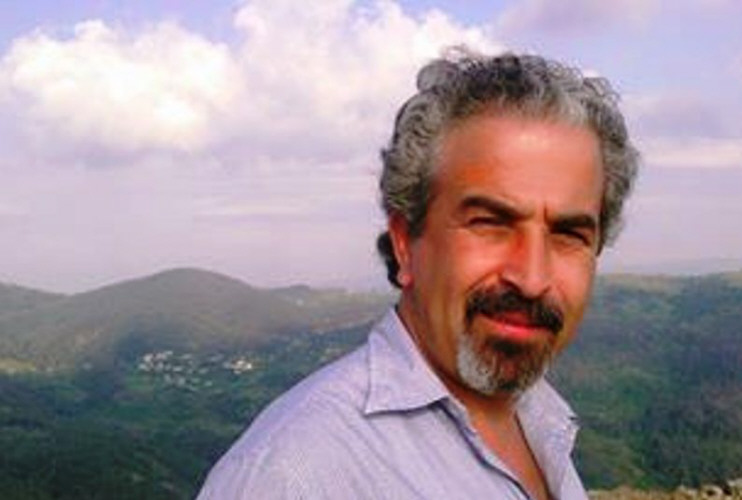
On the way to the village of Al-Khawarat, northeast of Slinfa and at an altitude of more than 1,200 meters, wild grape vines flow over the slopes of the highest mountains on the Syrian Coast, covered with dew and fog most of the year. Beneath these slopes are simple houses where, hundreds of years ago, people discovered that these wild grapes produce one of the finest wines in the world, or so they believe.
Wild grapes are no longer widespread after the people of the region patiently and lovingly hybridized them. Today, the fields are covered with hybrid grapevines. Near the beginning of winter, before the snow reaches two meters high, the harvest awaits to be turned into wine in a communal ritual performed by Alawite or Christian residents, trying to preserve a centuries-old legacy.
Thousands of years have passed between wild grapes and their hybrid counterparts, allowing for the production of juice that was traded across the Mediterranean in Phoenician and Ugaritic ships. According to the Russian Wine Encyclopedia, Syria exported the first wine in history to the rest of the world via the Phoenicians, under the names “Shalbon” and “Albon,” according to Dr. Imad Bilal, a grape specialist at the Agricultural Research Center in Latakia. An era of glory that has almost faded away.

Civil Society Spotlight - Episode X
23 December 2025
According to Dr. Imad, “Syria is located in the heart of the original homeland of the vine and was the first country in the world to domesticate wild vines—through selection and hybridization—and cultivate them since ancient times”. Imad is currently working on documenting and recording the wild grape varieties found here, in the first “Atlas of Grape Varieties in Syria”, which he is working on to include more than 270 varieties.
The glory of wine production in Syria dates back to ancient times. In the first century AD, the historian Athenaeus recorded in his work The Banquet of the Wise that the coastal wine of Latakia, known as “Pamphylus”, was among the most sought-after wines in the ancient world. The Roman geographer Pliny the Elder also mentions in his book Natural History that among the best wines in the Roman world were those from the region of Laodicea (Latakia). All that remains of this glorious era are archaeological remains, the latest of which were discovered in Tel al-Samahana in the countryside of Latakia, revealing the foundations of a 15-century-old wine press.
Vineyards cover the countryside and coast of Latakia and all other provinces, with a total production of a quarter of a million tons per year, planted on 43,000 hectares of various varieties (Halwani, Salti, Domani, Baladi, and Zini), according to 2023 statistics.
Syria produces varying quantities of wine annually, estimated by the FAO at around 50 tons. Other estimates indicate a production of 700 tons of alcoholic beverages in general. The quantities of wine produced in home presses are not included in the official statistics. While the Middle East section of vin du monde (wine in the world), a comprehensive reference book on wine producers and grape growers, includes producers from Lebanon, Turkey, and occupied Palestine (Israel), Syria is absent despite having cultivated areas equivalent to those of the other two countries.
Sweida has the highest grape production, with 54,000 tons from an area of 10,000 hectares, while Homs leads national production with a harvest of 55,000 tons from 19,000 hectares, according to 2023 statistics. In a striking paradox, production on the Syrian Coast has fallen to only 8,000 tons despite the suitability of its land for grape cultivation. Dr. Rabih Zeina, a soil specialist at the Latakia Agricultural Research Center, points to farmers' shift to growing French grape varieties intended for consumption (table grapes) because they are more profitable.
While the fires that swept across the Syrian Coast destroyed more than 15,000 hectares of wild and cultivated vineyards, other areas such as Homs are experiencing “increasing suffering every year with water shortages, rising irrigation costs, and increasing pests”, according to winemaker Hayyan al-Mahlah from the village of Abu Hakfa in the east of the province. Therefore, production quantities vary from season to season, affecting grape prices, wine production, and consumption as well".
Licensing is not the only problem
In April 2025, restaurants serving alcoholic beverages without a license in Damascus were closed several days before an agreement was reached with the governorate, and armed men attacked a store selling alcohol. In Latakia last July, owners of alcohol shops on the Blue Beach tourist road were given 72 hours to obtain new licenses or face closure. While no shops in Latakia have been closed so far—except for those owned by officers of the former regime in Sumeria and the Republican Guard housing in Damascus—the issue of licenses appears to be the first problem affecting the Syrian wine industry after the fall of the former regime.
The sale of alcoholic beverages in Syria is governed by Law No. 165 of 1945, which established a system of fees for alcoholic substances, but there are other laws relating to its manufacture, the most recent of which is Legislative Decree 61/2004, which stipulates that a license is required to trade in and manufacture alcohol.

An attempt to understand violence in the new Syria
15 December 2025
Adnan Suleiman, an alcoholic beverage manufacturer, explains, "The provincial finance directorates routinely renew licenses upon fulfillment of certain conditions, but the situation has changed this year. We applied for a license, but we have not yet received it. It seems that the state has suspended licenses". Similarly, Mr. Muwafaq Qudsiya, owner of the Ramita winery in the village of Ishtago in the Latakia countryside, says that he also applied for a license four months ago and has not received a response to date, adding: “I contacted the Latakia Finance Directorate, and they said that the delay is coming from Damascus and that, according to their promises, the license will be ready soon”. A source at the Latakia Finance Directorate reiterated in a phone call what Qudsiya said, the delay is coming from Damascus.
Joseph, a wine producer in the Jabal al-Halo region of Homs, adds: "The problems always come after licensing. Under the previous regime, customs, police, security, municipal authorities, health and finance authorities, the tax evasion authority, the consumer spending and protection group, the Chamber of Industry, the Chamber of Commerce, the Ministry of Agriculture and Environment, Social Security, and the Alcohol Division in every finance department all pursued producers after licensing with the aim of paying royalties, bribes, and justified and unjustified fines".
These prosecutions have created an endless maze. Anton Tokatlian, a wine producer from Safita, explains that the tax laws themselves are unclear, as they are limited to the mandatory financial stamp that must be affixed to each bottle, “but the possibility of violations lies in any other detail”. For example, corks are often smuggled in from Lebanon because they are difficult to import officially, exposing importers to customs scrutiny. The complexity extends to even the simplest logistical details, burdening producers with various legal proceedings.
Transportation between provinces, for example, it's a matter of luck.
Licensing and taxation issues affect the transportation of products and the purchase of grapes needed for wine production from domestic markets in Homs or Sweida. Producers agree that the transportation of products and supplies is subject to chance.
Adnan's “Al-Khamila” factory consumed 40% of the grapes it normally uses to produce wine and was unable to sell its production to other Syrian provinces this year. Qudsia agrees, adding: “We used to distribute in Aleppo, Damascus, and Latakia, but this year the production remained stockpiled”.
Joseph from Jabal al-Halo suffered from the same problem. He says: “Business is currently at 10% of last year's level, no more. Demand for beverages is almost non-existent. Personally, I have almost stopped working because of the weak markets and the risks on the roads”. Joseph recounts real stories from his experience: "A driver who was transporting grapes from the Al-Qusayr area to Jabal Al-Halo told me that a checkpoint stopped him on the road and asked him where all these grapes were going. The driver replied, 'To the wine and arak factories. The young man at the checkpoint simply let him pass, saying, ‘May God be with you’. Another young man at the next checkpoint scolded him but then let him pass with a warning not to take that road again".
The situation is slightly different for small producers such as Suleiman Ali, a 50-year-old owner of a small winery in the Kamaliya area of Latakia. Suleiman sells to shops in rural areas and in the city of Latakia. "We no longer dare to carry large quantities in our cars to sell. We resort to bottling the wine in small five- or ten-liter containers and transporting it on motorcycles to distribute it to shops with which we have long-standing relationships. New shops contact the old ones if they want to buy wine". Suleiman has a sufficient number of customers to sell his wine and arak production. He does not want to get involved with the security forces or anyone else, so he travels very early in the morning.
Production, transport, and distribution in the coastal region seem less complicated than in Homs. There are at least 150 licensed factories in Homs, as explained by a winemaker who asked not to be named: “Closed factories that bear the marks of their former owners, banned from working because of their support for the former regime, are inspected. As for the rest of the factories, no one has been officially banned, but there are strict procedures and cases of extortion, which make the situation uncomfortable and resemble a ‘cash cow’ in terms of paying bribes”.
Transportation problems extend to pose a direct threat to the safety of the product itself. The absence of official permits may expose shipments to long periods of detention at checkpoints, leading to damage to the wine and changes in its taste, turning a high-quality product into a guaranteed loss.
A market in distress
Wine producers may lose their product at a military checkpoint, or remain unable to sell it for whatever reason. This loss is not only measured in monetary terms. According to Hayan Melhem, a farmer and producer of arak and wine from the village of Abu Hakfa, east of Homs, Syrian wine production “is not just about numbers, but the tremendous effort made by farmers who are struggling against both natural factors and the security situation”.
The cost of producing one liter of wine, including the price of empty bottles, ranges from $2 to $5, and it sells for between $5 and $10 for premium quality. In general, wine production is economically profitable, but transportation alone adds to the cost after fuel prices were liberalized. He adds: “There has been a decline in domestic demand for wine and an increase in the price of raw materials (grapes) as a result of higher farming costs, which has led to a decline in wine production this year compared to other food products such as table grapes used for eating or making jams”.
Hayyan sometimes stores his wine production for aging, but selling is essential, and the problem lies in transporting it outside the province, where the new security situation in many areas has led to a decline in the quantities of wine sold, according to Hayyan and Qudsiya. Hayyan says, "The lack of security has prompted us to store our production... We are waiting for things to become clearer in the country, but we have lowered the prices of wine so that a 10-liter bottle of original wine is now selling for $30, without selling much".
Wine consumers tend to buy wine from reliable sources, whether it is locally produced by a reputable winemaker or produced by a company with a proven track record in the market. Zero red wine, as Adnan, owner of the Ankedo brand, says: “It takes a whole year of aging to become drinkable. The original product is stored in chrome tanks for a whole year. Otherwise, the wine is undrinkable”.
However, this trend is currently facing difficulties in the Syrian market, where it is hard to distinguish between authentic and counterfeit wine. “It is not difficult to counterfeit wine, especially sweet wine”, says Adnan. “90% water with a little alcohol, flavorings, burnt sugar, a cork stopper, and a glass bottle with a famous brand label, and the counterfeiting process is complete”. The owner of the Ankedo brand confirms that most of the sweet wine on the market is sweetened with sugar.
War on The Forests of The Syrian Coast
06 June 2019
Consumers and sometimes shop owners fall victim to this fraud. Jamil Khoury, owner of a beverage store in the northern Raml area (Latakia), tells us that fraud is rampant and that there are many offers from fake producers, which he refuses as a store with a reputation and history spanning more than 20 years. “Recently, we have been dealing only with trusted producers in Homs and the countryside of Latakia: well-known and reliable brands, and we do not deal with unauthorized distributors”.
Perhaps the only type of wine in Syria that has not been affected by fraud so far is the type produced in the town of Deir Toma in the Aramo plateau region. The Bargylus brand is the most famous Syrian wine brand in the world, with international certifications. This brand has escaped fraud because it is exported abroad without being widely available in the local market, but it suffers from difficulties in transporting its production outside the country, according to its owners, the Al-Saada family, who have repeatedly conveyed their suffering to the international press during the Assad era, with no change in their situation to date.
Roads are blocked
The unique experience of The Bargylus wine was not the only one in Syria to achieve international recognition. It may come as a surprise that Rayyan and Mimas wines, produced by the Syrian public sector, were available in some global markets. They now face a real crossroads with the closure of these factories in Sweida and Homs.
A source from the Sweida factory management, speaking on condition of anonymity, said, “The authorities in Damascus are pursuing policies that are economically arbitrary, and not considering renewing the company's machinery after nearly half a century of service to the agricultural sector since 1968. Farmers' problems with successive factory administrations have been reflected in delays in the payment of grape prices. This year, part of the payments were made after negotiations with the administration, but some of them have not been paid yet because the factory has stopped production”. The factory's shutdown is prompting farmers to stop growing grapes, which will lead to a decline in production and neglect of the fields.
Journalist Diaa al-Sahnawi points out that the wine festival that used to be held in Salhad every year will not take place this year, adding: “There is a surplus of production and currently no way to sell it outside the small town and its countryside. The same applies to the production of arak”.
Adnan Suleiman highlights that ‘the neglect of Syrian wine is due to several factors, including its lack of popularity abroad, the failure to introduce new grape varieties into cultivation, and, most importantly, the poor quality of Syrian wine as a result of tampering with its specifications and the poor quality of some of the grape varieties used in its production. There is also the Ba'ath regime's neglect of this important agricultural and industrial sector”.
The above factors are not expected to disappear quickly with the change of the political regime in Syria. On the contrary, new obstacles are expected to emerge, at least during the next few years, especially with the possibility of the spread of extremist currents in some mixed areas of the country, including areas where wine and alcohol are sold.
The problems of the wine industry are not only related to the fact that it is an alcoholic beverage, but also to the fact that it is a microcosm of the broader Syrian economy. This industry links integrated production chains, which means working to develop it or even not interfering in its affairs and allowing it to rebuild itself, thus preserving the livelihoods of thousands of families and a long agricultural heritage. Ultimately, contributing to the revival of an economy that needs a push forward after 15 years of war.