
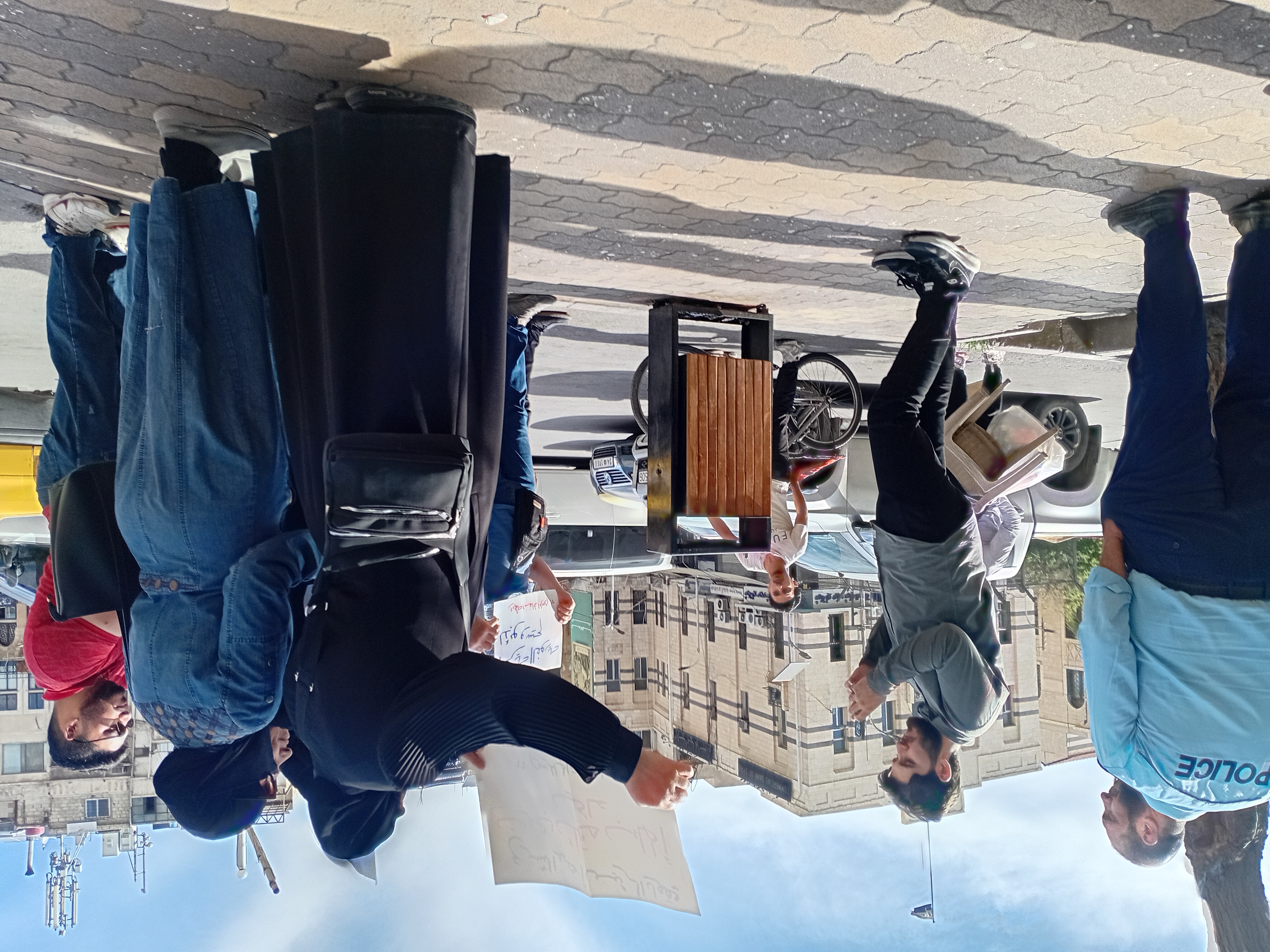
“4pm, at the Palace of Justice, the vigil continues”, a bearded young man says into his cell phone, studying the shot he’s filming. Facing him, a knot of women hold up hand-lettered placards, their shadows lengthening on the sidewalk behind them. Inside the Damascus courthouse, the spokesman for their land rights group, Yasser “Abu Wassim” Abbas, is being arraigned, his second arrest in under a month, along with an engineer who represents displaced residents. Outside, the handful of their supporters makes a small spectacle beside rush hour traffic.
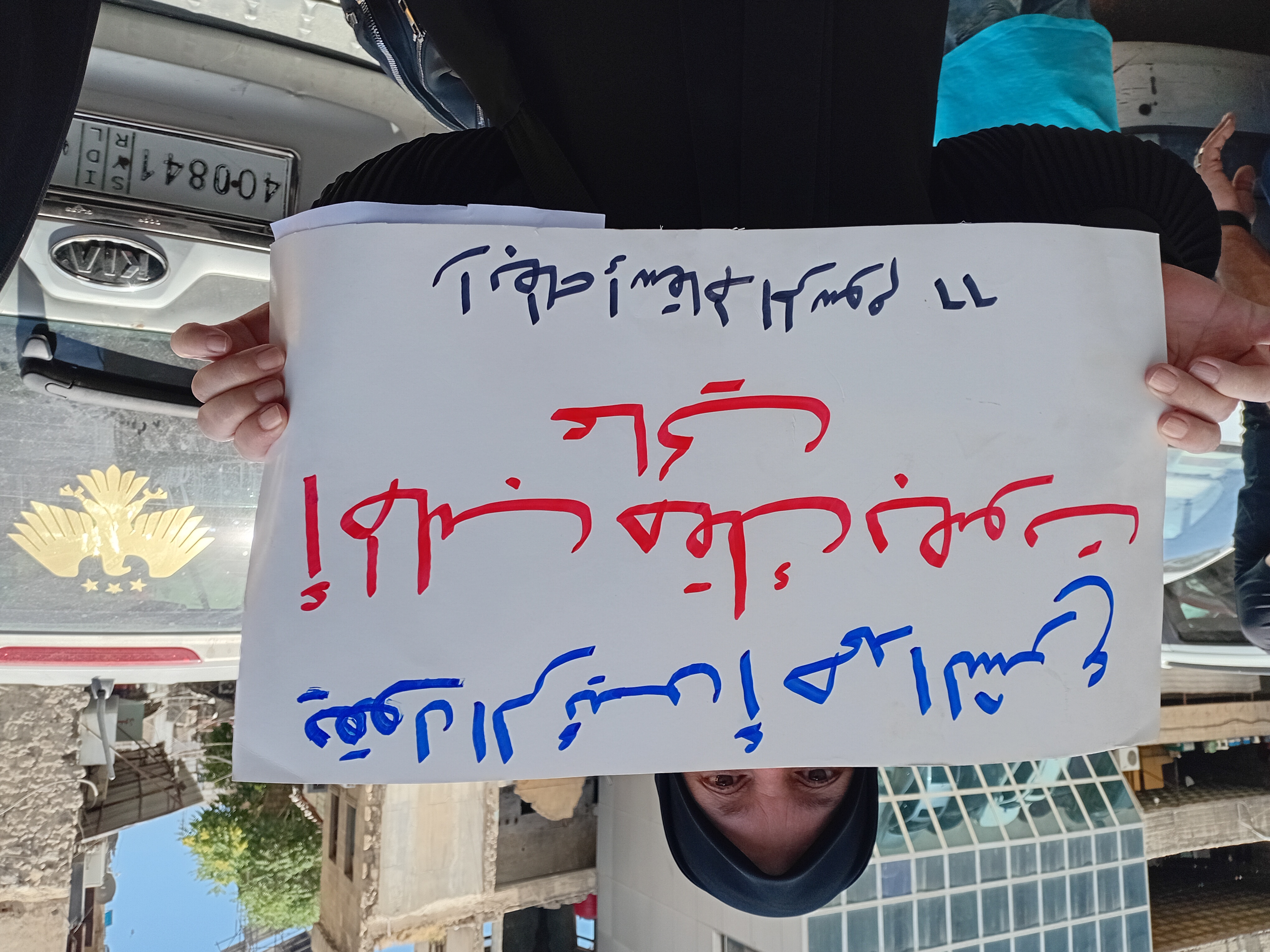
“What’s this?” mutters a man shouldering past. Others stop to gawk. A stout policeman leans in to study the signage. Sunburnt from hours standing in the sun, mother-turned-media-activist Safa Al-Ghafeer stares straight ahead. In red and blue letters, her sign reads: “President Ahmad Al-Sharaa says demand your rights in a loud voice”, and in smaller black script below, “The Association for the Fall of Decree 66”.
Al-Ghafeer is one of roughly 30.000 Syrians whose rebellious working-class neighborhoods the Assad regime wiped off the map. By fiat, that is, by Decree 66. In 2012 it ordained the homes, shops and orchards of Basatin-Mezzeh and adjacent parts of Kafr Souseh behind Al-Razi, commonly known as Basatin Al-Razi, be demolished to make way for an array of luxury towers. Named Marota City, the project spearheaded a “master plan” that weaponized upscale development into collective punishment. Now the scattered neighbors have regrouped to take their old fight to a new arena: the nascent administration running the capital.
So far, the authorities have kept Decree 66 on the books, kept the towers going up, and arrested two of the community’s spokesmen. At stake are two competing visions of how Syria gets rebuilt and for whom. Displaced residents want the old laws that stole their lands replaced with new ones that restore their right to their lost homes.
But local authorities are leveraging Assad-made legal frameworks to create a new, modern Syria of swanky gated communities and to silence the critics they dispossess.
War crime urban renewal
“Marota City is a symbol of the neoliberal age, and of the destruction of ‘Abu Shahata’ (“the father of flip-flops”), the working-class Sunni”, said Syrian economist Jihad Yazigi. “You completely erase these poor Sunnis and you show modernity”.
The deluxe development furthered the modernizing persona Bashar al-Assad projected after inheriting the dictatorship from his father. Under that neoliberal veneer, Bashar buttressed a system of crony capitalism that milked “Assad’s farm”, as Syrians called it, for all it was worth. By the end of Bashar’s first decade in power, one of his maternal cousins owned roughly 60% of the Syrian economy, and half of Syrian youth were unemployed.
When Arab Spring protests spread to Syria in 2011, the gloves came off quickly. Security forces fired indiscriminately on protestors, and when some of the opposition took up arms, the regime escalated from infantry assault to aerial bombardment and siege warfare. In southwestern Damascus, residents of Basatin Al-Razi, near the Iranian embassy and a constellation of security branches, joined the uprising.
Nurse Ina’am Al-Baalbaki turned her house into a secret, first-responder field clinic to treat the wounded, who would be arrested and tortured at a regular hospital. Under the pseudonym “Basil of Damascus”, Safa Al-Ghafeer began posting news on Facebook after her son and two of her brothers were arrested, and she saw the injustice “with my own eyes”. In mid-July of 2012, when opposition fighters advanced from the countryside into downtown Damascus, 20-year-old conscript Wassim Abbas defected from the regime army to join them.
By August, regime forces had routed these rebels, summarily executing dozens. On the night of 15 August, Wassim was killed fighting in the orchards of Mezzeh. His father, Yasser “Abu Wassim” Abbas, buried him and four other young men on his land. In September, the Assad regime capped its victory with Decree 66, which established two zoned real estate areas in the capital: Marota City, the size of 115 football fields, and south of it, four times as large, a second development called Basilia City.
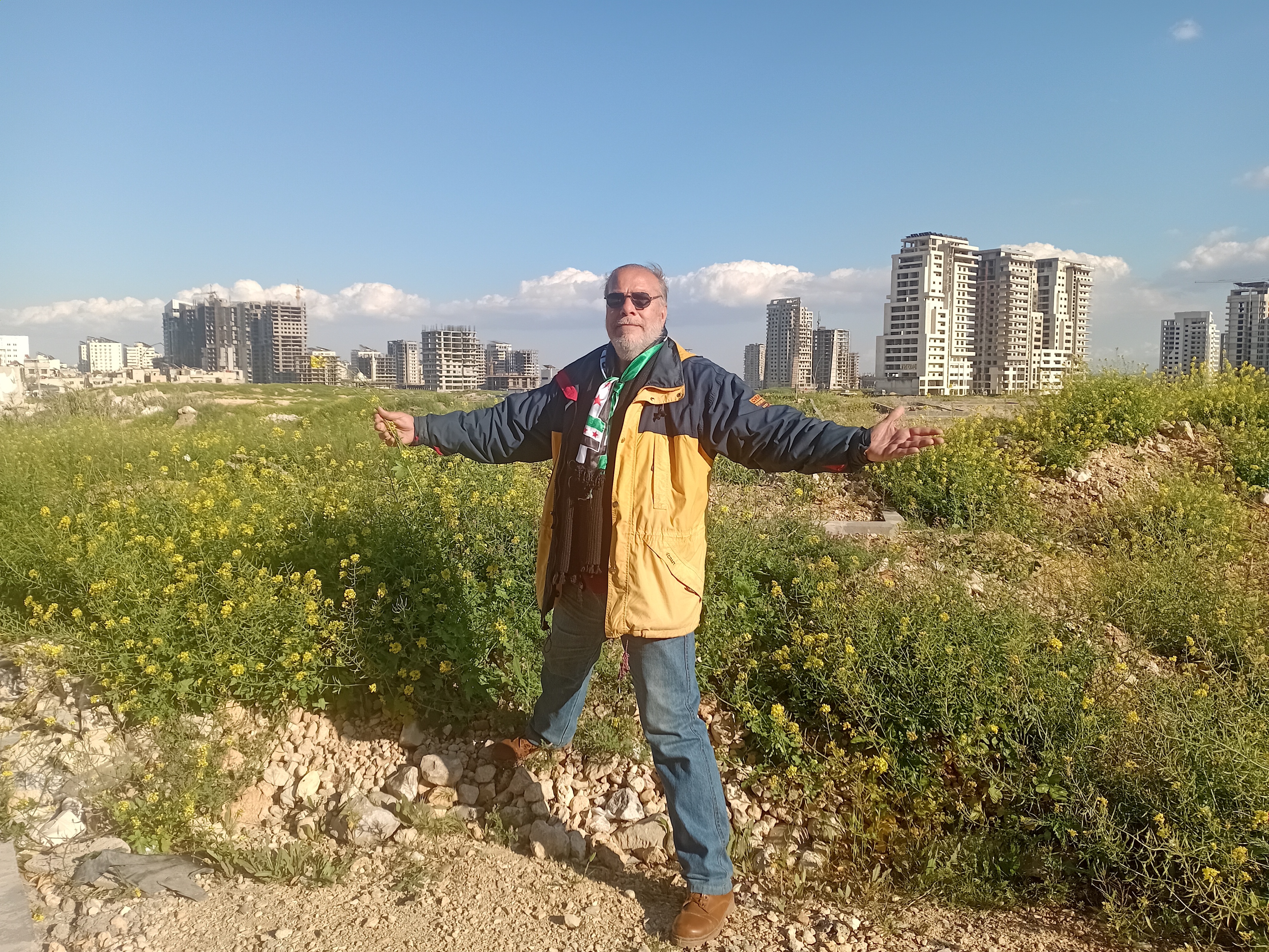
“They drove us out because we were one big family”, said Abu Wassim, an imposing figure with a white beard, aviator sunglasses, and a revolution flag scarf, as he stood surveying the land that was once his neighborhood. “All the families grew up together. Every one was the family of a martyr. Every one was a family of the revolution”. The regime targeted them, “because this is the heart of downtown. When we stood here saying God is Great, our voices reached the [presidential] palace”. Decree 66, he said, was a decree of revenge.
Like any good lawfare, it dressed its essential rapacity in a fig leaf of red tape. To residents able to jump through bureaucratic hoops to prove themselves eligible for one of four categories of recompense, it promised a modicum of relief, including a sliver of rental assistance, eventual alternative housing and fractional shares in the future development. Of course, having a relative who was a terrorist - anyone who opposed the regime was officially a terrorist - disqualified all claims.
On these charges, many sons of Basatin Al-Razi disappeared forever into regime prisons, including Al-Baalbaki and Al-Ghafeer’s husbands and one of Al-Ghafeer’s brothers. Wanted for her activism, Al-Ghafeer fled to Turkey. To dislodge holdouts, the governorate cut the water and then the electricity supplying the area before sending crews to destroy the houses, empty or not. From late 2015, the demolition continued in waves across 2016 and into 2017. The neighbors were scattered across Syria and beyond.
By then, pillage of opposition areas was a hugely lucrative industry dominated by regime cronies. But with Syria cut off from the global financial system by sanctions, where could a war profiteer safely store his loot?
“You don’t invest in currency, which can fall quickly. You put your money in gold or property, physical things”, explained Yazigi. To that end, Asma Al-Assad had real estate brokers - “Asma’s men” - in every city. To shield its gains, the regime played a shell game of shell companies. Damascus Cham Holding Company, a corporation established at the end of 2016, gave legal cover for investors in Marota City.
Two years later, with the frontlines largely frozen by regional powers, the regime upscaled this public-private raze-and-rebuild business model with Law 10, which permitted it across all of Syria. In this “mafia capitalism”, wrote Swiss-Syrian economist Joseph Daher, reconstruction was a blunt instrument “to consolidate political and economic power and reward allies”.
After declaring victory, the Assads shook down their cronies through “systematic extortion operations”, reported the Syrian Network for Human Rights (SNHR), strong-arming moguls into “donating” up to a million dollars a year. Asma Al-Assad, who worked in hedge fund management at J.P. Morgan and investment banking at Deutsche Bank before her marriage, proved “particularly adept at using these complex financial mechanisms”, thus avoiding sanctions until 2020.
“By the time they fled Syria in December 2024, the Assad family had amassed a vast fortune, estimated [at] close to $120 billion”, the SNHR concluded. “The story of Asma al-Assad represents one of the most prominent examples of human corruption in modern history”.
New rulers, old rules
In the wake of the regime’s crimes, the immensity of the job facing Syria’s new rulers cannot be overstated. 90% of Syrians live below the poverty line. Seven million remain displaced, including over a million in camps; 30% of all housing stock is severely damaged or destroyed.
Thus far, the authorities have leaned heavily on the executive branch, forming a cabinet whose core ministries are headed by former members of Hayat Tahrir al-Sham (HTS), the armed group that led the overthrow of the Assad regime. They have prioritized foreign investment, foremost from the Gulf, while starting to “expropriat[e] the stakes regime cronies have in a vast network of companies”, stated the Syria Report, “although they have to be careful that Assad cronies are not replaced by HTS cronies”. This “liberalizing agenda”, Daher also cautioned, “favors big capital and breeds new forms of cronyism”, especially when paired “with measures that consolidate [the authorities’] power over the Syrian economy”.
The transitional People’s Assembly, directly and indirectly appointed by the president, first convened in mid-July. Consequently, there are as yet no constitution or laws governing parties, elections, or other legislative tools of collective political action and transitional justice. This means, in the case of Marota City, that while the forced displacement and pillage on which it’s founded are crimes under international law, Syrian penal code has no category for these crimes. This lack, wrote Syrian researcher Ali Aljasem, “risks reproducing authoritarian structures of the past”.
UN experts concurred, stating that Decree 66 and Law 10 “led to the widespread displacement and dispossession of thousands of families for the benefit of a privileged elite”, and urging Syria’s transitional authorities and the People’s Assembly to suspend and replace these laws with new regulations “in line with international law”.
So far, though, Decree 66 remains on the books, and Marota City in care of the Damascus Governorate, but with zero transparency about how its funds or land will be managed. Without “substantive review” of both the decree and its implementation”, warned the Syria Report, “any resumption of the project – if it occurs – without dismantling the original structure of Decree 66 would not constitute reform, but rather a reproduction of an exclusionary urban model based on forced dispossession”.
It is occurring. So in May of 2025, displaced former residents and their allies launched the Association for the Repeal of Decree 66 and the Restitution of Rights. To achieve these aims, they repurposed the peaceful tools of the revolution: a Facebook page, on-the-ground grassroots organizing and training, and a series of public actions, including demonstrations by Umayyad Square, the Ministry of Justice and the Damascus Governorate Building, and a Ramadan iftar meal on their old land.
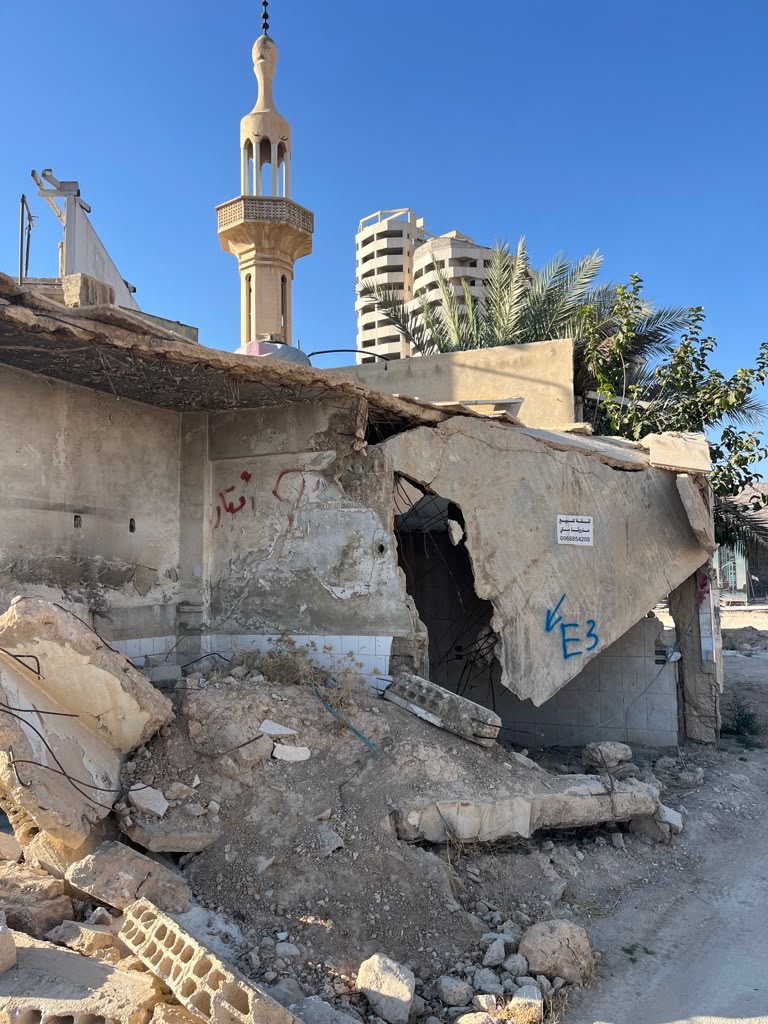
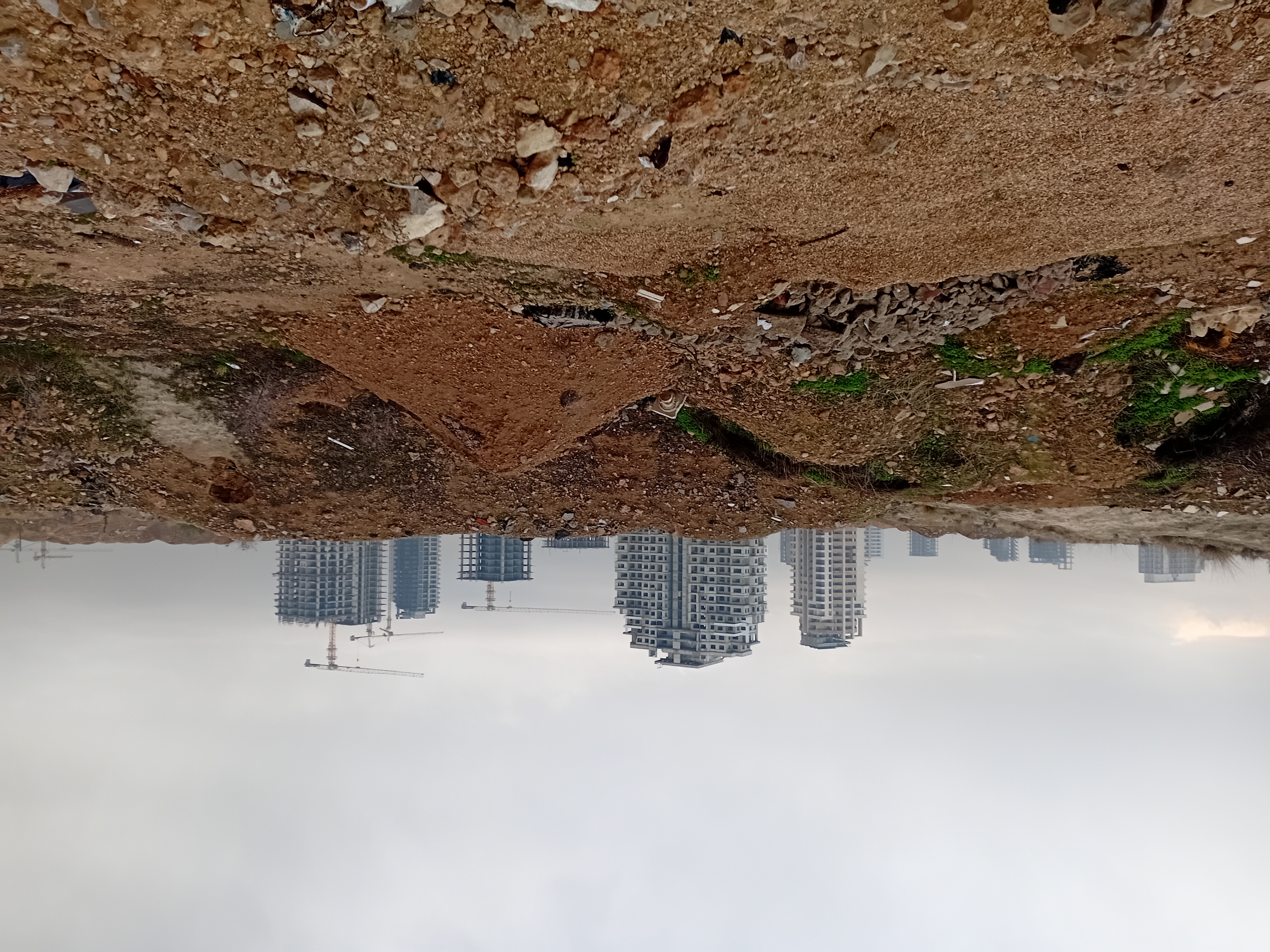
In April, when I met Abu Wassim with a dozen other association members at the border of their old land, it was green from spring rains, dotted with wild poppies, and vacant save for yellow construction cranes flanking scores of more or less skeletal towers. Across the street from the smashed Mustafa Mosque, a drainage ditch sprouted bits of piping labeled as parts of a future smart city. Martyrs were buried in this culvert, former residents said, after a battle around the mosque. Now a squatter’s laundry hung across a gaping hole in one of its walls. I found a laminated Baath Party ID card lying in the dirt; its owner must have discarded it in the hasty collective about-face when the regime’s forces melted away.
But in the massive spires undergirded with phalanxes of rebar, the old regime’s identity - as modernizer, modernity itself, Syria’s westernizing savior - stood intact, firmly planted and still rising skyward. Over 200 towers, residential and commercial, a mall, gyms, schools, parks, lakes, bike lanes and even musical fountains: this is the dream life of Marota City. With some penthouses selling for 2,500 dollars per square meter, for total profits estimated at between three and a half to seven billion dollars, it is a big-ticket utopia that erases its human cost.
When I asked the former neighbors to detail their losses, the first thing they named wasn’t money, but kinship, roots, and care.
“If someone is in the hospital, we can’t visit them”, one woman exclaimed. Now they live far away from one another, in the rural margins. Now they can’t afford the bus fare. “We were one big family”, she said, too. “Not that we were all related, but because we all lived together”.
It was paradise, our life here, several people agreed. As they reminisced, they finished one another’s stories. One big family: it struck me that despite being scattered for nearly a decade, they were still in ways acting like one.
The people want the fall of the unjust decree
In May, the transitional authorities issued two new sets of regulations. Protests now require permission, applied for in advance. And the Damascus Governorate updated Decree 66, including beginning payment of arrears, increasing share sizes and rental compensation, and other “corrective measures”.
Association members declared these measures insufficient and unfair, and held a protest on their old land. They did not apply for permission, so their protest was illegal. The authorities summoned Abu Wassim for questioning, and requested that he stop posting videos. He did not. On 2 June, he was summoned again.
“Just because we’re asking for our rights, do you want to jail us?” he asked in the video he posted before answering this summons. “Mr. President said come down and demand your rights. If something happens to Abu Wassim, there are a million Abu Wassims”.
The association called a vigil for Abu Wassim for 10am the next day. I arrive at the courthouse at ten to ten expecting to find a large crowd of protestors covering its wide marble steps, like in Facebook videos of past protests. There is none. Are they inside?
The cavernous, crowded Palace of Justice is chronically under construction, the second floor caked with rubble. On one wing of the first floor, a brand-new Western Union office is parked incongruously like a bright yellow space ship between dingy offices crammed to the rafters with moldering manila files.
In the hubbub of the entrance hall with its milling crowd, I am debating whether to leave when a round-faced woman fixes me with her bright blue eyes and beams. It’s Oula Al-Masri, a teacher displaced by Decree 66 and an association activist. She’s come prepared to stand in the sun, with a sun visor fixed firmly over her black hijab. Her dad stands beside her, his weathered face impassive under a baseball cap. Where is everyone? Al-Masri doesn’t know.
“There’s fear,” I suggest.
“I am not afraid!” she says brightly. “We are demanding our rights. Abu Wassim is wronged.”
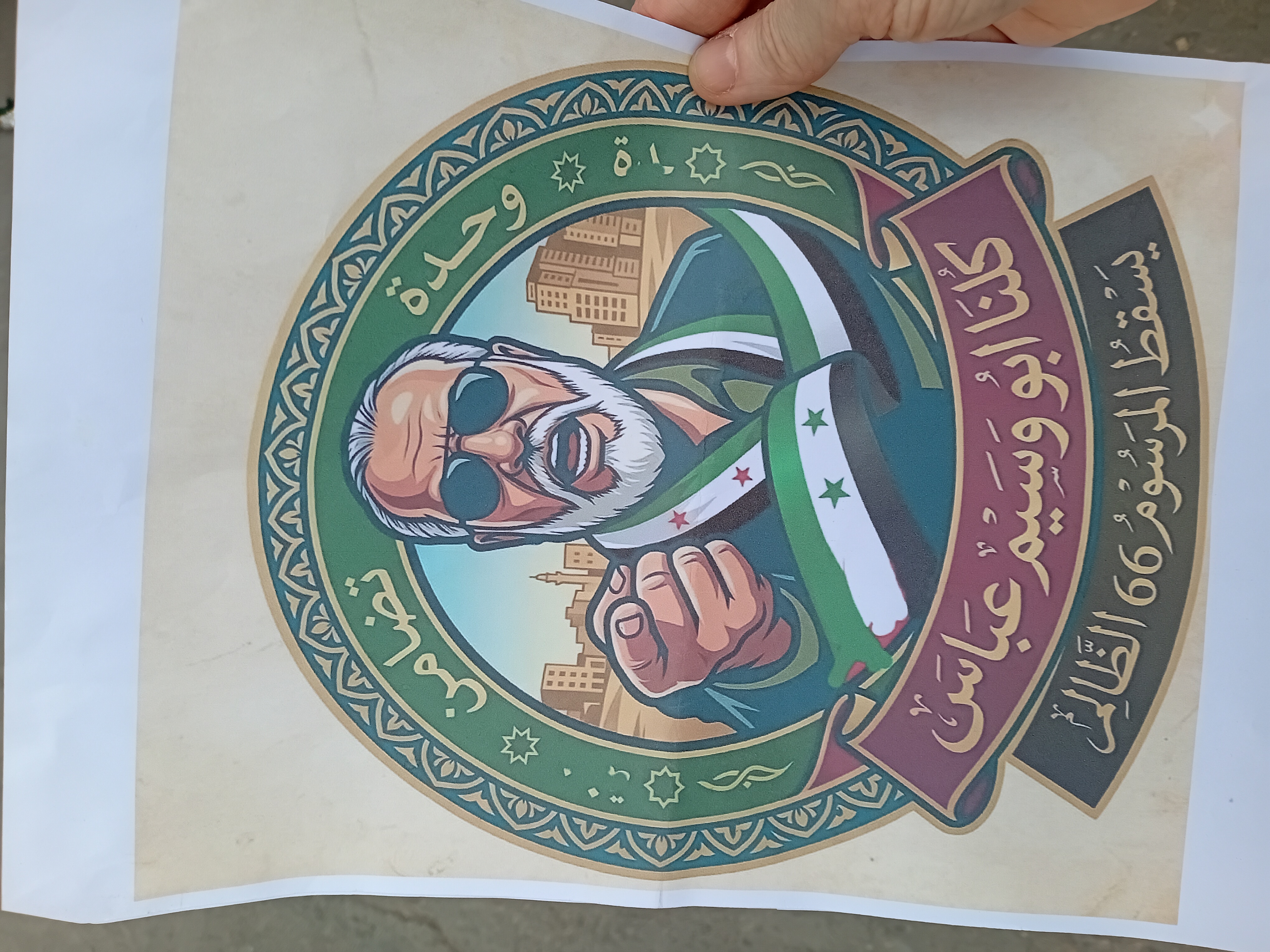
Al-Masri spots Abu Wassim’s lawyer, and we follow her outside and around to the side parking lot. There, between a line of cars parked against the courthouse and a crowd of men and boys hawking coffee, soda and snacks, two dozen or so former residents of Basatin Al-Razi and a few allies stand holding signs and prints of Abu Wassim’s face wreathed by the words “Unity, Solidarity, we are all Abu Wassim Abbas”.
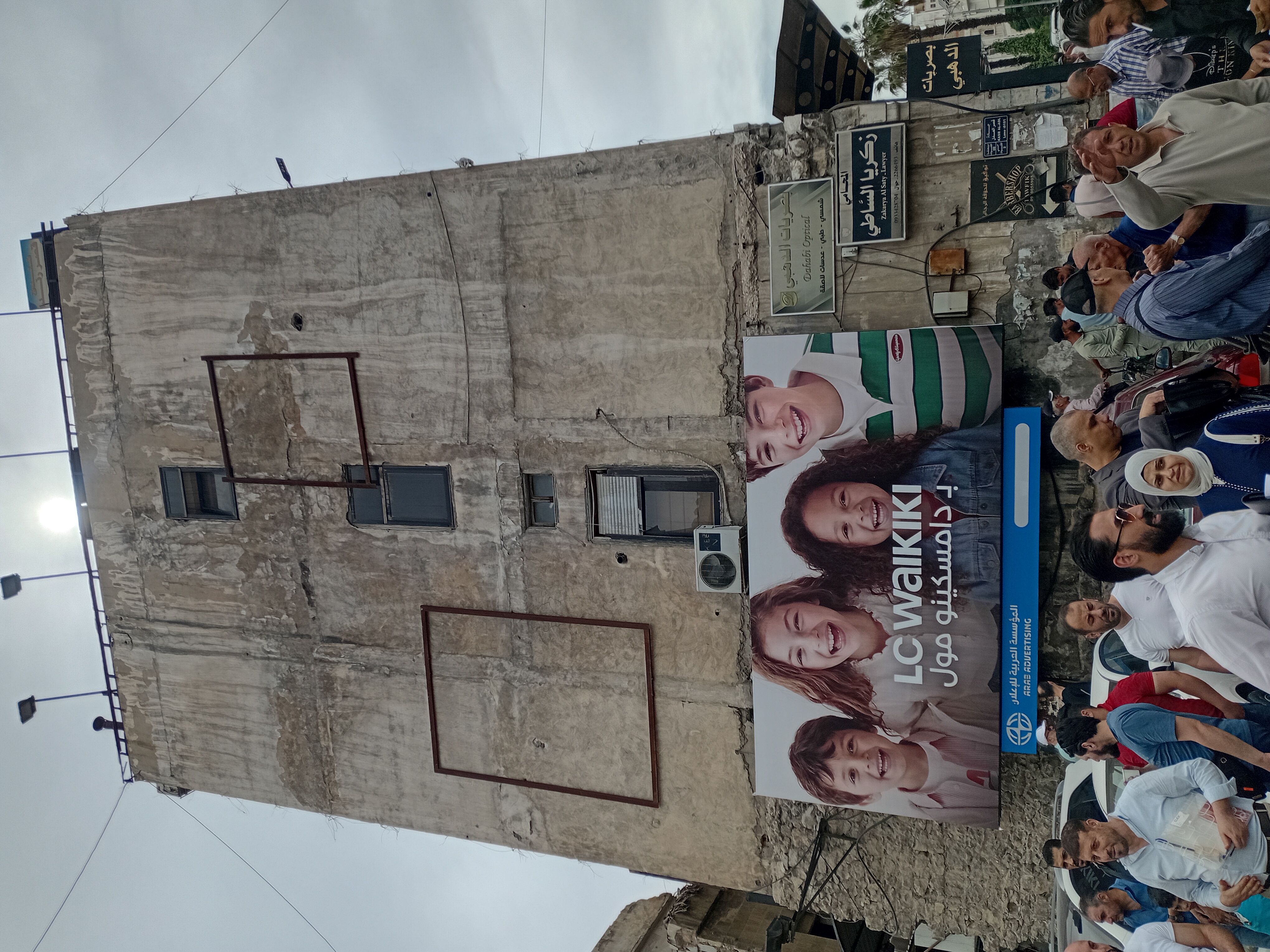
Facing them are roughly ten young men in the black uniform and tan boots of the security forces now tasked with keeping their elders in line - or in this case, keeping them in the parking lot. Reporters from two news outlets arrive. The security guys watch over their shoulders as they film. On the exhausted raw wall of the building opposite, four giant, improbably jolly children chortle down at us from an LC Waikiki billboard. The low-cost clothing brand, one of 18 Turkish companies registered in Syria since the regime fell, opened its first store in Syria in Damasquino Mall, just northeast of Marota City, the week before.
The press is gone before noon. Shortly after they depart, the security guys march away, too. Al-Masri has to leave for work, as do some of the men. After another hour or two, Safa Al-Ghafeer and her sister Wafa decide to go inside the courthouse to sit down. Safa rolls up her poster, then hesitates, unsure if it’s ok to bring with her. When we enter the women’s security screening booth, the women running it wave her cheerfully through. But on the courthouse steps, a bearded man bounds up to halt us.
“It’s forbidden to protest in the courthouse”, he says. The women insist they won’t, that they just want to rest inside. After some negotiation, the man takes Safa’s poster and gives it to the women in the screening booth. Inside the crowded courthouse, we find an open bench to sit on. I ask Safa if people are afraid to protest.
“Some people are very afraid,” she says. Because of how the old regime was. “Fear is planted in them.”
At three, someone brings Safa back her poster and shoos us out: the courts are closing for the day. We traipse back to the parking lot. The vigil has dwindled to less than ten people. They decide to move to the other side of the building, to the gated lot from which they hope Abu Wassim will emerge. I sit on the stone base of the lot’s iron fence and peer through the gate. A few employees drift out at intervals. The Al-Ghafeer sisters take turns sitting next to me.
“What’s taking so long?” I ask Wafa.
“They haven’t finished with the instruments.”
The instruments of the law, that is. But what law, and what instruments? The spokesmen were charged under two laws created by the Assad regime - on public gatherings and online communication – to criminalize its critics. They are held for a week, then released on bail; in their support, twenty-five Syrian civil society organizations issue a petition demanding that the justice system, especially Assad-era laws, not be used to hamstring freedom of expression.
Dream cities underwritten by wholesale dispossession
In late June, the authorities clamp down harder, charging two more media activists with defamation under Assad’s “cybercrime” law. Following their release, the Ministry of Information issues a vague new set of prohibitions, including a ban on publishing “insults” and anything that “offends public morals”.
Abu Wassim breaks his silence since his release. Gone are the revolutionary scarf and righteous demands for rights. Standing before the foundation of his demolished home, Abu Wassim says he’s remembering: “My son who was martyred here, on this land, all this land here that was lost to us”.
It reads as a retreat. But as he said before: in Syria there are a million Abu Wassims. Hyperbole if you count only those displaced by Decree 66: 30.000 from Marota City, 100.000 from Basilia City. But include the millions liable to displacement under Law 10, and it’s an undercount. Women, especially the wives of disappeared men, are especially vulnerable to dispossession. An estimated 70 % of Syrian women lack any formal property documentation, and 87% of those with missing husbands cannot access their property rights, making it harder for them to contest eviction.
In the last week of June, two more communities, in the Al-Mazra’ah area of Homs countryside and Al-Baja’a in rural Damascus, receive eviction notices from local authorities giving residents 15 days to vacate their land. The farmers in Al-Baja’a say they won’t go. But Saudi company Abyat and the Syrian General Housing Establishment have launched a billion-dollar “Modern Urban Community” of over 20,000 residential units to be built where their olive groves now stand.
Gathered by organizers with the Association to Repeal Decree 66, on August 28, Syrians opposed to property seizures under Assad-era legal frameworks, including residents of Al-Baja’a, demonstrate in front of the People’s Assembly building. Holding up their surviving property deeds and registry documents, they call on assembly members to abolish expropriative laws and pass laws that restore their rights.
As they wait and hope for these new laws, and continue to organize and mobilize, the displaced former neighbors get by as best they can. Pushed by rising rents, Al-Masri’s family has moved four times within Moadamiya, a rural suburb of Damascus countryside damaged by regime bombardment.
Al-Masri works two jobs to support her parents and younger siblings, teaching herself new skills and pedagogies on the side. She walks three hours to work to save the 30-cent bus fare, a trek compared with her old commute of just 20 minutes on foot from her old, razed neighborhood. Heading out at 6am, moving steadily from the margins of the capital to the center, she makes up the distance between her stolen home and the scant choices left to her.