
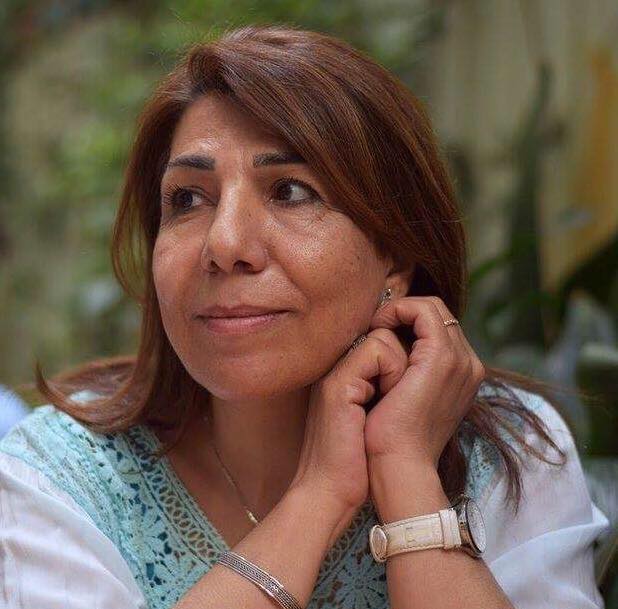
My hand cradles my travel ticket: Berlin–Beirut, then on to Sweida on July 15… My bags are packed. Inside them, chocolate for my family—they haven’t tasted it in ages. Practical gifts for them, and a heap of clothes for me, because this time I’ll be staying a long while.
Fantasies tickle my mind… A thousand laughs will greet me. I’ll drink in their hugs first. I’ll sleep safely in my old bed, wake up, sip my Arabic coffee with my husband… then go about my day, like any ordinary person—working at my clinic, launching a center to educate and empower women, continuing my writing from a land where I can feel the firmness of the rocks beneath my feet like no other place has ever offered.
July 13
The news breaks: clashes have begun, and all exits from Sweida are closed… except entry, and only for select groups. Lawless factions are sweeping through the western and northern countryside of Sweida—killing, burning homes, cutting down olive trees only to torch the groves afterward. The villagers flee in waves, their eyes blind to any clear destination.
Groups from Daraa are attacking villages near the Daraa border. My birthplace, the village of Al-Duweira, where my maternal uncles live, and its neighboring village Ta‘ara—largely inhabited by people who had relocated from Al-Duweira—are both in flames. So are Al-Dour and Al-Tayra… Then farther out: Al-Tha‘la, Kanakir, ‘Ara… And from the northern countryside… from Al-Sowrah al-Kabira all the way to the outskirts of Umm al-Zaytoun—so many villages, too many, engulfed in an expanding, raging clash between the Druze and the Bedouins in Sweida. My heart quakes with fear that the chaos might spread even further!
I rush to the travel agency—I’ll postpone my trip by a week. I try to reassure myself: General Security will step in, contain the fighting, calm the city, then the countryside.
The agent says, “Postpone it longer… or don’t travel at all!”
I’m trapped in Berlin...
July 14

My Fleeting Return
17 February 2025
My fear has become reality—this time, a personal terror. All my family is in Sweida, and my sister has been displaced from the village of Najran to the city. The attackers have reached the outskirts of our town! Every corner, every inch of that place matters to me—but the safety of my family… that is the sharpest, most searing anxiety.
My husband, the surgeon Dr. Osama Abu al-Hassan, stayed at the hospital past midnight—working as needed: doctor, nurse, porter, even janitor. With him was my nephew Taim, a fourth-year medical student. Afterward, they left to get a bit of rest before returning the next morning.
I call my mother. Her phone rings—she doesn’t answer. My mother doesn’t answer! What could stop a mother from picking up her daughter’s call? I try to calm myself: maybe she’s busy, the phone is far, she didn’t hear it... I message my sister Noha. She replies with a calm that only amplifies my dread: “The electricity, water, and internet are cut. We’re at home. Father refuses to leave. We’ve armed ourselves with sticks, kitchen knives—and a grenade. A last resort. We’ll pull the pin to kill ourselves if, God forbid, they don’t kill us but decide to abduct us instead.”
My mind is at war with itself, bombarded by visions of burning, killing, injuries, and the abduction of women… And it becomes clear—at a terrifying speed—that these lawless groups are none other than the “General Security” forces themselves, or those disguised in other attire, acting under its command and direction. This so-called General Security didn’t enter—not even with a single official convoy—via the Damascus–Sweida road. In fact, they were the raiding gangs that began, just yesterday, sweeping through the countryside from every direction except the Damascus–Sweida road, which has been sealed off by government orders for two days now.
The province’s only main artery is blocked. There is no water, no electricity, no fuel, no internet.
Sweida is under siege.
July 15
The world turned upside down by morning. The invaders had seized control of the city. Its residents were fleeing toward the eastern and southern villages of Sweida’s countryside—the only areas not yet under attack.
My sister Noha writes: “My sister Shafiqa and her family are now in Salkhad. Najwa and her children are in Imtan. Amal is stuck in Damascus, where she’d gone on a work trip. My brother Qasem loaded his wife and kids—along with my brother Sami’s wife and children—into his small truck (about the size of a Suzuki, but Chinese-made) and took them to al-Kafr, which is safe… for now. As for me, Mom, Dad, and the rest—we’re still in our house.”
My husband writes: “I’m trapped at home. They warned me the road to the hospital is a battlefield… not to mention the snipers.”
I message my sister Noha. She replies with a calm that only amplifies my dread: “The electricity, water, and internet are cut. We’re at home. Father refuses to leave. We’ve armed ourselves with sticks, kitchen knives—and a grenade. A last resort. We’ll pull the pin to kill ourselves if, God forbid, they don’t kill us but decide to abduct us instead.”
I read on Facebook: *Dr. Faten Hilal was shot in the head by a sniper on her way to the hospital. I refuse to believe it. Dr. Faten is my colleague, my own doctor… the kindness of the world and all its goodness reside in her.
*A massacre—men from the Al-Ridwan family, unarmed civilians gathered in their guesthouse, slaughtered. Their bodies sprawled across the floor, their blood pooling beneath them. The portraits of fallen fighters on the wall—shredded by bullets. Dear Lord of the universe… that guesthouse isn’t far from my parents’ home, I whisper to myself.
*Young men shaving the mustache of an eighty-year-old sheikh—mocking as they do so—saying it should “follow the Sunni laws,” while his half-paralyzed hand cannot resist their assault on one of the symbols of his dignity. I would later learn that it was Sheikh Murhij Shahin, attacked in his guesthouse in the village of Al-Tha‘la, surrounded by his collection of copperware and coffee sets he so loved. It’s said his coffee had no equal in taste...
*Four brothers from the Qardab family—university graduates and students—were executed by gunfire in front of their mother and father.
*A young woman pleads online: “Please, if anyone knows anything about the men in my family—eight from the Saraya family. Houssam is among them—he holds American citizenship. They were taken by General Security.”
Personally, I know half of those men. I catch my instinct murmuring: no news will come to her but one of sorrow for the Saraya family.

HTS’ strategy to Consolidate its power in Syria
28 July 2025
All that had once been the terror of imagination has now taken on real, tangible form. The nightmares we once experienced while reading of the tragedies of others—we now find ourselves squarely at their center.
My sister Noha writes: “Don’t send voice messages—just type, and keep it very brief. We’re rationing mobile data; it’s our only link to the outside world. Qasem told us he dropped off the women and children and is on his way back.”
A little while later, she writes again: “Qasem is late… and he’s not answering his phone.”
My brother Qasem works in baking. He has never once carried a weapon..
A short while later, my sister Noha writes: “After dozens of failed attempts to reach my brother’s phone, a strange voice finally answered the last call—laughing: ‘Qasem?! Yeah, we’ve got him… slit his throat from ear to ear”. My mother heard it—my mother, who bore nine daughters before Qasem came along...
I freeze, curled up on the corner of the couch in my tiny Berlin apartment. My whole body trembles—from the crown of my head to the soles of my feet. I can hear the rattling, as if it’s coming from a body not my own, a sound from another world.
I hear my tongue—no longer mine—murmuring the old incantations (lajmat) my grandmother taught us fifty years ago. She showed us how to say them if we ever faced a rabid dog. I had thought those chants had vanished from me, faded ever since I became a graduate of medical school, a secular woman…
And yet here they are, gripping me. My tongue and my heart whisper them again, here in Berlin—begging they offer some mercy for my brother.
I can’t steady my fingers enough to check for a new WhatsApp message from my sister. With great difficulty, I force them to type—choosing the fewest, heaviest taps—a brief question to my husband, the doctor. His nerves, supposedly, are a bit stronger than most. “My brother… Qasem… what…?” He needs to reply with just one word: Lie. They’re spreading rumors to break us. Your brother is fine. Your brother is alive. And I will believe him—because I won’t accept reading anything but what I want to hear.
My husband writes: “I’m heading now to search for him along the Kafr road,
—where my brother was supposed to be.
My awareness sharpens, unexpectedly: “Don’t you dare leave the house…”
I stop my husband—forcefully—from rushing out to help my brother, or even to retrieve his (body). His body! What a cruel, piercing word.
My husband is my family’s pillar now, after my brother. Our family cannot bear another loss. My body shudders. My thoughts are crushed, mangled, stabbed.
What state is my eighty-year-old mother in right now? Did her heart give out and she die? And my father—eighty-five—dignified, patient, noble… with his long, untrimmed white mustache, left as God made it, and his flowing white beard…Is he still composed? Has his patience cracked too, his soul burst in silence?
A short while later, my sister Noha writes: “After dozens of failed attempts to reach my brother’s phone, a strange voice finally answered the last call—laughing: ‘Qasem?! Yeah, we’ve got him… slit his throat from ear to ear”. My mother heard it—my mother, who bore nine daughters before Qasem came along...
My sister writes: “Father is going now to see the Sheikh al-Aql, Yusuf Al-Jarbou, to confirm the news about my brother—and so the Sheikh’s men can help find his body and bring it back…” Do I have the right to stop a father from trying to do anything—anything—to save his son? Or… his son’s body?
Yes—and only yes. I do have the right to warn my father, alive for now, of the threat of death—or of humiliation. My family has no internet access to see the video of the Al-Ridwan massacre on Facebook, nor the footage of the eighty-year-old sheikh’s mustache being shaved. And in that moment, I imagine a similar atrocity being committed against my father if the barbarians were to catch him.
I write to my sister: “Don’t let Father—or any of you—step outside the house. Don’t you dare.”
I wake from my trembling to the sound of my phone ringing. I realize three hours have passed. My husband is risking a voice call—precious mobile data, the most valuable currency under siege: “Qasem is alive. Someone got him to the hospital. I heard his voice while the nurse was stitching his wounds… They didn’t kill him. Just injuries… they only took his car and phone…”
The full story would become clear later:
My brother Qasem had dropped off the children and some of the women from our family, then turned back. On his return, he saw injured men and women by the roadside and picked them up to take them to the national hospital. After dropping them off, he continued toward home. Along the way, he saw a young man with a child. He gave them a ride. The man wanted to secure the child somewhere safe, then return home to fetch his weapon and join the fighters.
My brother said to him, “The road you’re asking for is dangerous. I’ll take you as close as I can get. The boy can stay at our house.” Suddenly, a checkpoint appeared—manned by General Security forces. They asked for phones. Nothing about my brother’s phone drew their attention. But in the young man’s phone—there was a photo of a friend holding a rifle, and a voice message from that friend: “If I become a martyr, make my photo your WhatsApp story.” One of the General Security men shouted: “Ah, you pigs—get out of the vehicle!”
They pulled the child aside. They pinned my brother down inside the bed of his truck, alongside the young man—whose name my brother hadn’t even asked. Some of them climbed onto their bodies. One of the soldiers drove off in Qasem’s truck.
No one knows what became of the child left behind on the side of the road...
In that small truck bed, the soldiers stood on my brother’s back and the back of the young man beside him—kicking them, beating them, calling them “pigs”. My brother didn’t realize he was being stabbed. He said he didn’t feel pain—just the crushing weight of their boots. He heard one of the General Security men say to the others, “Let’s throw him out.” My brother felt that soldier truly wanted to save him. Thank you—from the depths of my heart—to that kind young soldier. My brother remembers that, as they threw him out, he saw the soldiers’ boots soaked in blood. Only then did he touch his back and feel it covered in blood. Only then did the full pain of his body awaken.
Before he lost consciousness, he recalls one of them giving him water—this kind one turned his back to the others so they wouldn’t see him helping a wounded man.
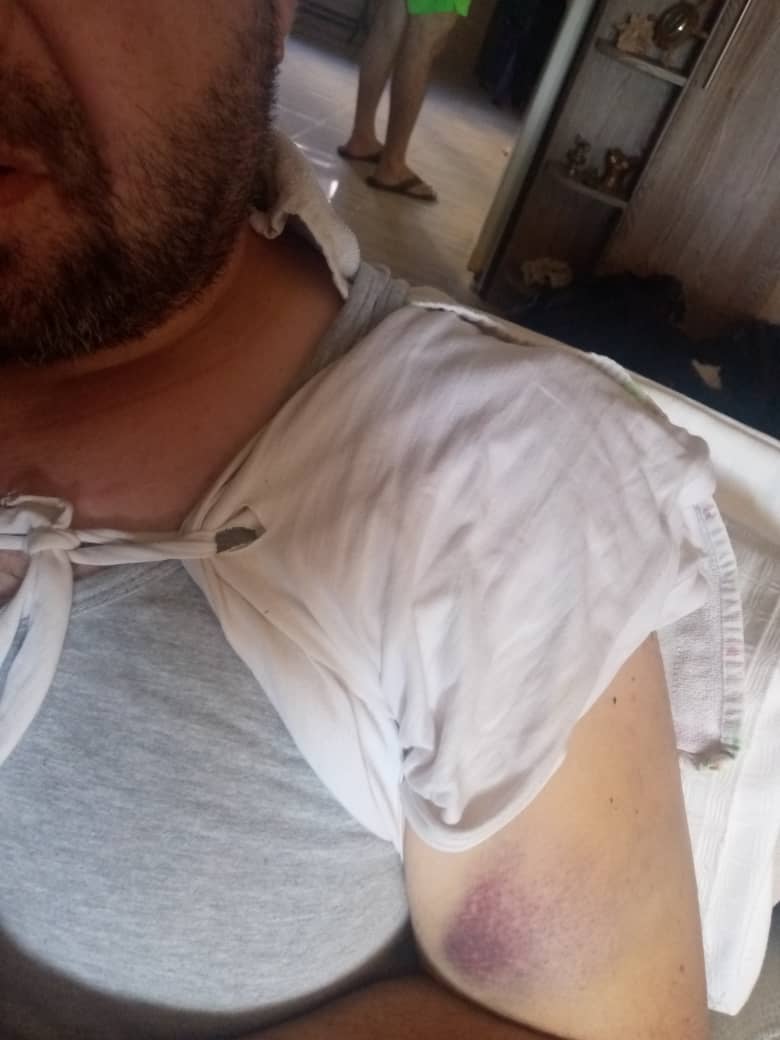
My brother doesn’t know who helped him or how. His back was riddled with puncture wounds from the tip of a knife—one of them pierced a muscle in his shoulder. The bleeding didn’t stop until he received stitches at the hospital. That’s what a nurse told my husband over the phone.
They hadn’t slit my brother’s throat “from ear to ear” as they had told my family. That was just for terrorizing, and intimidation.
The hospital discharged him because it was overwhelmed with critical injuries.
He barely managed to walk to the house of relatives near the hospital—he stayed with them for two days, unable to return home. And my father, my mother, my sisters—remained alone in the house.
July 16
That morning, the hospital was surrounded by tanks. They killed our colleague, Dr. Talaat Amer—one of the most skilled surgeons in Syria—at a checkpoint near the hospital, while he was on his way to support the medical team trapped inside. They told his wife over the phone: “His green scrubs are red now.”
A video spread showing the execution of the Saraya men, riddled with bullets in Khaldoun Zein al-Din Square—broadcast by the killers themselves.
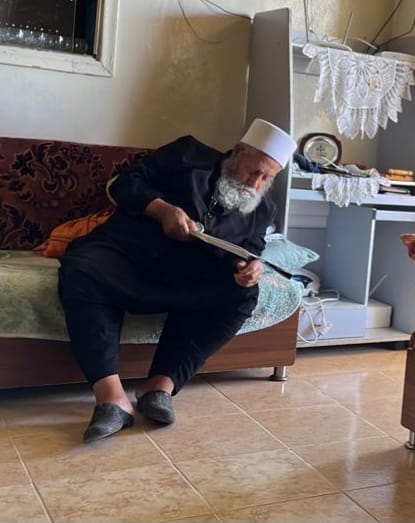
By noon, they attacked the homes in my family’s neighborhood—one of the poorest quarters, far from any checkpoints or clash points. Many of its residents had already fled. General Security men parked their car in front of my family’s house—and entered. My father said to them, “If you’ve come as guests, you’re welcome. The house is yours, and we’ll serve you coffee...” One of them pointed at my father’s beard. My father is a religious man, 85 years old, walking with a cane. He said, “That beard says you’re a clan elder. Now tell me—who is al-Hijri? He’s my sheikh. Disown him. I will not. Curse him. I will not. Then you’re with him! He is the sheikh of my sect. I will not curse him, and I stand with no one!
The General Security officer pointed his weapon at my father. My father, leaning on his cane, said calmly: “If you’re a real man—finish me.”
My sister Nawal rushed forward, stood between him and the gun, and cried out: “Kill me first—then kill him.” Then my eighty-year-old mother hurried over, leaning on her cane, and joined my sister: “Kill us first—then you can kill him…” It was as if the “General security” memeber‘s hand refused to pull the trigger. He must have been raised by a kind mother, a good one. They left. And kept them alive.
The General Security officer pointed his weapon at my father. My father, leaning on his cane, said calmly: “If you’re a real man—finish me.” My sister Nawal rushed forward, stood between him and the gun, and cried out: “Kill me first—then kill him.” Then my eighty-year-old mother hurried over, leaning on her cane, and joined my sister: “Kill us first—then you can kill him…” It was as if the “General security” memeber‘s hand refused to pull the trigger. He must have been raised by a kind mother, a good one. They left. And kept them alive.
After they left, my family discovered that they had stolen money—and much more—from my brother’s house. They smashed the oud his son was learning to play.
News arrived that my cousin Iyad had been martyred. A spiritual, devout man, with the gentle manners of the Prophet Yusuf—an artist, a calligrapher, an enemy of all weapons and war. He was killed in his own home.
That evening, once the soldiers had withdrawn from the neighborhood, my family dared to cross into the adjacent houses of our neighbors. They found that seven unarmed young men—right next door (I have all their names, one by one)—had been killed inside their homes.
They had also shaved the mustaches of three elderly religious men, all over sixty, abducted two of them, and taken everyone’s money, gold, and phones.
I drift into thought… and catch myself smiling through my silent sobbing.
Nabeel—one of the murdered—was a childhood friend. He used to make us little flutes (zummayrat) out of wheat stalks. What a sweet, whistling sound they made.
July 17
Radio Fresh: A Syrian history
01 August 2025
My sister writes: “Every moment, we discover a new nightmare…” She writes: “Today we counted more victims in the homes a bit farther from ours (I have them all documented by name): Ayman and his son Rammah, Assem, Amjad and his brother and their four children, Issam and his brother, and Issam’s son, who was found hiding in a water tank—and they killed him there. Severe beatings and the shaving of mustaches for two elderly men and one young man. Burned: two coach buses, one minibus, and three cars.” Four cars stolen. One car’s windows smashed. Another car’s wiring ripped apart. Several homes burned. Most homes looted. I’ve documented the names of the victims and the owners of the homes and vehicles.
Calls are being made from the stolen phones—filled with insults to their faith, baiting family members into certain locations, possibly to abduct or terrorize them, spreading an endless stream of rumors and fear…
My sister writes in another message: “Today, I heard news that my cousin’s daughter was abducted—four days ago. I can’t remember if it was that day or the next when I saw an interview on Al Araby TV with a man in tribal dress, placing women in the back seat of his car. He said he was heading toward Daraa. One of the women behind him wore a Sunni-style hijab but spoke in the Druze dialect: ‘They said they wanted to take us with them.’”
The coast events flare up in my mind again… The word ‘abducted’ slaps me across the face. The news pours in: Women from our extended family in the countryside have been kidnapped—some were hiding in farms around the villages, others had sought refuge at the religious shrine. The men with them were beaten on the head. A woman, whose phone wasn’t taken, wrote: “They devoured us with their eyes. I told one of them: don’t look at us like that. He replied: You only worth a bullet…”
I would later learn that a few honorable men in Daraa had secretly smuggled some of the women to Jaramana. But some remain missing to this day.
Today is August 3, 2025—Sweida is still under siege..