
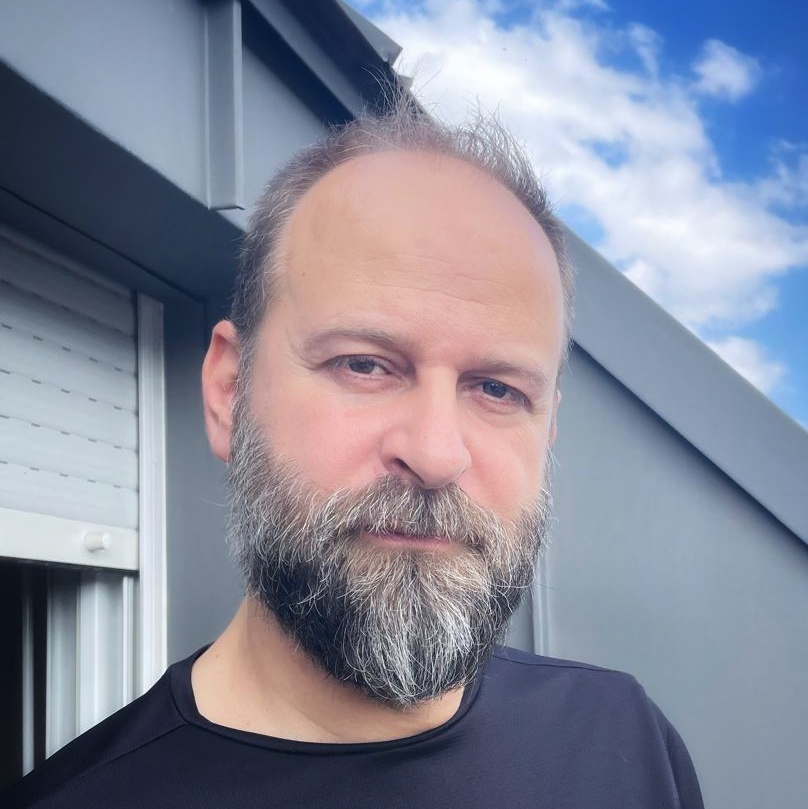
In September 2025, the Syrian Archive published a photo book by Syrian photographer Muzaffar Salman. The book was printed as a limited edition, and its copies freely distributed at different venues, such as the bookstore Khan al Janub in Berlin. It is available at the Blibliothèque Nationale de France. Currently Salman and the Syrian Archive are discussing the production of a second edition, in both English and Arabic.
Muzaffar Salman describes the publication as “a self-published photo book that fuses documentary photography with introspective narrative to explore the fragmented reality of contemporary Syrian identity. It emerges from my personal experience of war—starting with a battle I witnessed from my home in Damascus in 2012, which I was forced to flee, leaving behind thousands of photographs that were later destroyed. As a photojournalist for Reuters, I believed that capturing front-page images of war was more vital than personal loss. But over time, I realized that widely published images lose their original context, becoming vulnerable to reinterpretation and erasure. Inspired by John Berger’s reflections on private versus general images, this book questions the permanence of war photography and reclaims a more personal, emotionally anchored narrative. Through a combination of images and text, it builds a dual perspective: the camera as an outward lens and the writing as an inward one. This work challenges the documentary form itself, arguing that in a dictatorship, photography often records not truth—but the absence of it”.
SyriaUntold is honored to publish some excerpts of the book, available online for a wider public.
Damascus, 25 March 2011
The Shadow of a Little Cloud That Never Reached the Ground
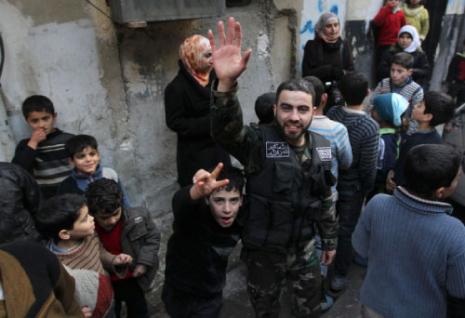
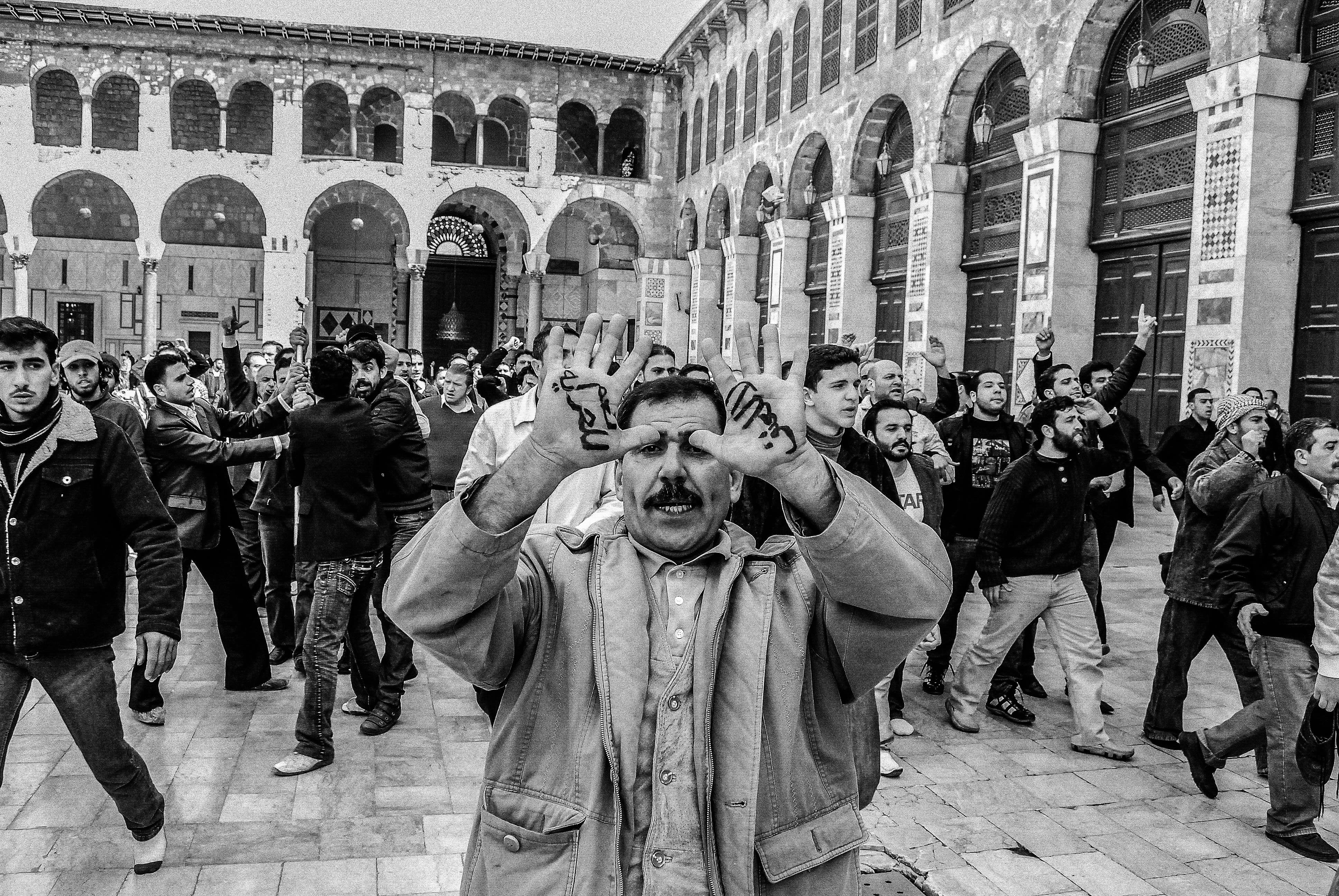
The photographs I took that day were published by the Associated Press. Some made it to the front page of Libération in France and Al-Akhbar in Lebanon. Even though the Washington Post published images of protestors being beaten inside a mosque, the editor-in-chief of the newspaper I worked for—Al-Watan—was fixated on just one photo when he summoned me urgently to his office: the front-page image of Al-Akhbar. At that time, Al-Akhbar was still an opposition newspaper in Lebanon. The photo was a portrait of a protester staring directly into the camera, his mouth open in a cry, his palms raised to reveal, scrawled in blue ink: “Yes to freedom—No to violence.” The editor-in-chief slid the newspaper toward me and asked, “What is this?” My naivety made me think, for a brief moment, that he wanted to know why we weren’t publishing similar images.
But then came his next words: “I’ve been asked to hand you over. I won’t—for now. But if you don’t stop working with the Associated Press, if you don’t stop sending photos abroad, if you don’t stop photographing these protesters, I will personally hand you over to the security services next time.”
One image, capturing a single day’s event, had the power to erase my entire life. Since when did a photograph possess such power to destroy its creator? Why did not the thousands of images I had taken before carried even a fraction of that force? It seemed my silence was no longer enough. Now, I was required to be blind as well—to guarantee my own safety.
What had happened to the demon of vision? Had he lost control of his relentless compulsion to see? Were the images slipping from his grasp?
A month after that incident, I visited my family in Homs. Secretly, I took a few mobile phone photos of the army’s presence in the city following the massive Homs protest in April 2011. I published them anonymously. That night, I sat with my younger sister and asked her, “What happened that night when the protesters occupied the central square?” My sister—the same one who used to only tell jokes—answered, her voice filled with fear, “The muezzin in the mosque next to us kept calling for jihad for a full hour.” Surprised, I asked, “But where did the white security van go? The one that had been stationed near the mosque for years? The one that never let me pass without searching my backpack and checking my ID? How did it ignore someone using the mosque’s loudspeakers to call for jihad for an entire hour without taking action?”
That night, I retreated to my room, lost in thought, revisiting my old photographs until I found myself waking up from a weird nightmare. In the dream, my editor-in-chief had handed me a magical coin—one that grew larger every time I used it to expose a leak of light. I packed my bag and left quickly, determined to return to Damascus before anyone at the newspaper noticed my absence. On the way, I passed by the mosque. For the first time in my life, I was actually glad when security officers stopped me to verify that I wasn’t an American spy. I handed them my Syrian ID and my press card with a smile, studying their faces, glancing at the white security van, at the mosque.
If I could, I would have recorded their voices and sent the audio to my sister, asking her if the voice that had called for jihad belonged to either of these two men.
It would have been the best joke I had ever told her. Several months passed after that. I continued to receive my salary from the newspaper—but without any assignments.
The paycheck I had once earned for photographing reality had now become a paycheck for not photographing at all.
Aleppo, 30 December 2012
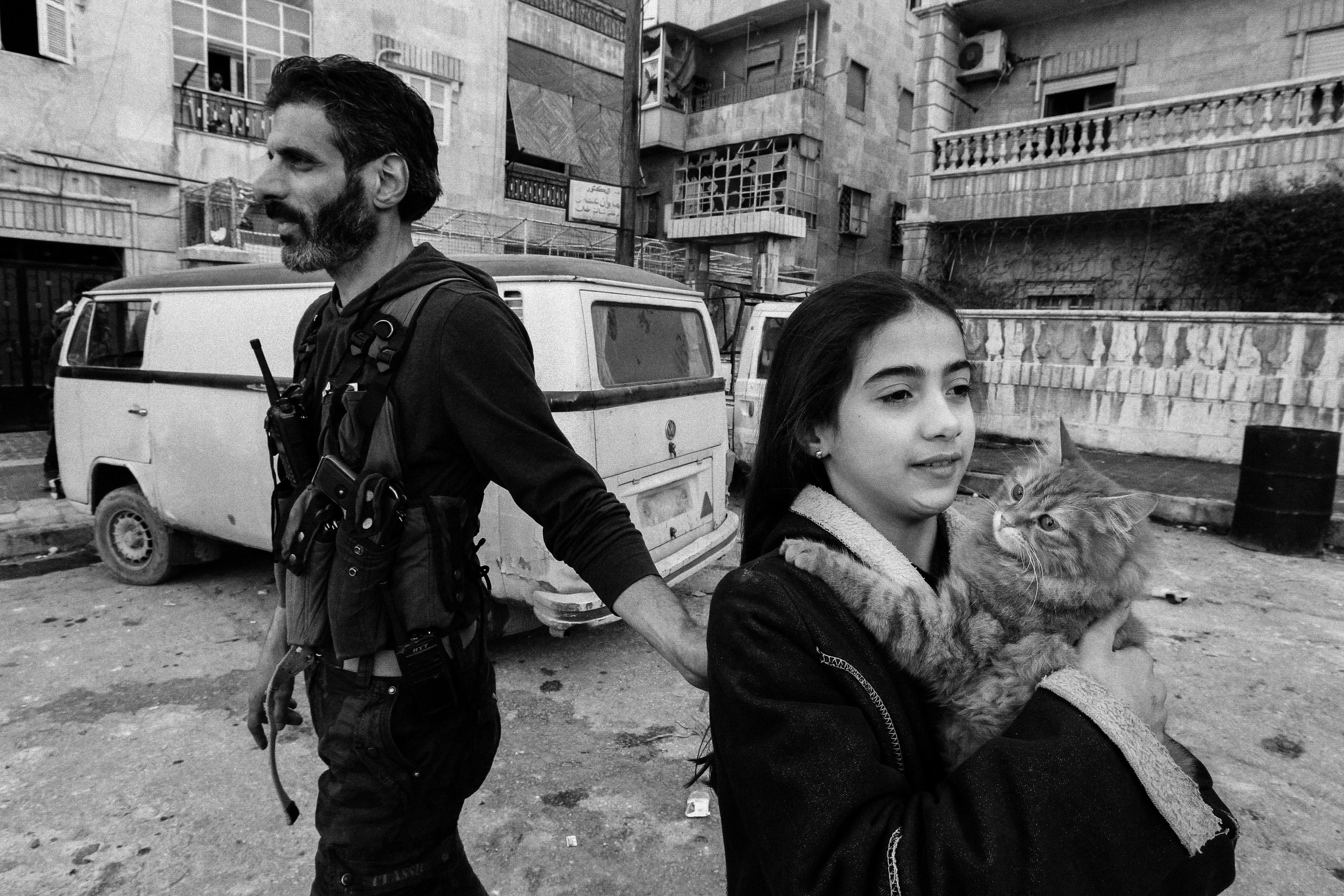
Before the revolution, he was an engineer. When the war erupted, he refused to abandon his neighborhood, even as it emptied under relentless shelling by the regime. “Abu Ali Al-Salibi” became a Free Syrian Army commander in Al-Izaa, leading battles against regime forces. He survived multiple assassination attempts, but on November 4, 2013, ISIS captured him. Since then, his fate has remained unknown. In the photo, he stands next to his daughter, Helen, who clutches her cat beside their temporary home in Al-Izaa—a neighborhood nearly abandoned, transformed into a frontline.
Aleppo, 9 July 2013
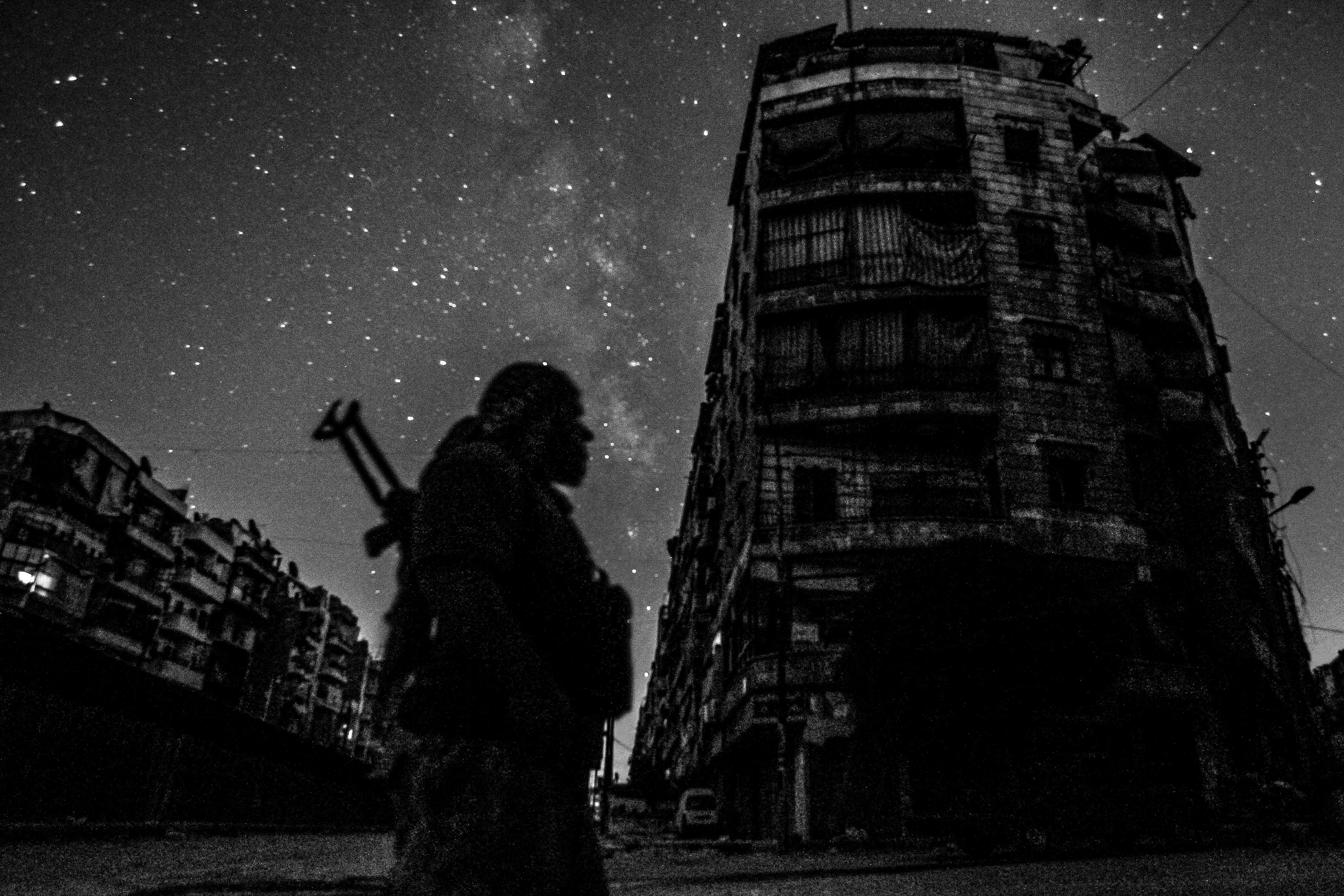
He asked me, “What are you photographing in this total darkness?”
I turned the camera screen toward him and showed him the image. He looked at it and said in surprise, “Oh… there are stars in the sky. I hadn’t noticed that.”
Then, after a brief silence, he added in a quiet voice: “The last time I went home to grab my rifle, my little daughter ran toward me as I was leaving. She clung to my leg, crying, ‘Daddy, I love you! Daddy, I love you!’ I had forgotten that—until now.” This was everything Abu Adel, a Free Syrian Army fighter, said during his guard shift on the front line in Karm al-Jabal.
Aleppo 2013
The Sniper
Some fighters from the Free Syrian Army managed to capture a regime sniper on one of Aleppo’s frontlines. He admitted to killing nine of their comrades. They attempted to exchange him for other prisoners, but the Syrian regime refused.
So, they decided to execute him.
On the way to him, there was nothing obstructing my view—everything was laid bare in detail. Every street, every shop, every house, “Everything was destroyed— the streets, the shops, the houses, the buildings, and everything inside them was exposed. Even what lay hidden between the walls was now visible. It was as if the road itself led to an undeniable truth, one that had to be erased completely.”
When I reached him, I sat beside him and put my camera aside. He told me he was being fed well, that they had treated his wounds. From the religious tattoos on his body, I could tell he was an Alawite. I asked him, “Where are you from?” “Homs,” he replied.
He was stunned by how his captors treated him, surprised that he had not been tortured. The hardest thing for the Free Syrian Army fighters in urban warfare—where neighborhoods were packed tightly together—was hearing the screams of a captured comrade being tortured through the night. When my time with him ended, I picked up my camera and left without taking a single picture of him.
So, this is who I am.
When I finally had the chance to see the true reality, and to capture it without encountering any threat, I found that I could not do it. I could not take a photograph.
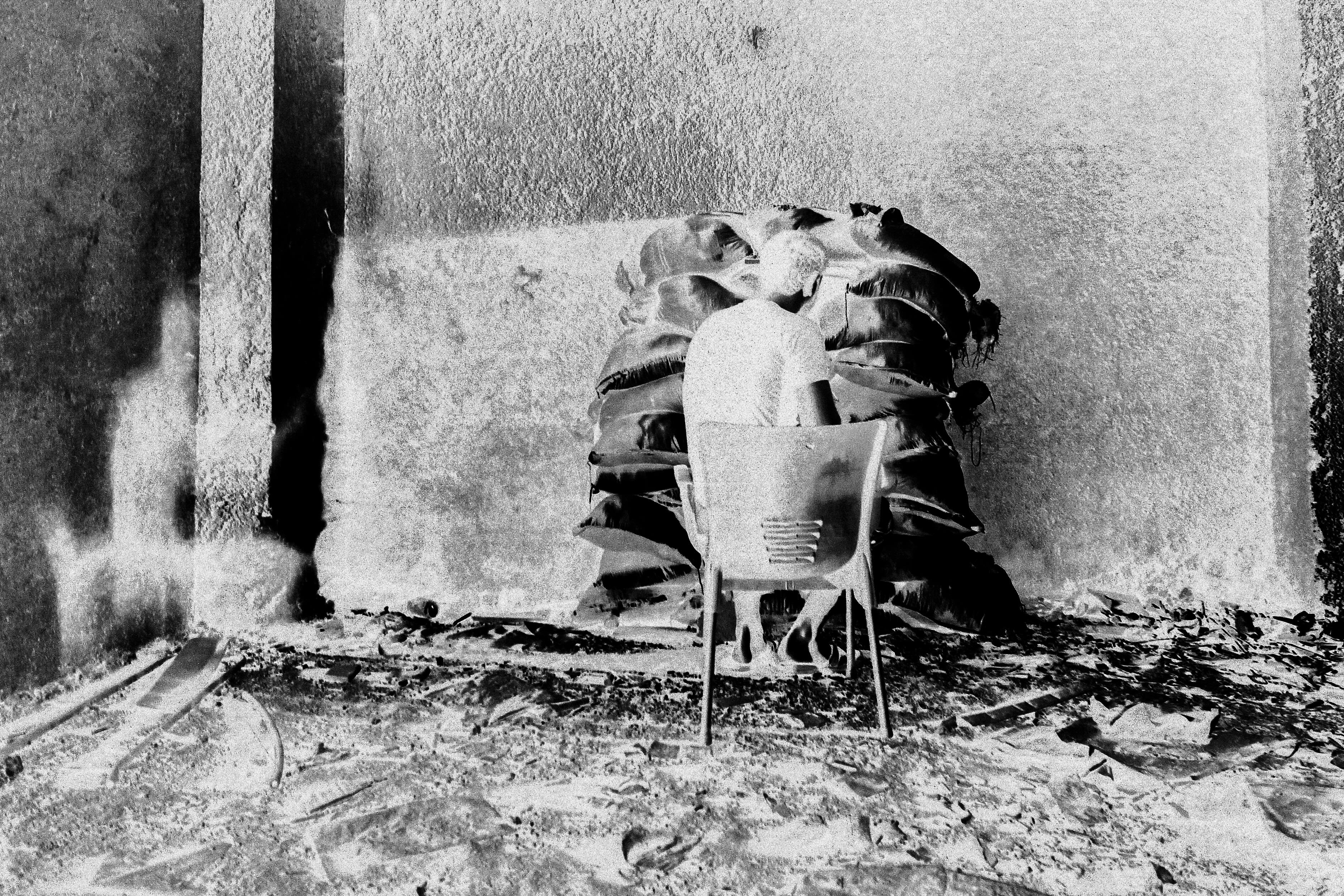
Maybe I could have taken a picture of the mother if she hadn’t reminded me of my own, my mom who was left to feed seven children after my father died. Maybe I could have found a way to tell the Dreamer’s story before he died if I hadn’t seen the reflection of my own loss in his—a thousand pigeons lost, just like the thousands of photos I lost, coincidentally at the hands of someone also named Bashar. And maybe I could have photographed the sniper if I hadn’t realized that his fate would have been mine had I not escaped military service. In some way, those three figures—the mother, the Dreamer, and the sniper—together formed my deepest self. And when I saw them, I couldn’t photograph them or tell their stories. It was a shock, for sure—the realization that when I photographed others, I was, in fact, photographing myself. Maybe one of them looked into my eyes and recognized me but didn’t expose me. Maybe they saw that I was just like them—a lost soul searching for its past. And I found it in their stories. Maybe they saw that I carried the same identity as them—our new, undeniable identity here, in this real, unmasked, unfiltered reality: pain and death. A few days later, while I was sending some pictures from home, the bad news came; Two Scud missiles had fallen on separate neighborhoods in Aleppo. They were launched from a base in Damascus. Their margin of error was so large that they couldn’t possibly be targeting small armed groups. I arrived at the scene that night. Dozens of homes had beenreduced to rubble. I saw a terrified man wandering aimlessly through the neigh-borhood, asking people, “Where is my house?”
26 March 2025
Twenty days have passed since the massacres on the Syrian coast. Current figures indicate that 1,500 civilians, most of them from the Alawite sect, have been killed, while investigations are still ongoing. Was the security officer right when he told me, “If the revolution wins, you will be the first person the revolutionaries will slaughter”?
And was my friend right when he said, “You’re crazy—if they knew who you were, they would kill you”? Perhaps they would be—if we Syrians continue to carry that boat that has weighed upon our heads for centuries, convinced it is our only salvation from death, from the threat of the other—the different. Yet we fail to see that it is crushing us, killing us, day after day.
A boat built from thousands of images, pre-etched into our un-conscious, reshaping themselves every time fear tightens its grip on us. We mistake them for proof of truth, when in reality, they are a veil that obscures our vision of the world as it truly is.
A world in which the former regime’s security officer and the Salafi jihadist are two sides of the same coin—a coin that continues to grow in a darkroom, expanding until it blinds us from developing the real image of who we are.