
SyriaUntold republishes historian Keith David Watenpaugh notes from post civil war Syria, part two. All pictures are taken by the author. You can read the first part here.
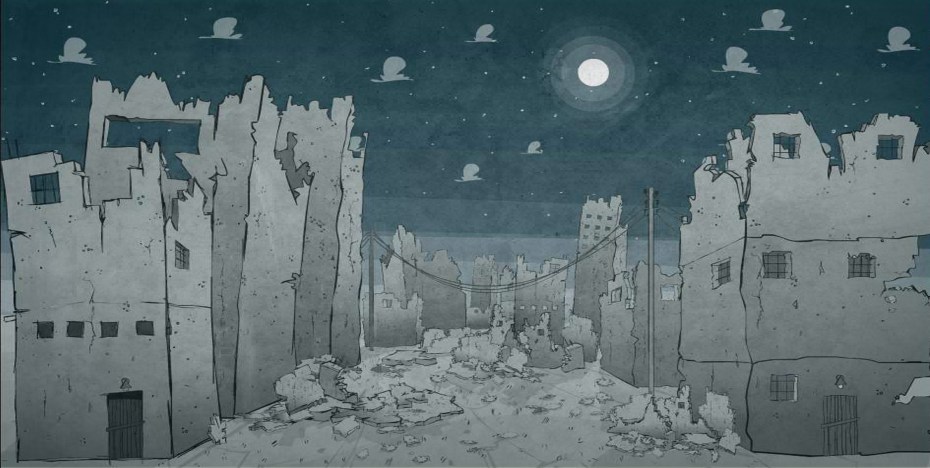
Cover caption: The Damascus suburb of Jobar was the site of terrible fighting and shelling (2013-2018). The UN estimates that 92% of the city was destroyed and remains uninhabited. In the center is the Great Mosque of Jobar and the Eliyahu Hanavi Synagogue.
Before the civil war in Syria, when you crossed into Yarmouk Camp, you knew it was different from the rest of Syria. Settled by Palestinians forced to flee their homeland in 1948, it is named for a pivotal Medieval Battle between the Arab armies of Khalid ibn al-Walid and the Byzantine Emperor Heraclius. The Arabs won.
The names of the streets recall lost Palestinian cities and towns. Palestinian political and armed movements had offices in the camp. Generations of Palestinian children attended UNRWA schools where they were taught by Palestinian teachers including Ghassan Kanafani. Palestinians could build lives in Syria, attending university, finding jobs in the government, opening businesses, and serving in the military.
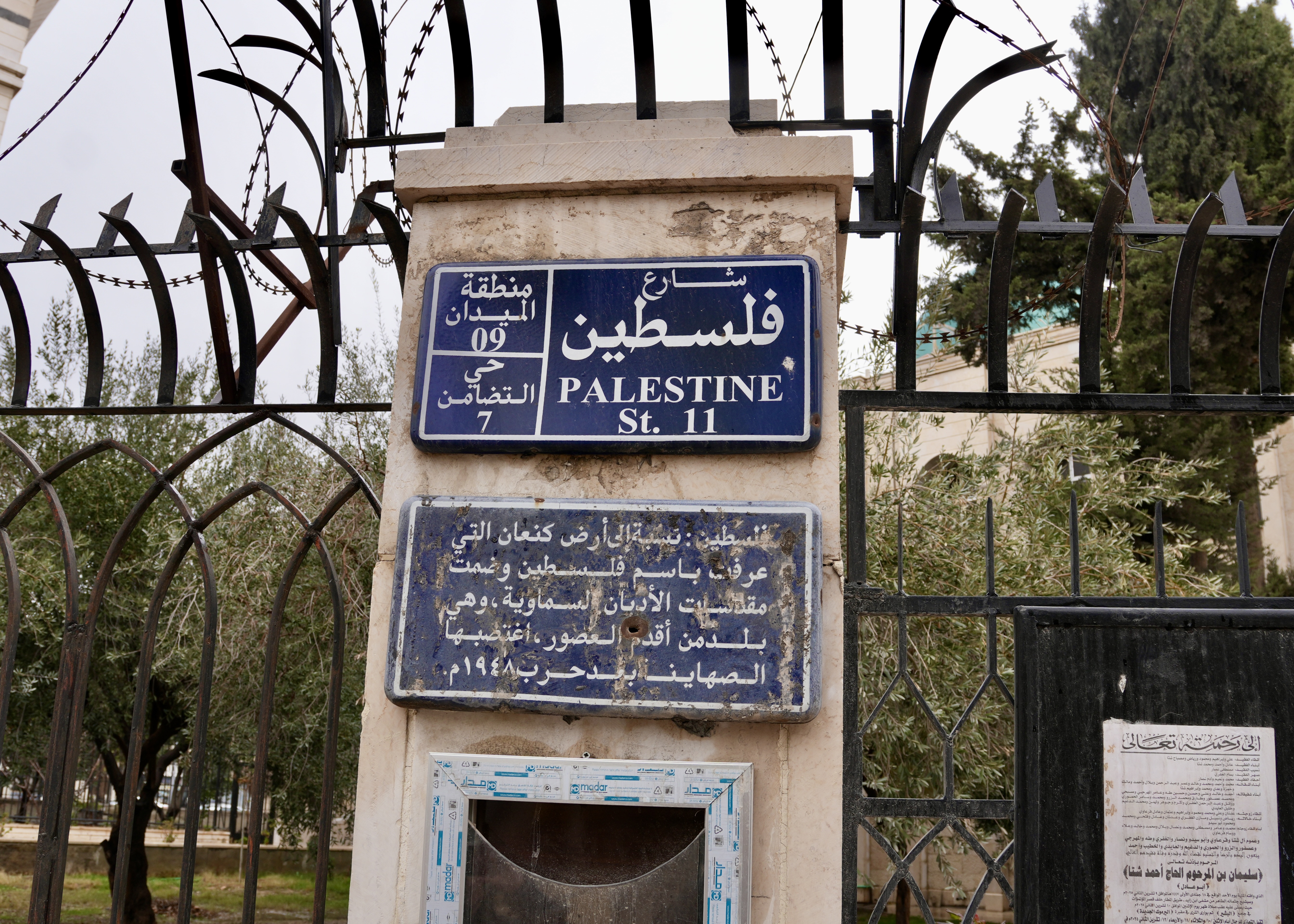
From its founding in 1954, civil society organizations for mutual aid, public education, youth movements and the environment formed were tolerated by the security apparatus as long as they stayed focused on Palestinians and the Palestinian cause.
Yarmouk sits at the center of diaspora Palestinian efforts to preserve history and memory, and an independent Palestinian political and cultural identity. That tendency towards independence explains, in part, the ferocity of the Assad régime’s assault on the city and its people during the civil war. The violence directed against the people of the Damascus suburbs like Yarmouk far exceeded any military necessity. Here it was carried out with a particular viciousness intended to eliminate the Palestinians as a social and political presence, altogether.
Early in the civil war, Palestinians sought to remain neutral but efforts to prevent militias from entering the camp ultimately failed, and anti-government forces, including those connected with the Islamic State, took it in 2015. Earlier, in 2013 the régime placed Yarmouk under siege which remained in place until 2018 when pro-Ba‘athist forces, with Russian air-support, retook the camp. The human toll of that siege is immortalized in the January 2014 UNRWA picture of Palestinians filling a street waiting for food and the haunting and award-winning photography of Niraz Saied, who would be murdered in detention at the age of 26.
Yarmouk’s civil war history
The political history of Yarmouk during the civil war documents the nightmare of shifting alliances and loyalties, internecine militia warfare, and foreign fighters that terrorized Syrians for more than a decade. The fact that many Palestinians had allied themselves with the régime — sometimes to oppose Islamist radicalism from other Palestinians, including Hamas-affiliated groups — creates a challenge to those hoping to write Palestinians into Syria’s emerging historical orthodoxy. Palestinians fought Palestinians just as Syrians fought Syrians, and elements of the traditional Palestinian leadership were complicit in their starvation, and the camps were occupied by ISIS and other Islamist militant groups.
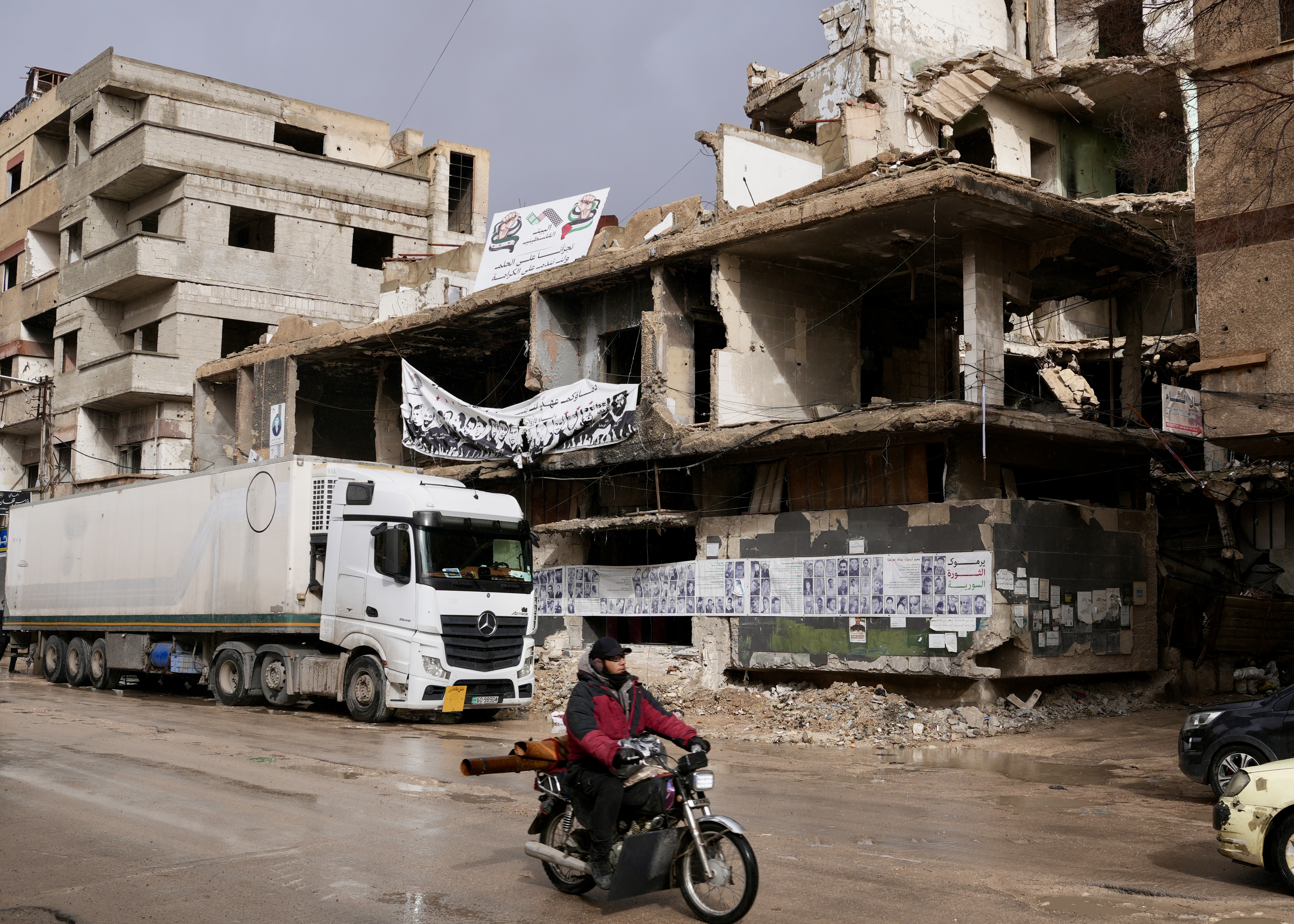
On the skeletal remains of the Palestinian Red Crescent Hospital, I saw an early effort to write that history and the evolution of a strategy to elide the shifting alliances and loyalties that complicate any effort at a simple narrative. In 2018, Russian jets pummeled the hospital, which, like all other hospitals and schools in the camp, had been targeted since the siege began. By 2018, the hospital was no longer functioning and had become a redoubt for ISIS fighters.
A large banner hangs across the entire width of the building, dense with text, I.D. photos of the dead and graphics in the Palestinian colors. Above it is a banner depicting dead fighters and at what is now the top story of the building is a billboard created by Palestine House, the civil wing of the militia Aknaf Beit al-Maqdis (Guardians of Jerusalem.) ABM as it was labeled, was loosely affiliated with younger Hamas leaders. The fists wrapped in the new Syrian and old Palestinian flags with a keffiyeh linking the two symbolizes an alliance of equals and persisting distinct national identities.
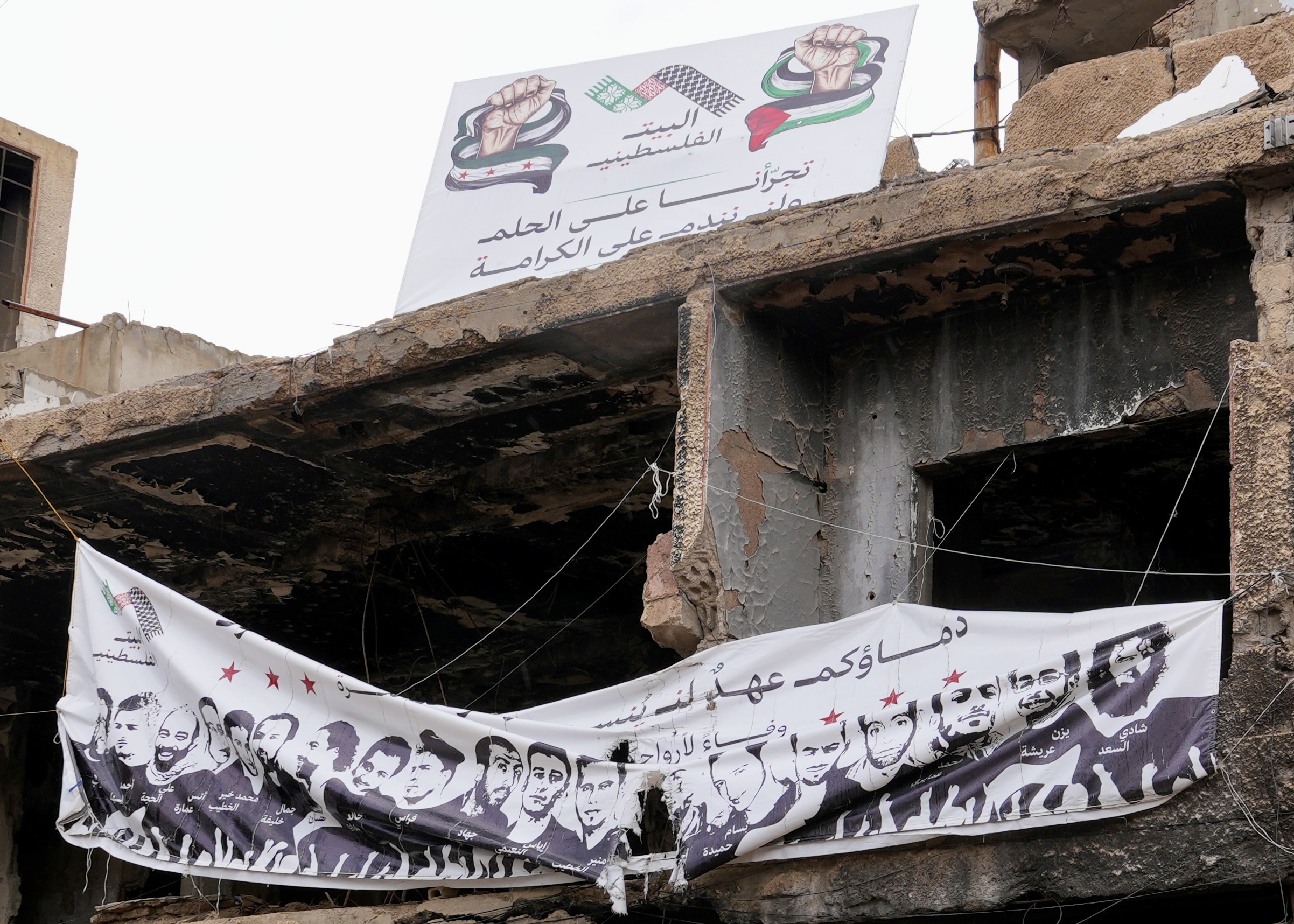
Below is its motto that takes the meaning of the loss and violence back to the very first days of the Arab Spring uprising just as the history in Daraya does:
“We dared to dream, and we will not regret (fighting for) dignity.” (Tajra’nā ‘alā al-hulm / wa lan nandam ‘alā al-karāmah)
The upper banner is a classic martyrs’ banner, referencing blood and souls and the names of several prominent ABM fighters, but also civil society actors, most prominently Yazan Arisha, (1989-2014?) a secularist law student who worked to document human rights abuse in the camp. The martyr claiming in the banner is interesting as it brings Palestinians from different affiliations together, who probably would have been in competition or opposed to one another during the war and introduces their deaths in a manner that portrays a unified struggle.
The chronology of a city under siege
That same process is most apparent in the long, text-heavy banner at the bottom.
Under the title of Yarmouk: The Syria Revolution, we are shown an “information card” that tells the reader that the camp is the capital of the Palestinian diaspora, home to 160,000 Palestinians and an extension of the body of Palestine, where streets, neighborhoods, schools and hospitals carry Palestinian names.
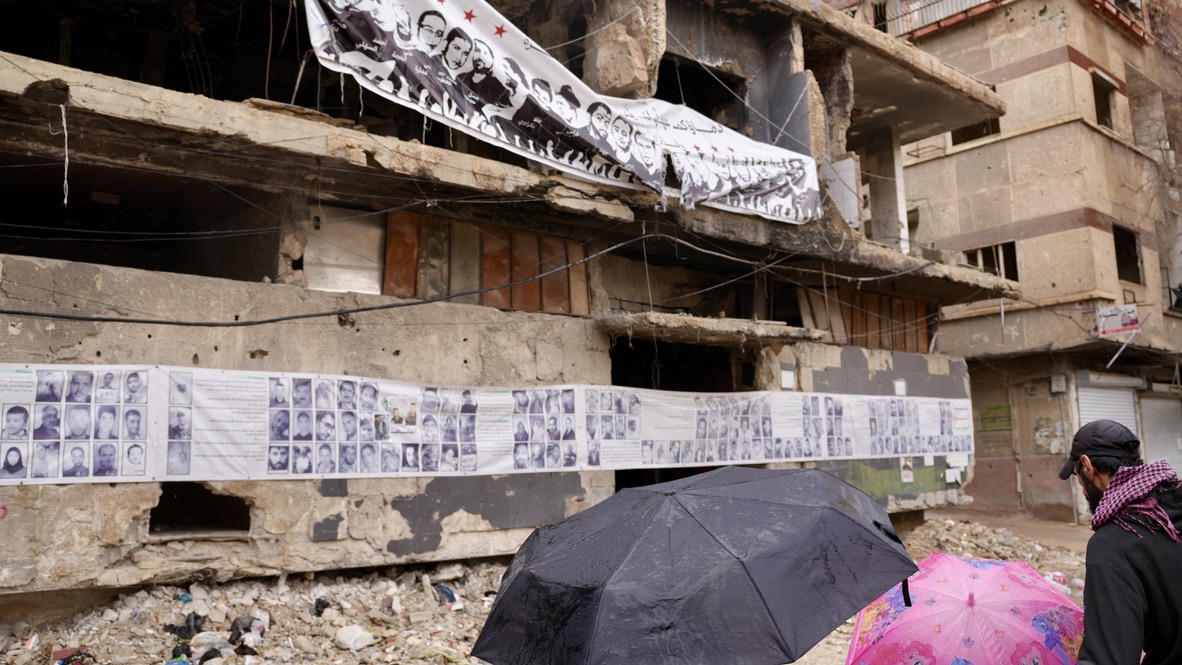
The following panel, headed by the word “Chronology,” begins to center the Palestinian experience in the civil war, identifying the al-Khalisa Building massacre (June 6, 2011) as the origin point for the revolutionary shift.
March 2011:
The beginnings of the Syrian Revolution: From the start, Palestinian youth in the camp supported the revolution and rejected the Assad régime, confirming that they belong to the fabric, [nasīj] of Syrian society and rejecting tyranny and demanding freedom.
In other words, Palestinians had always supported the revolution and, unlike perhaps other groups like the Kurds or Druze, considered themselves part of the Syrian body politic.
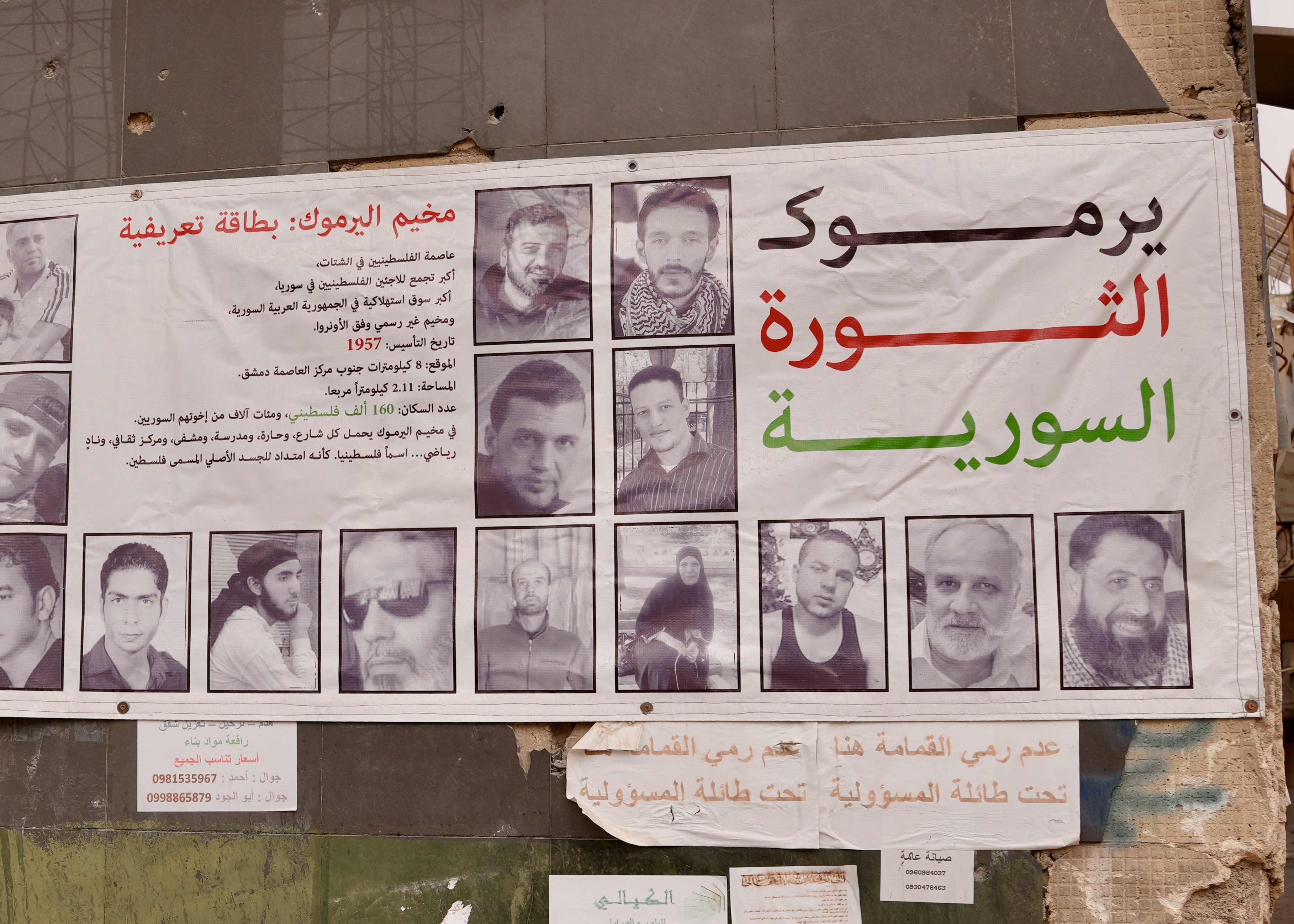
The remainder of the chronology explains how across 2011 local coordinating committees formed to support the displaced, demonstrations took place in support of the besieged cities in Southern Syria and Homs, and how many were murdered by régime allies during a demonstration, which pushed the Palestinians into opposition. Gone are the names of any groups, even ABM’s role is minimized in favor of Palestinian unity and Syrian solidarity. Later in the “public document” names of organizations and Palestinian groups do appear, but as perpetrators.
The chronology continues, narrating attacks on demonstrations and then a brutal airstrike in late 2012 on a mosque that killed dozens of families sheltering in the UNRWA school nearby.
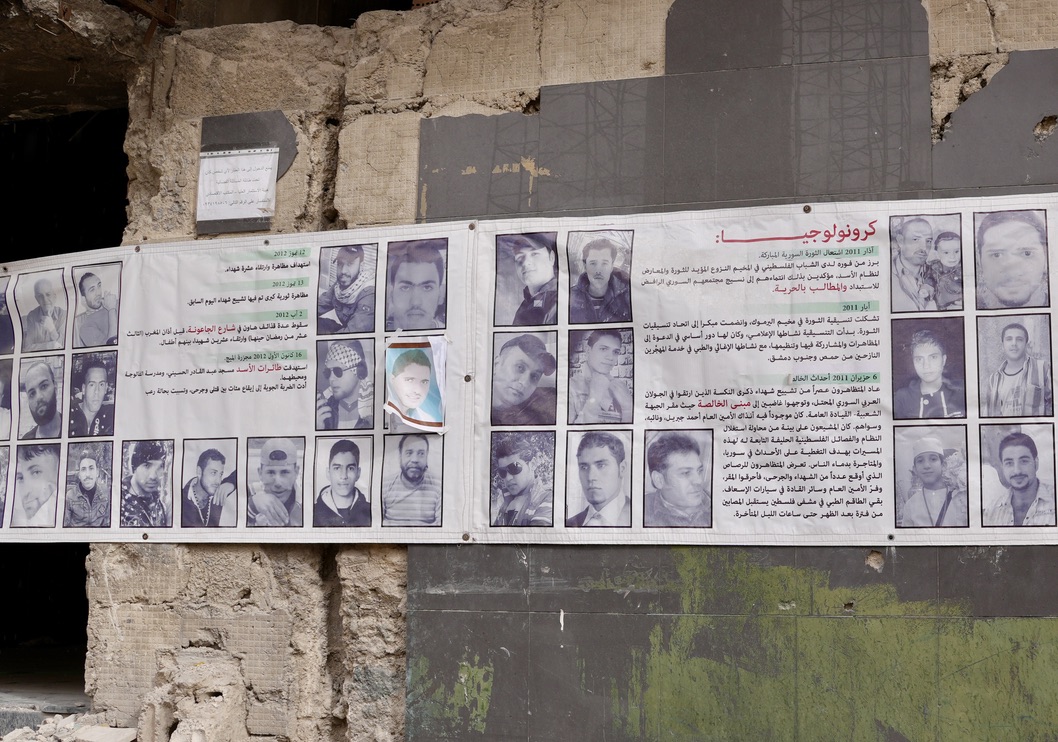
On the following panel, we learn of the “Great Exodus” following the airstrikes of December 2012 into 2013 and the beginnings of a reign of terror by pro-régime Palestinian groups. The banner explains that hundreds of thousands of Palestinians fled in a day and that they were terrorized by checkpoints, informants, extortion, and mass arrests. Six months later the siege began and no food or medical supplies were allowed in and the people were not allowed out. It tells us about the first appearance of the birdman syndrome, (rajul al-asfur) caused by slow starvation. 188 people would die of hunger.
The sixth panel narrates the story of the Ali al-Wahsh Street massacre (January 2014), where a humanitarian corridor was used to ambush civilians, and led to the disappearance of over 1500, including women. Later that month some aid was allowed in, though as the text tells us only enough to keep people living “half a life and half a death” (”نصف حياة - نصف موت”).
The next two panels explain how targeted assassinations of Palestinian civil society and political leaders across 2015 took place, which weakened to a breaking point the ability of the camp to resist its seizure by ISIS and the Nusra Front, and forced the Aknaf, the Guardians, to retreat from the city. What followed were beheadings and summary execution of fighters and civilians, and ISIS began to impose its ideology on the remaining inhabitants, including controlling education and dress.
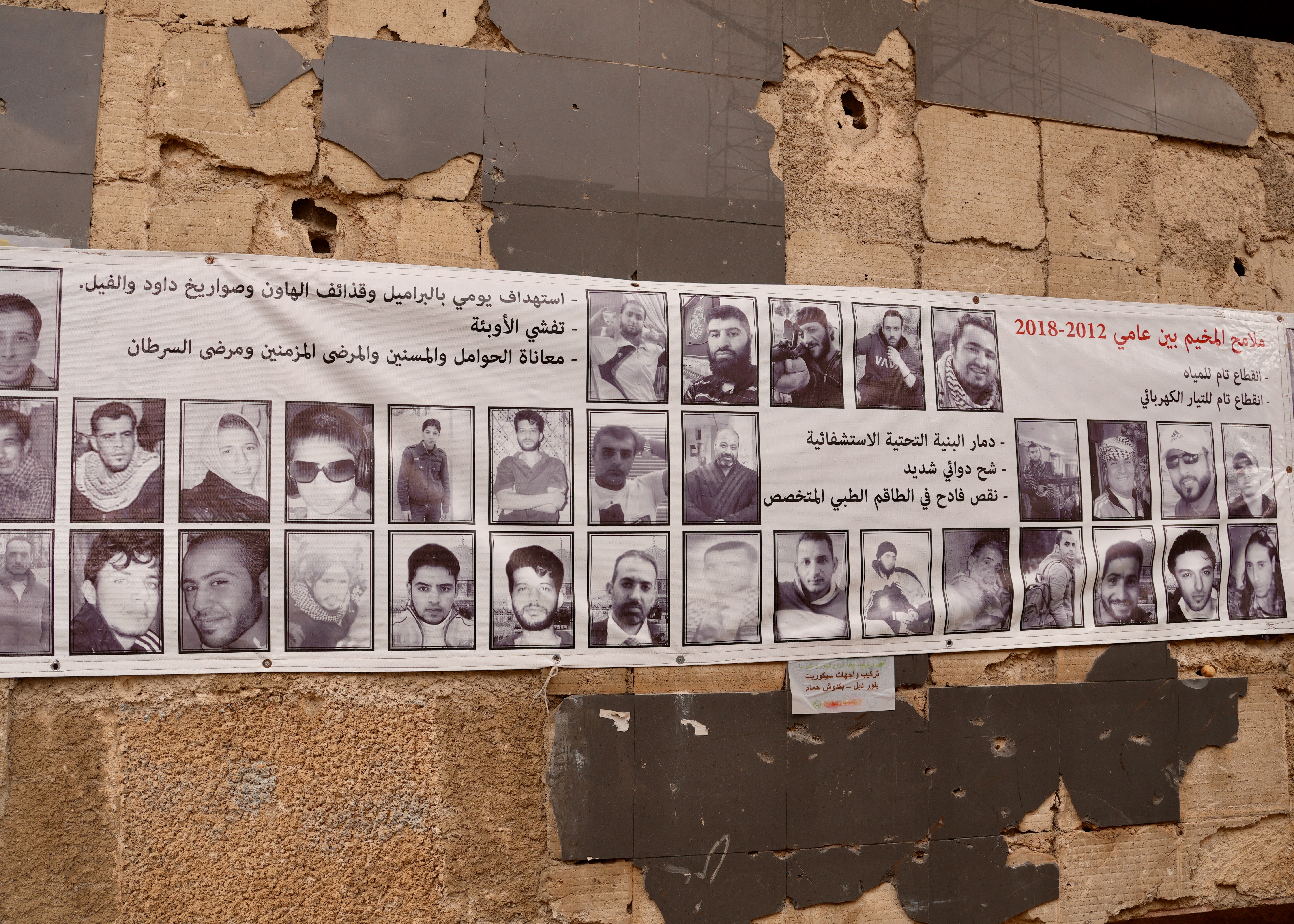
The final panels describe the urbicide of Yarmouk, its suffering under daily barrel bombs and missiles, loss of water and electricity, and present a butcher's bill of those killed and imprisoned to 2018 — 4000 Palestinians across Syria, 1500 in the camp; with 1700 imprisoned and 300 missing. In the penultimate panel we learn of the city’s capture by the Syrian Army and the desecration of the old martyrs cemetery by the Russian military searching for the remains of an Israeli soldier captured in the 1982 Lebanon War.
Transitional justice needs an economic perspective
13 January 2026
The conclusion notes that unlike the other suburbs, Yarmouk refused to reconcile with the regime, an act that forced the remaining inhabitants into internal exile. The text blames the traditional Palestinian leadership for “failing” to “protect civilians and just making empty statements that could neither feed nor nourish.” The final sentence is moving and reminds us what is at stake for Palestinians in Syria is bundled with other moments of loss and memory; it combines the Palestinian right to return to Palestine with the right to go home to Yarmouk.
مخيم اليرموك ليس مجرد حيز جغرافي، بل هو ذاكرة ورمز للعودة، ومحاولات طمسه وتغيير معالمه استهداف للحق الفلسطيني في العودة.
Literally: Yarmouk Camp is not just a geographical space, rather, it is a memory, a symbol of return, and trying to erase it or change its nature is an attack on the Palestinian Right to Return.
Uncomfortable endings: search for a revolutionary telos
The chronology ends abruptly in 2018 which leads me to suspect the banner was made earlier, stored, and rediscovered as Palestinians gradually made their way home and started to inhabit ruins and rebuild.
Whereas in Daraya the story itself could “end” with the seizure of the state by HTS, that narrative is more complex in Yarmouk, as HTS, as its Nusra Front predecessor was part of the coalition of Islamist militias that fought Palestinian units for control of the city. How to reconcile the memory of the Islamist occupation of the camp with Syria’s new masters and their version will push Palestinians along a narrow path between remembering their resistance and not reminding the regime of the complex nature of that resistance.
Also striking is a kind of strategy emerging where a combined or consensual narrative of the war is possible for the first decade of conflict, but explaining how it ended and what that ending means continues to be a space of conflict and disagreement. One strategy to deal with that is ending the story short of that moment.
Like in Daraya, these memorials tell us about the existence of a strong civil society forming in the Damascus suburbs that was targeted alongside fighters. The régime killed or exiled the youthful raw material of that possibility.