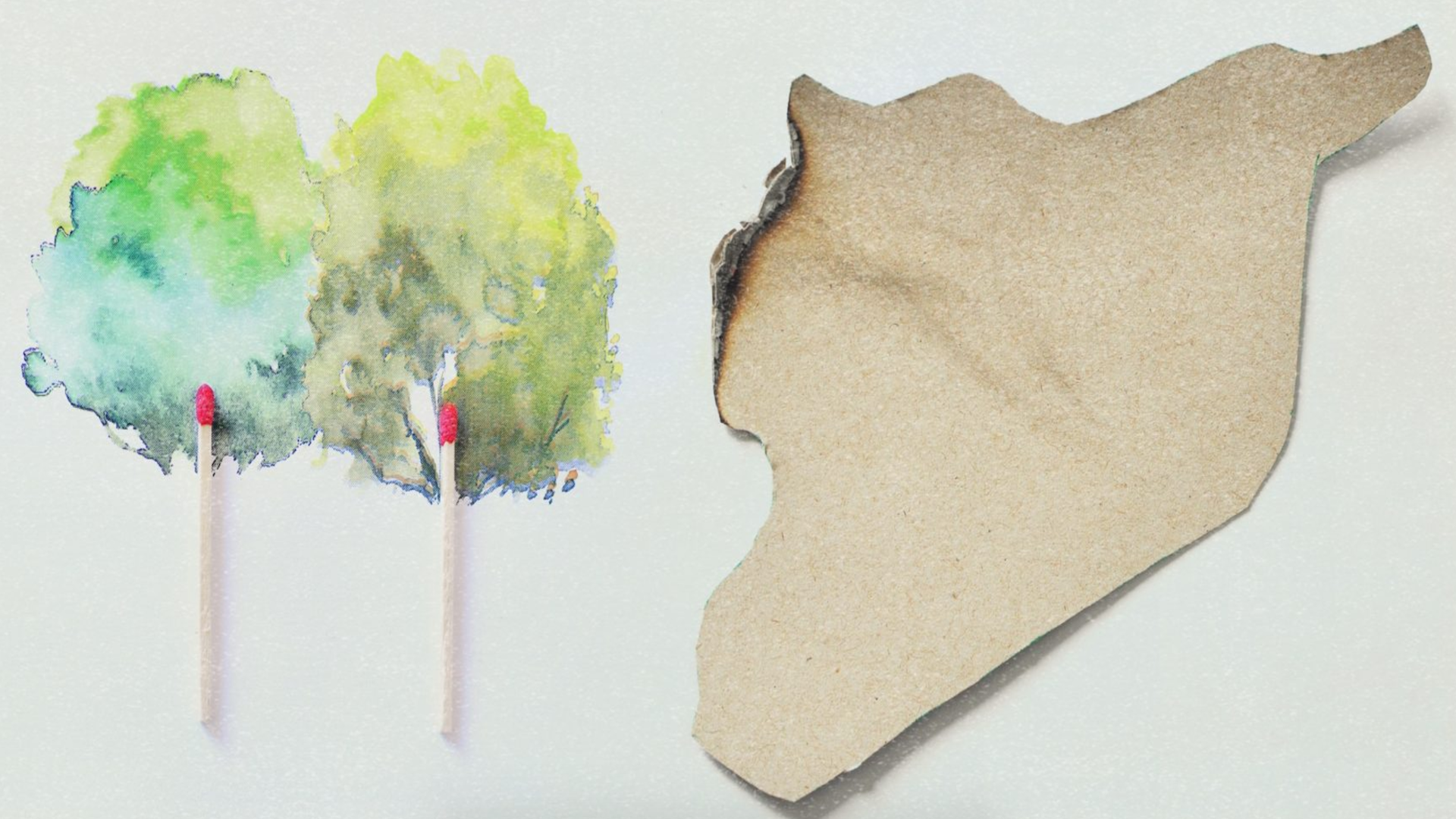


“Bring me to the shrine of Sheikh Abdullah” cried 80 year old grandmother Maryam Sulaiman after her neighbours came to her home on a Saturday morning in March 2025, telling her “they are killing the Alawites in Qosour, Baniyas”.
Maryam did not ask for more information, instead she simply called her grandson: he came quickly to take her to the shrine. They drove onto the highway on a motorcycle, Maryam sitting behind her grandson, holding his waist, gripping anxiously, as if she were a girl holding her father. For decades she believed that it was not possible for those who take refuge in the shrine to be harmed, for the shrine is a holy place, she told SyriaUntold.
Maryam believed this holy place and its values had divine power to protect people. But recently it had been harmed in a series of arsons, bombings, and attacks which had prompted a struggle to deter the aggression. At the end of November 2024 the founder of the Alawite sect, Abu Abdullah Al-Hasan Ibn Hamdan Al-Khasibi, to which Maryam belonged, was challenged in an attack according to a report from Tawakkol. Security personnel were at the gate of the shrine when the attacks and assaults occurred.
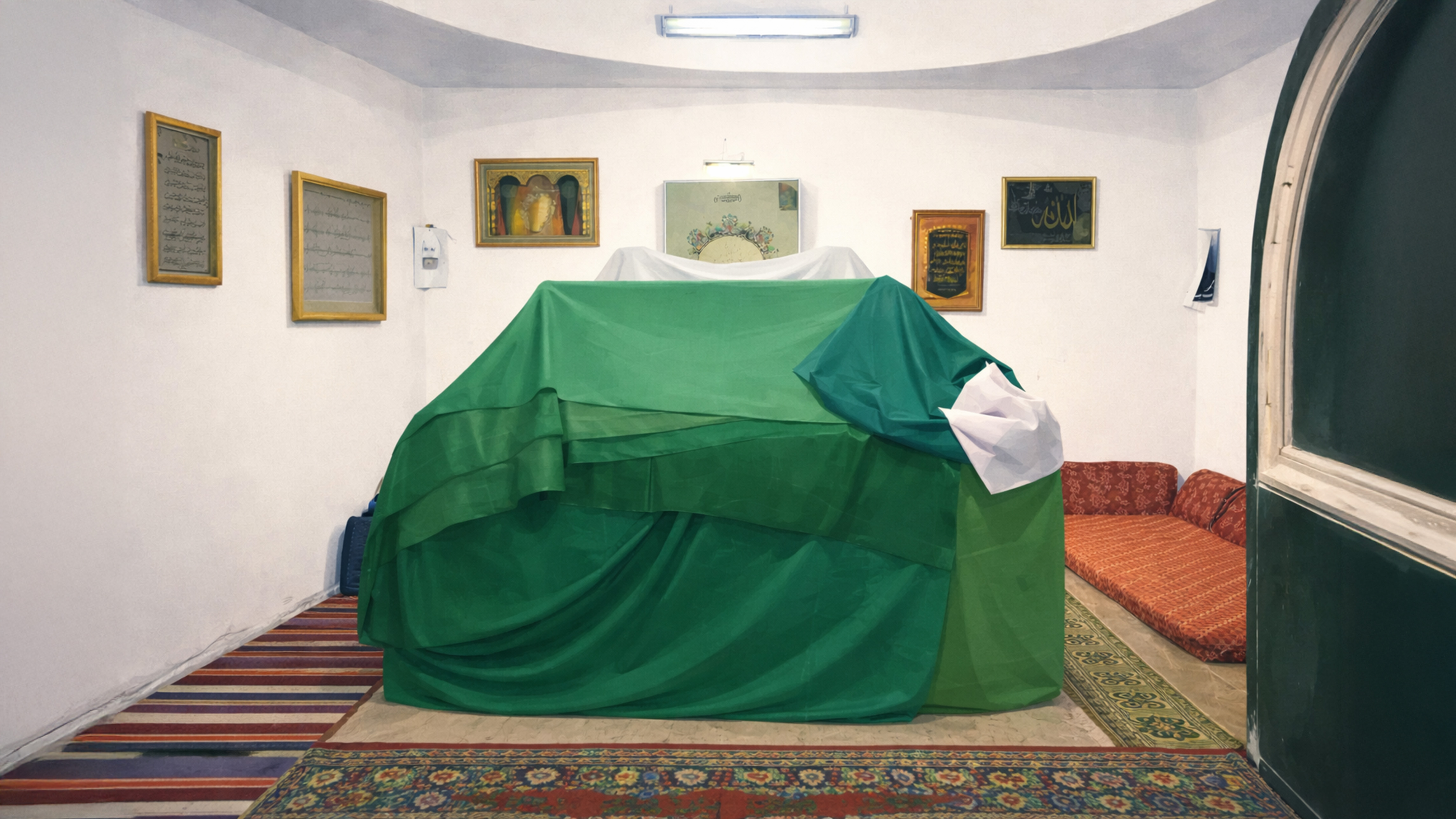
When Maryam prayed at the door of the shrine after climbing the steps, she sat out of breath, relieved, and surrounded by the deep scent of incense: she knew it well. Inside, the religious shrine resembled a small camp. Dozens of women sat on the ground, staring at their cell phone screens, while children played noisily around the shrine with its green dome and stone box containing various editions of the Holy Quran.
Maryam sat under the white dome, gathering from the commotion of the crowd that thousands of Alawites, like her, had flocked to hundreds of shrines in the mountains and plains of the Syrian coast in search of protection. The ringing of cell phones was in contrast to the usual silence of the place. A phone rang with an annoying tone, emitting a weary voice: “The Shaheen family… Math teacher Ghassan? And his wife? They were shot… Their house was completely looted”. A woman cried out to those present: “Oh, people, your time has come. Teacher Ghassan and his family… they’re dead”.

The Syrian Coast After the Fall of the Syrian Regime
10 January 2025
Maryam froze, picking up on bits of conversation as she tried to make sense of what she had heard. Ghassan? The short, slender young man who had taught her eldest son mathematics ten years ago, whom she hadn’t seen since. She didn’t remember him wearing glasses. The last time he had been to their house was when her son left for Damascus to study engineering. Ghassan, along with a number of other students, teachers, doctors, and engineers, was a victim of the March massacres in the Al-Qosour neighborhood of the coastal city of Baniyas.
Maryam, who was wearing a blue dress with orange flowers that matched the natural surroundings, is not the only one who believes that the shrines protects from evil. Almost everyone at the shrine believed in the sanctity and power of the shrines, which are scattered across the coastal mountains, the plains, and other areas where members of the Alawite community live. As Mr. Ali Ibrahim, 70, a resident of Al-Bustan, said, “Every shrine has a sanctity that humans cannot touch”. They all held a deep-rooted, age-old belief that the shrines protect them and watch over their lives. Even the younger generations believe that seeking refuge there offers protection from arrest by the new authorities, partly because of their faith in the shrine’s patron’s power to do so, and partly because these sites are often located in hard-to-reach places with exposed paths leading to them, making escape easier, as 22-year-old Haidar Ibrahim from the same village tells us.
On 7 March 2025, when local armed factions and foreign forces affiliated with Syria’s new transitional authority carried out a massacre in the Al-Qosour neighborhood against the Alawite residents, the news spread rapidly to the villages adjacent to the city, such as Barmaia, Ba’marail, Al-Zallo, and Bustan al-Hamam. Everyone began leaving the villages for the surrounding open plains, rugged valleys, and the sect’s religious shrines, where “hundreds gathered around the shrines located in the vicinity of those villages,” according to Mr. Talal Ahmad from the village of Ba’marayil in the Baniyas countryside.
20 days after the massacres of March 2025, the fire had destroyed the interior to the shrine of Prince Salem (aide to Prince al-Mukzon al-Sanjari, one of the leading founders of the Alawite sect) in the Rumaylah neighborhood, north of the city of Jableh. The smell of fire lingered in the air, forming a strange mixture with the scent of burning Quranic paper and fabric. Someone had thrown a small incendiary bomb into the little room, blasting the tiles upside down but not affecting the internal display. The white walls of the shrine’s room turned into a black canvas studded with nails, devoid of any inscriptions or images. The carpet that had covered the floor of the shrine had disappeared, most likely stolen along with the contents of the small metal donation box, which was found with its lock broken and empty. Only the marble plaque on the door, inscribed with the date of the shrine’s occupant’s death (616 AH / 1241 CE), had survived.
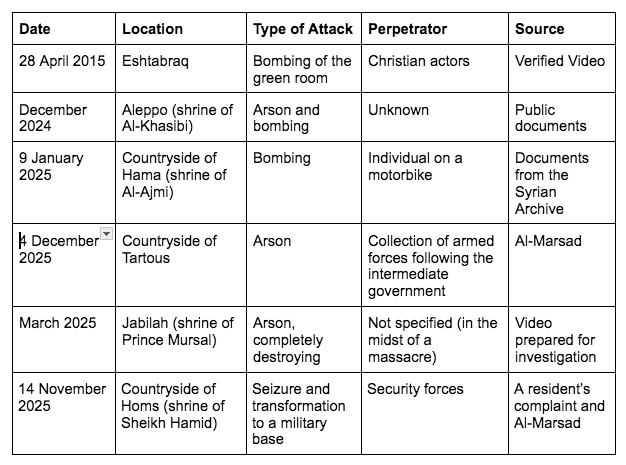
This attack was not the first of its kind. It was preceded by the attack on the shrine of Al-Khasibi, as well as other attacks. On 9 December 2025, two individuals on a motorcycle blew up the shrine of Sheikh Muhammad al-Ajmi in the village of Fan al-Wustani in the Hama countryside. According to the Syrian Archive, two other shrines of Sheikh al-Ajmi in the villages of Al-Safsafiyah (31 December 2024) and Tal Sakin (28 February 2025) were set on fire and vandalized. On 5 December 2025, three shrines in Khirbat Al-Akrad, south of Tartus, including one dedicated to al-Ajmi and two others to Sheikhs Hamid Zagbour and Ahmad al-Shabani, were attacked by “local factions”, according to the Syrian Observatory.
On 5 March 2025, the shrine of Sheikh Nasser Asaad in the village of Tal Abdulaziz in the Hama countryside was targeted by an explosion that completely destroyed it; the attack was claimed by “Saraya Ansar al-Sunnah”, according to the Syrian Archive. On 14 November 2025, members of a security checkpoint took the shrine of Sheikh Hamid Ahmad bin Batta al-Shami on the al-Mukhram Road in the eastern Homs countryside as their headquarters, prompting residents to file official complaints.
Why are shrines being targeted?
The burning and vandalism of shrines does not come out of nowhere. A 50-year-old Alawite cleric currently residing in Germany (contacted via Telegram, who requested to remain anonymous) told SyriaUntold, “The legitimacy of these acts stems from a long history of declaring Alawites (Nusayris) as apostates in Islamic records, dating back to the sect’s emergence more than ten centuries ago. Ibn Taymiyyah’s fatwa is always cited, along with hundreds of commentaries and books that declare Alawites as apostates and deem their blood and honour permissible, well before the Assad family came to power in Syria”.
Ibn Taymiyyah was a religious scholar (1263–1328) who authored numerous works and issued fatwas on a wide range of topics, including those pertaining to the Alawites. Syrian scholar Muhammad Jamal Barout states in his book The Kesrouan Campaigns in the Political History of Ibn Taymiyyah’s Fatwas (p. 229): “Ibn Taymiyyah lumped the Druze together with the Nusayris into a single doctrinal and theological category, on the basis of which he asserted that they are ‘infidels by consensus of the Muslims; it is not permissible to eat their slaughtered animals, nor to marry their women, nor do they accept the jizya [tax], for they have apostatized from the religion of Islam; they are neither Muslims, nor Jews, nor Christians’...”

In his book The Circle of Fear: Syrian Alawites in War and Peace, New Zealand author Leon Goldsmith notes that "In early 1820, the Sunni sheikh Muhammad Nasir al-Din al-Maghribi (1827) issued a fatwa in Latakia, the first against the Alawites since 1516. According to Samuel Leid, it stated that the lives and property of the Nusayris (Alawites) were lawful for Muslims to take. Shortly thereafter, in 1824, a group of Ottoman soldiers attacked Alawite villages near Latakia, killing 30 or 40 men and enslaving the women and children” (p. 124).
The Alawites believe that these fatwas and others like them act as justification for attacking and burning shrines, a view shared by the sheikh residing in Germany, who told SyriaUntold that the practices of the Alawites - including reciting the Quran, fasting, and uttering the two testimonies - is, in the view of some supporters of the new regime in Syria, “hypocrisy and falls under the category of deception and lying to other Muslims, as if they were God’s agents over people’s intentions and actions. So what if the matter concerns shrines, whose existence, visitation, and invocation of the names of their patrons they consider to be polytheism and apostasy?”.
Mr. Muhammad al-Rihawi (a pseudonym at his request), a member of the government’s General Security Directorate and a resident of Masyaf, in an interview with SyriaUntold, attributed the burning of shrines to “the actions of individuals with criminal records who aim to cover up crimes of theft of money or items suitable for sale that they might find in the shrine, such as carpets”. However, he does not rule out the possibility that “some extremists may have done this, but the state is pursuing the perpetrators to the best of its ability”.
According to SyriaUntold’s monitoring, no arrests have been made for the burning of Alawite shrines. In general, there are no local or official statistics on the number of shrines that have been burned or vandalized (the table below reflects available data).
What are the shrines?
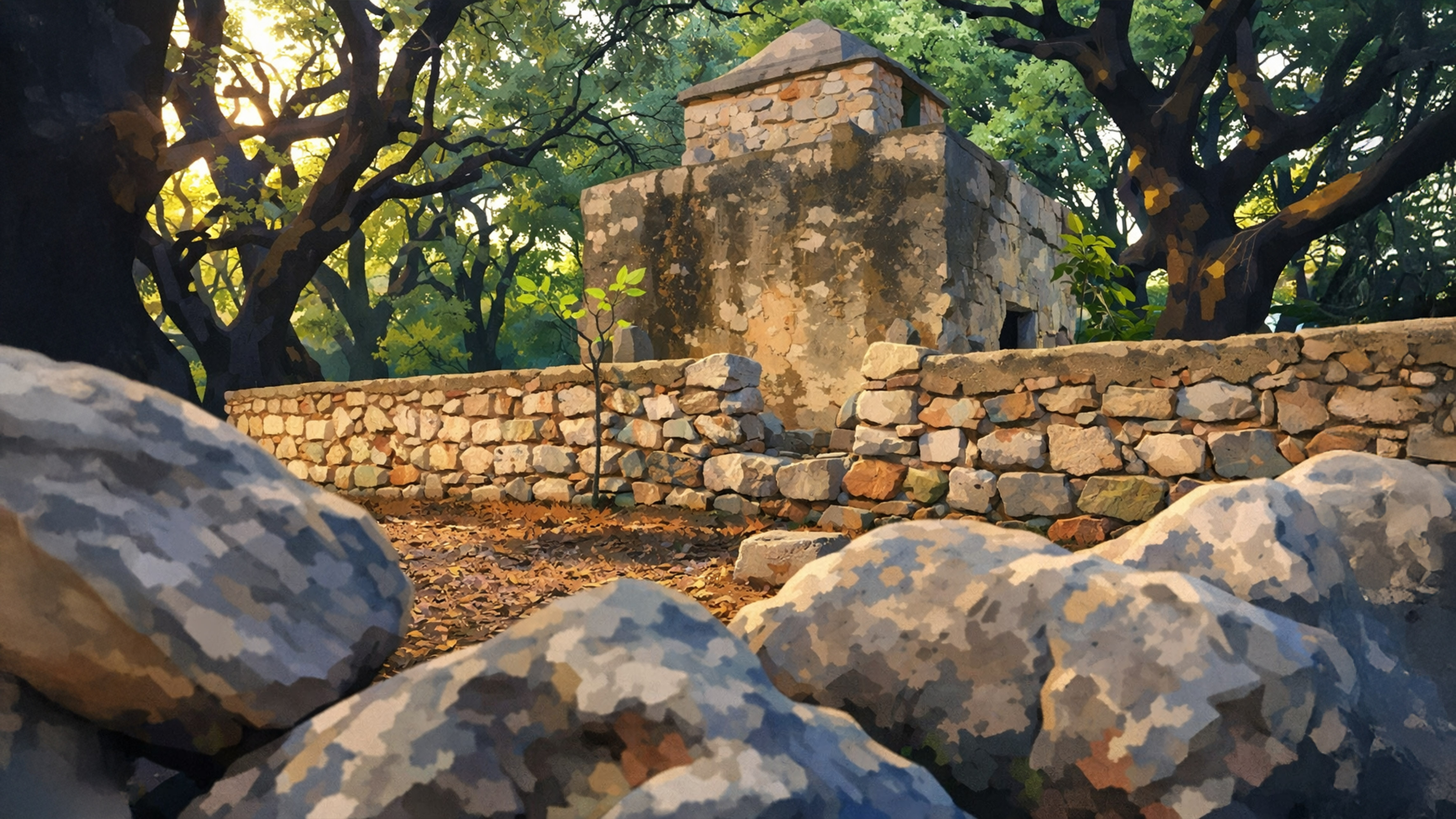
Maryam knows the shrine she has sought refuge in for nearly three-quarters of a century, ever since it was just a simple tomb with no surrounding room, encompassed by ancient oak trees. As a little girl, she used to play around it with her friends, encircled in complete safety and love. Holding onto her cane, Maryam says: “My father (who passed away at the age of 100 in the mid-1990s), buried next to Sheikh Abdullah’s shrine, would rest here on his way back from working in the fields. He would sit down, light an Arabic cigarette, and enjoy himself. I would return with him, my shoes covered in dirt, and throw them off before entering the shrine. My father insisted that I wash my feet before going in”. The oak forest was so ancient that Maryam and untouched that Maryam can remember it exactly, “Those trees never changed”.
No one knows the exact date Sheikh Abdullah was buried, but like all shrines scattered across the coastal mountains, it has its roots in ancient times. In his study of peasants in Syria and the Near East, the French historian Jacques Weulersse argues that “the ziyara or maqam (two terms interchangeable for shrine) is the living heart of peasant agricultural piety on the Syrian coast. It is a sacred site close to the peasant’s daily life, where he feels a greater sense of closeness and familiarity than he does in organised places of worship”. Weulersse adds that the shrine “is often built in the form of a whitewashed stone dome on a previously sacred site, which may be a great tree, a spring, or a place known for its sanctity since time immemorial. In many cases, the sanctity stems from a name that came later to cover an older religious presence that has persisted through the ages, regardless of changes in the dominant religions, reflecting the continuity of places of worship in this ancient land”.
Because these places are an integral part of their surroundings, their architectural style is derived from their environment. Dr Bassam Dayoub, a doctor in Islamic Archaeology from Sorbonne, Paris, founder and director of the ‘Arabic Calligraphy in Syria’ page on Facebook, is responsible for publishing a journal specialising in Syrian inscriptions. He notes that ‘the most common architectural form in Alawite areas is a square building covered by a dome, inside which lies the mausoleum. The façade is adorned with an arch extending beyond the door, surmounted by an inscription and sometimes geometric motifs such as stars to the right and left, and there are usually two small steps leading up to the shrine”.
Historically, Dayoub documents the existence of ancient Alawite shrines through inscriptions: “We have more than 140 inscriptions relating to the Alawites, some of which concern shrines and mausoleums. The oldest is the shrine of Sheikh Hamdan Jufin in the Qadmus area, recording the sheikh’s death in 685 AH (1285 AD), inscribed on a Mamluk-era stone box whose authenticity can be relied upon. There is also the shrine of Sheikh Salman al-Rawas in the village of Falqsu, but the date of its construction (861 AH/1455 AD) is questionable, as dating by numbers was rare during that period”.
The shrines have multiple functions rooted in religion, as explained by Mudar Hassan, a professor originally from Jableh who lives in Japan and is an expert in the sect’s religious sciences. He states that “The people and the names of the shrines we visit are simply symbols of souls that have risen above lusts and hatred, and above the world’s vices, evils and vanity; they have come to know the Creator through true knowledge, and have united with Him, and all the dignity emanating from them stems from the will of the Creator Himself”. Mudar continues, saying, “The human visit to the shrine is a visit by those seeking both the path and their needs at the same time. The sage buried here knew his way to the Truth, and those who visit him are either seekers of the Great Sage (the Creator, the Source of Existence and Meaning) or ordinary people seeking solace through the sage’s connection with the Creator. When we believe that a particular saint or shrine can perform an act that would be considered a miracle under normal circumstances, we attribute this to the power of the Almighty”. This explains why people turn to it, seeking protection or the fulfilment of their goals; some would place photographs of their children inside the shrine to protect them and to ensure they prosper in life as well.
There are many tales of the miracles performed by the occupants of these shrines, passed down orally from generation to generation. Folklore tells of Sheikh Mansour al-Gharabili, for example, whose shrines are found in several regions of the Syrian coast. The tale is that he was mocked by a high-ranking Mamluk cleric when he was a child of no more than ten years of age. The elder sent him with a sieve to fetch water from a nearby well, to ridicule him. The boy went and returned carrying the sieve filled with drinkable water, which he presented to the Mamluk sheikh, causing the latter to fall to the ground in a faint. There is a mention of Sheikh Mansour dating back to the early days of the Mamluk era, according to the book The Forgotten Ones in the Mountains of Latakia by Ali Abbas Harfoush.
Rituals of the Past
Alongside their religious and protective roles, the shrines serve an equally important social function. Outside the shrine, there are rituals such as cooking, studying, and a space for children to play; furthermore, the village cemetery is usually situated near a shrine. In the past, right up until the 1980s, social and agricultural festivals were held near shrines with spacious courtyards, such as the shrines of Sheikh Abdullah al-Daliya and Sheikh Ahmad bin Shaaban in Baniyas. Among these, as Maryam recounts, was the ‘Rabi’ ceremony, which for many decades was held on 17th April near the shrine of Sheikh Mansour al-Gharabili in the village of Babaluta, close to her own village. “We used to carry our food with us and walk three kilometres to get there, where we would take part in dabke and zammar celebrations. There were people riding on swings and playing games for some money” said Maryam.

“To whom will I say good morning from now on!”
20 March 2025
These celebrations form the basis of social and spiritual interaction, according to researcher Simon Ali, a specialist in the social history of the Syrian coast. “The map of the shrines of Al-Khudr helps us understand how Alawite villages used to interact spiritually and socially”, he told SyriaUntold. “In the vicinity of the village of Damsarkho alone (near Latakia in the north), there are several shrines dedicated to this figure who united Christians and Muslims. People would come there for blessings and to seek healing, but it was also a gathering place during festivals, a site for fulfilling vows, and a popular court for resolving disputes between families through the blessings of the place”.
The shrines during the Assad Era
In the decades prior to the Assad government, the shrines underwent no significant architectural or functional changes, however, during the rule of the two Assads, the shrines were subject to a number of changes, some contradictory. Given Hafez al-Assad’s concern for his image and power consolidation as an Arab and a Muslim, he refused to engage with the Alawites on religious grounds; consequently, no donations or grants were made to alter anything in the architecture of the shrines. Dr Bassam Diop and Dr Munir Shuhud (author of the book The Alawites in Contemporary Syrian History (1918–2024)), in an interview with SyriaUntold, noted that the shrines began to display portraits of Hafez al-Assad. Following the death of his son Basil, a second portrait was added, and the third was that of Bashar. During the reign of Hafez al-Assad, the First Lady carried out improvements to some of the roads leading to major holy sites, such as the Arba’een shrines in Jerd al-Qardaha and Wadi al-Qala’ (Jableh countryside).
There is an incident that coastal residents remember well, recounted by Muhammad Shabaneh (66), a retired civil servant from the city of Baniyas. “In the 1980s, several Alawite shrines were set on fire and vandalised; the perpetrators at the time were members of the ‘Al-Murtada Association’, founded by Jamil al-Assad. In 1984, the shrine of Sheikh Ahmad Qarfees was the target of an arson attempt by members of this group, who were backed by the security forces and the authorities. The aim was to dismantle the most powerful symbols of the Alawite community in order to disperse the Alawites, as Jamil was leaning towards Iran at the time. The Alawite sheikhs intervened with Hafez al-Assad and the attempts ceased; subsequently, Jamil shifted his allegiance to Saudi Arabia and Alawite pilgrimages to Mecca began”.
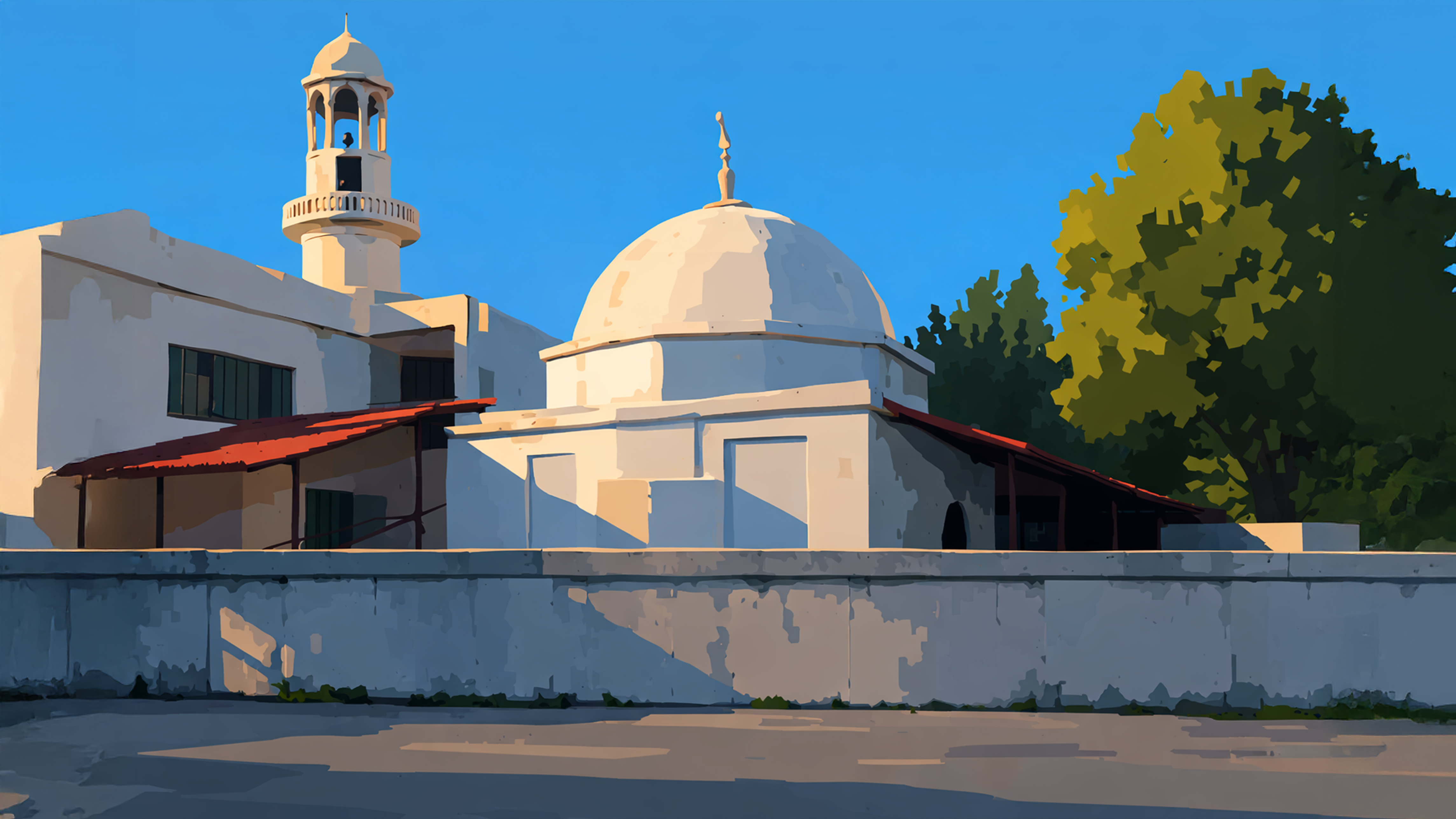
In times of war, the shrines took on an additional role; they became a gallery of memory, specifically the memory of war. In their corners and on their walls hung photographs of young men who had left for the front lines and never returned. Shortly before the fall of the Assad regime, pictures of him and his father, and to a lesser extent of Hassan Nasrallah, were widespread in most of the shrines, but they were removed very quickly after the fall, as if whoever removed them had foreseen the targeting of these shrines. The shrine of Sheikh Salim was attacked because of the photos and supposed support for the previous regime; inside still the green khulats, or cloths, remained hanging, untouched by the fire.
These strips of cloth, which visitors take and tie around their wrists as a religious and social tradition, were not consumed by the fire. According to popular belief, the cloth taken from the shrine offers protection. The green cloth strips remaining intact despite the intensity of the fire that consumed everything is viewed as a supernatural sign. A neighbour of Prince Salem’s shrine, teacher Muhammad Ismail (50), sees it as a symbol of steadfastness, life and eternity. “If the strips on the shrine haven’t been burnt, how can we be burnt?” he says in a calm, unemotional voice, reflecting his deep faith in the ability of these shrines to respond to such acts of desecration.
“We will rebuild the shrine and furnish it just as it was, and even better”, he continues. “The shrine’s dignity is our dignity, and the vandalism will not affect our relationship with the shrine because it is a relationship of spirit to spirit, not of body to body… And if the militants burned the Qur’an inside the shrine, we will place those burnt copies back inside so that future generations may see what these people did”. Maryam is doing precisely this now that she has returned home, by another route, recounting to every visitor what happened to her and how death did not come near her because “the Sheikh protected me and God loves me”.