
The Long Shadow of Alois Brunner was presented by the Maklouba collective at the latest D-Caf, or Downtown Contemporary Arts Festival, in Cairo last October, at the Jesuit Theatre. It is a political theatrical experience that delves into the body of the Syrian memory: how Nazism lives on in Damascus, not through ideological discourse, but within the structures of oppression inherited from the “school” of fugitive Nazi executioner Alois Brunner.
Brunner is not a passing historical figure, but an integral part of Syria. The man who fled to Damascus after the fall of Nazism and became an expert with the security services does not return to the stage in 2023 as a ‘criminal of the past’ (the show opened in 2023 at the Schaubühne Leipzig theatre as part of the European Stage Festival), but as a shadow that continues to operate today. A shadow that subjugates and legitimises, consuming survivors whose experiences remain open to pain.
But the irony is that Bruner only appears in the show as a powerful political presence through his absence. An absence the show describes as a ‘long shadow’ that transcends the biography of one man to a form of governance in Syria. The question posed by the work from the outset is: Who will judge the jailer? And have the survivors received justice commensurate with their memories and scars?
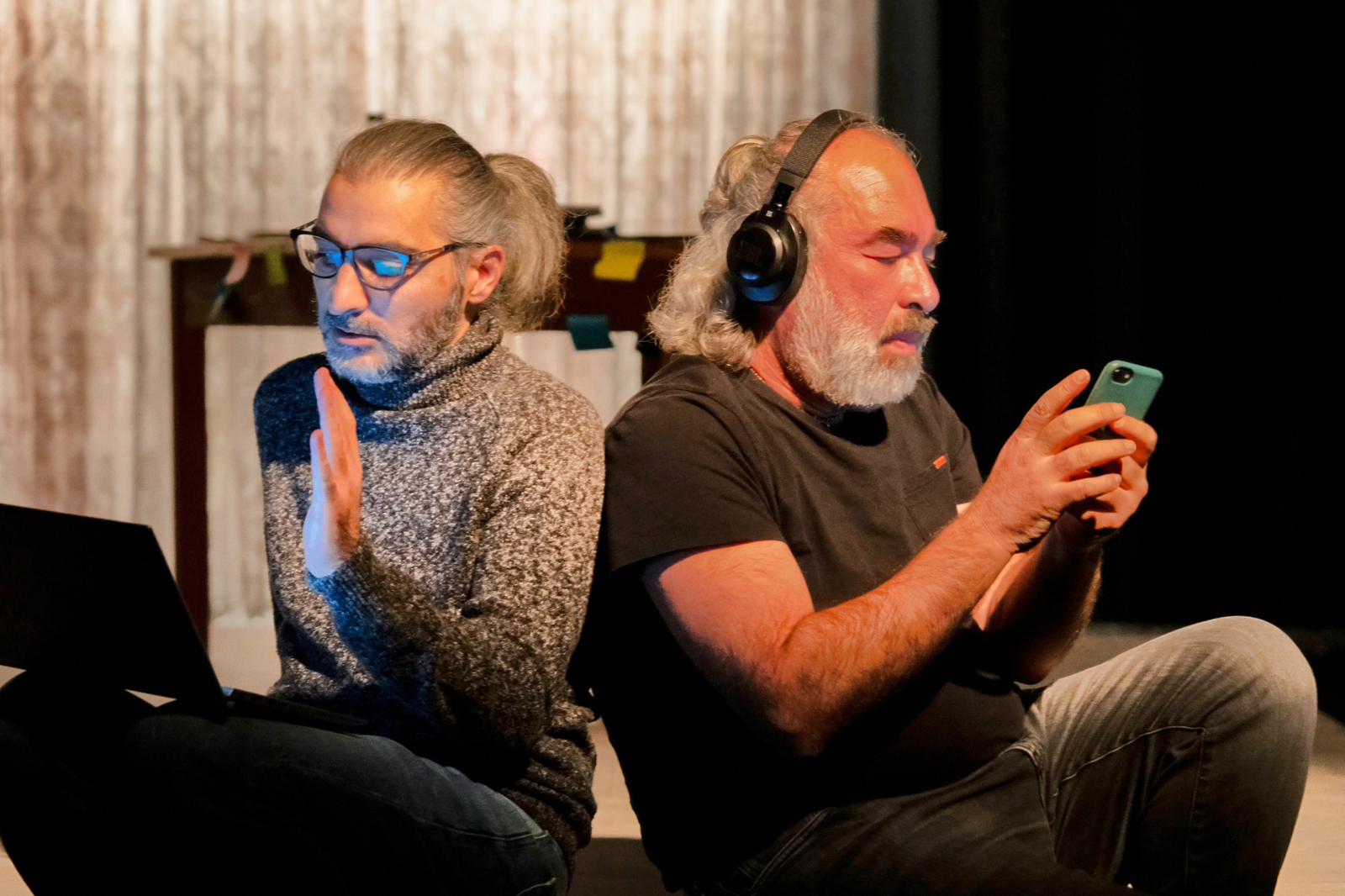
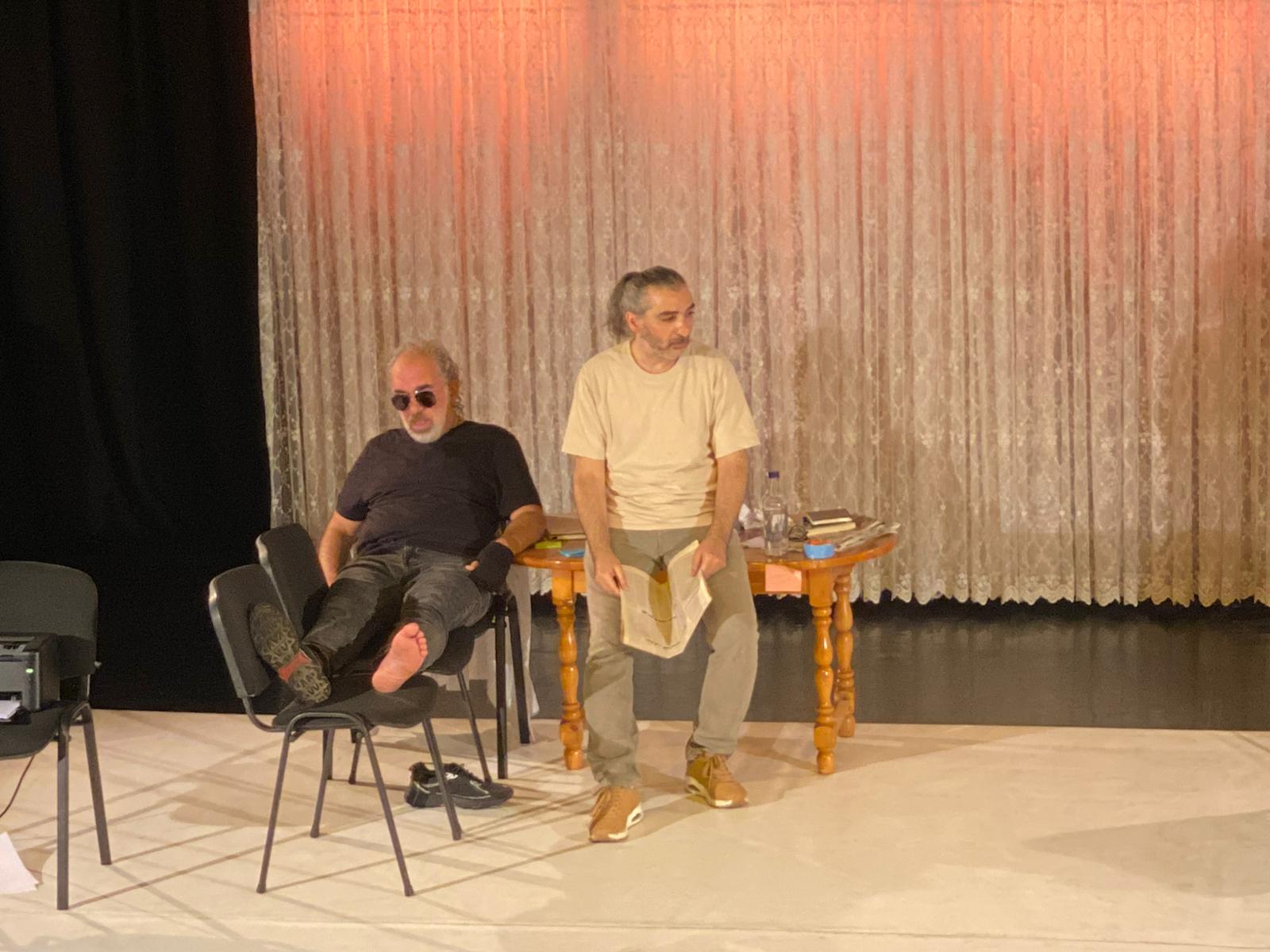
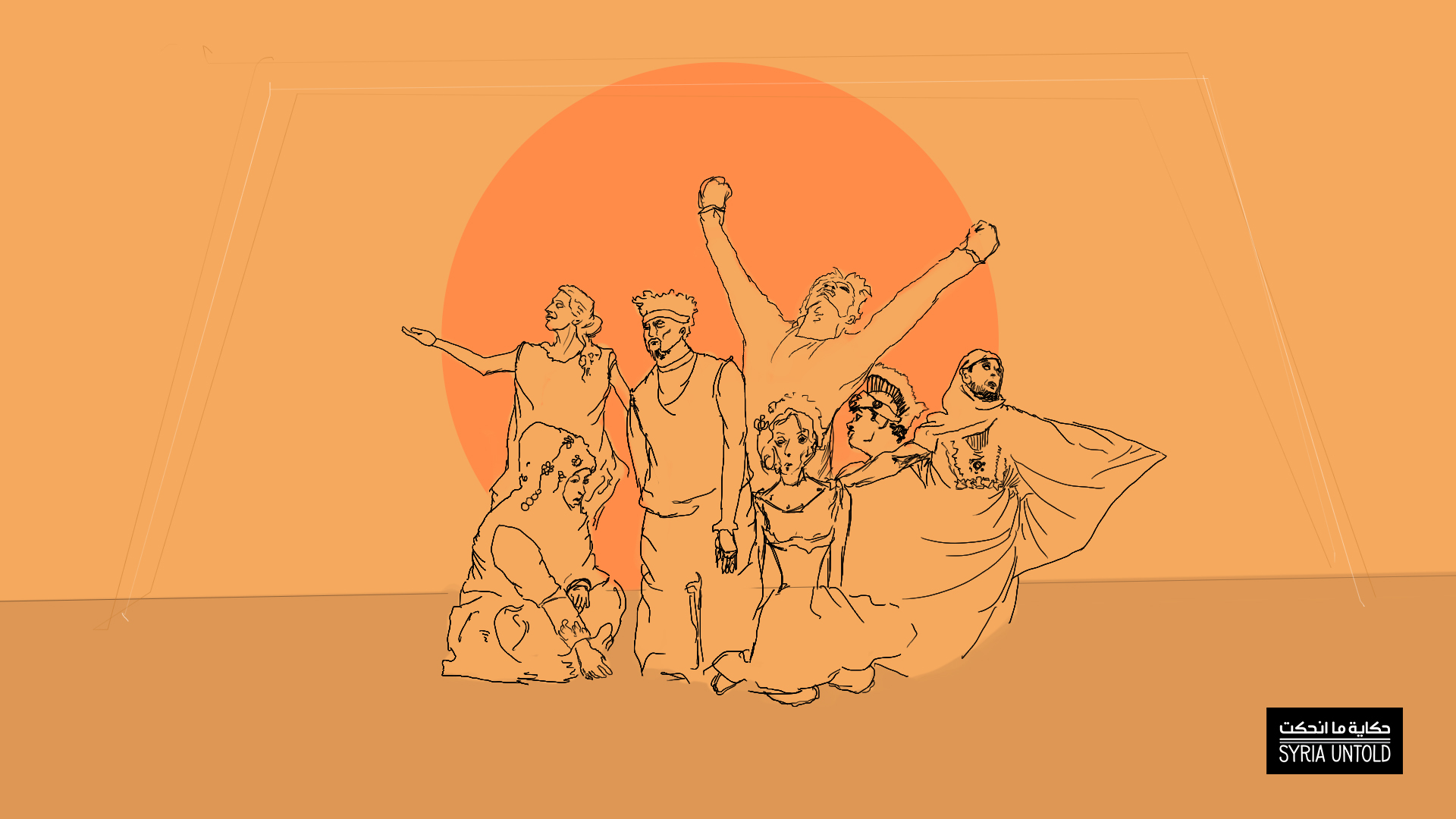
On stage, actors Mohammed Al-Rashi and Wael Qaddour do not embody fictional characters, but rather perform as theatre artists attempting to work on an unfinished script by writer Mudar Al-Hajji. The writer is absent, but his absence becomes a force that drives the play forward. As the show progresses, the work shifts from an attempt to write a play ‘about the past’ to a direct confrontation with a present that is not yet over.
Theatre in this case does not restore history, but rather reveals the mechanism of its burial and concealment. It does not create an evil character, but rather exposes the systems that have adopted evil as a policy of governance. In this sense, The Long Shadow of Alois Brunner is not a performance that recounts what happened, but rather one that reveals what is still happening.
Theatre about theatre: when research becomes performance
The Long Shadow of Alois Brunner tackles a complex aspect of contemporary theatre: theatre about theatre itself. The script, whose first draft was written by Madar Al-Hajji, is incomplete, and the writer is absent from the stage and out of sight, unable to finish writing the script. Mohammed Al-Rashi and Wael Qaddour confront this absence by trying to find written evidence on colourful scraps hidden by Madar. They try constructing and understanding the script, deconstructing it, and then reconstructing it before the audience's eyes.
The creative process - which usually takes place behind closed doors - is presented here as the subject of the performance itself. The question is not ‘How do we represent Brunner?’, but rather: How can Syrian violence be represented? Who has the right to speak? Who has the right to remain silent? Thus, the performance belongs to the heart of post-dramatic theatre traditions: the decentralisation of the ready-made text, meaning created moment by moment, and the actor as researcher, witness and mediator all at once.
This vision is reinforced by a multi-layered performance structure that breaks down the boundaries between representation and reality, so that three existential levels of the actor coexist on stage. First, the actor as a real identity, where Mohammed and Wael discuss rehearsals and the theatre industry, revealing their personal fragility to the audience. Second, the actor within the character, where the body becomes a vessel for memories that are not his own, but which he lays bare as he embodies the lines of the imagined story of Brunner. And third, the actor as a mediator for the absent writer, where at times they become the voice of Madar Al-Hajji himself, who continues to question history even when he is off stage.
This intertwined play does not aim to embody Brunner, but rather to reveal the methodology he left behind. The meaning does not lie in the absent character, but in the present system that has cast such a long shadow.
Lost Damascus: identity as an extended exile
In another illusion, The Long Shadow of Alois Brunner presents another image of Damascus: not only as a city of imprisonment, but also as a city of memory that the actors carried with them into exile. Through personal recollections of the time before 2011, the performance leaves the audience with fragments of the city they once inhabited: a café in Old Damascus, a street leading to the National Theatre, the Higher Institute of Dramatic Arts, the sounds of dawn prayers flowing from its minarets, and details of daily life before the moment of collapse. Here, memory becomes a document of resistance; the real Damascus is no longer accessible, but narrating it on stage becomes a way of keeping it alive.
This theatrical return to the city is not a simple nostalgia, but a troubling question of identity: does a Syrian remain Syrian when far from his country? And what does Syria mean when it becomes a place to which one cannot return?
The show poses an existential dilemma: the Syria we grew up in - the Syria of art, friendships, and the future - no longer exists. Syrians who left took with them another homeland, one torn between memory and reality, between love for the place and fear of returning to it, between a sense of belonging that refuses to die and a political entity that continues to expel its children.
Thus, Damascus' presence on stage becomes an archive of Syrian existence, a city that is no longer what it once was, and citizens who no longer know if their country still recognises them. It is a homeland that can only be restored through words—and through theatre, when wounds are transformed into narratives, and exile into a suspended identity.
Theatre as interrogation... and memory as incriminating evidence: performance, scenography, and rhythm
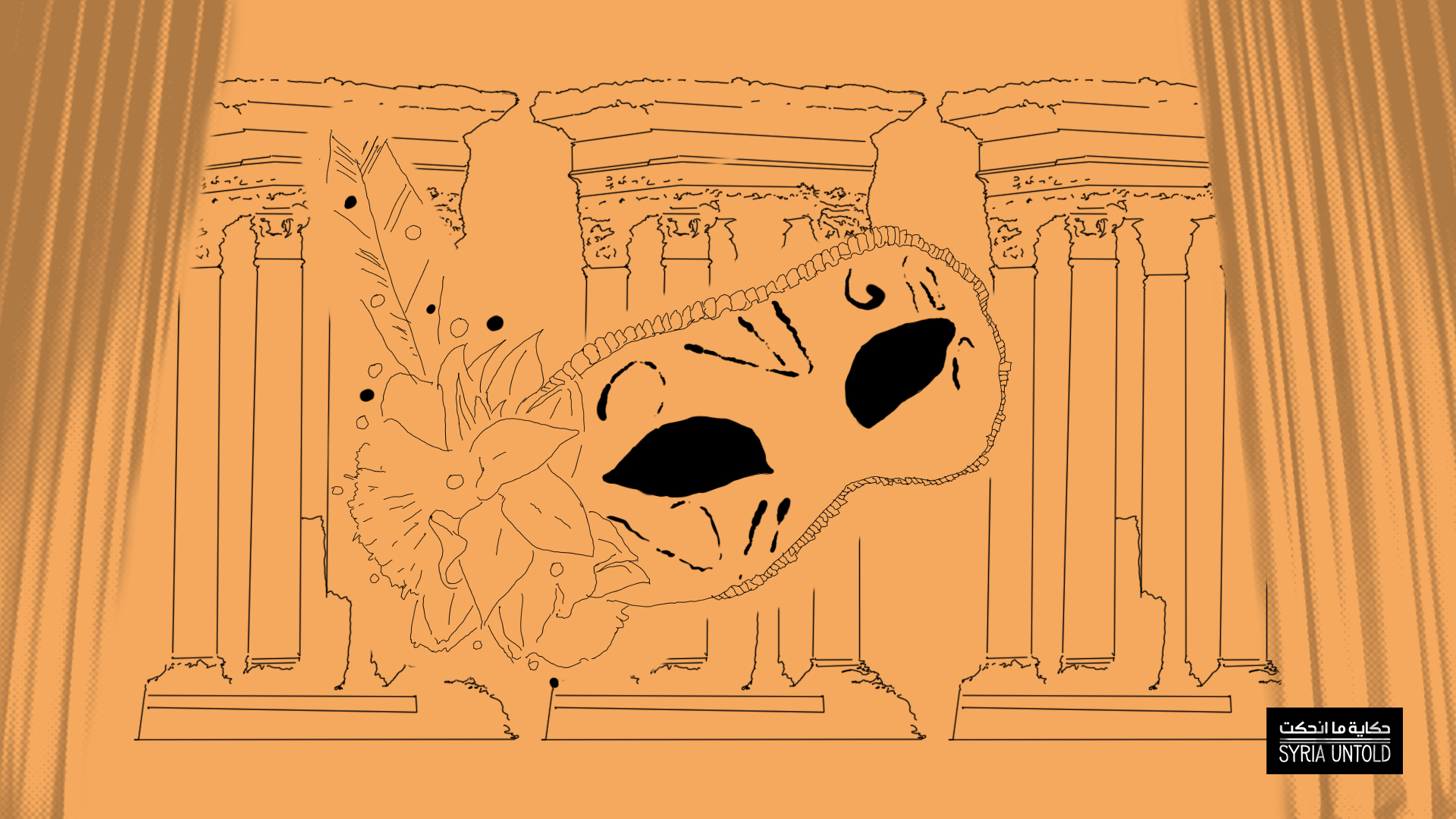
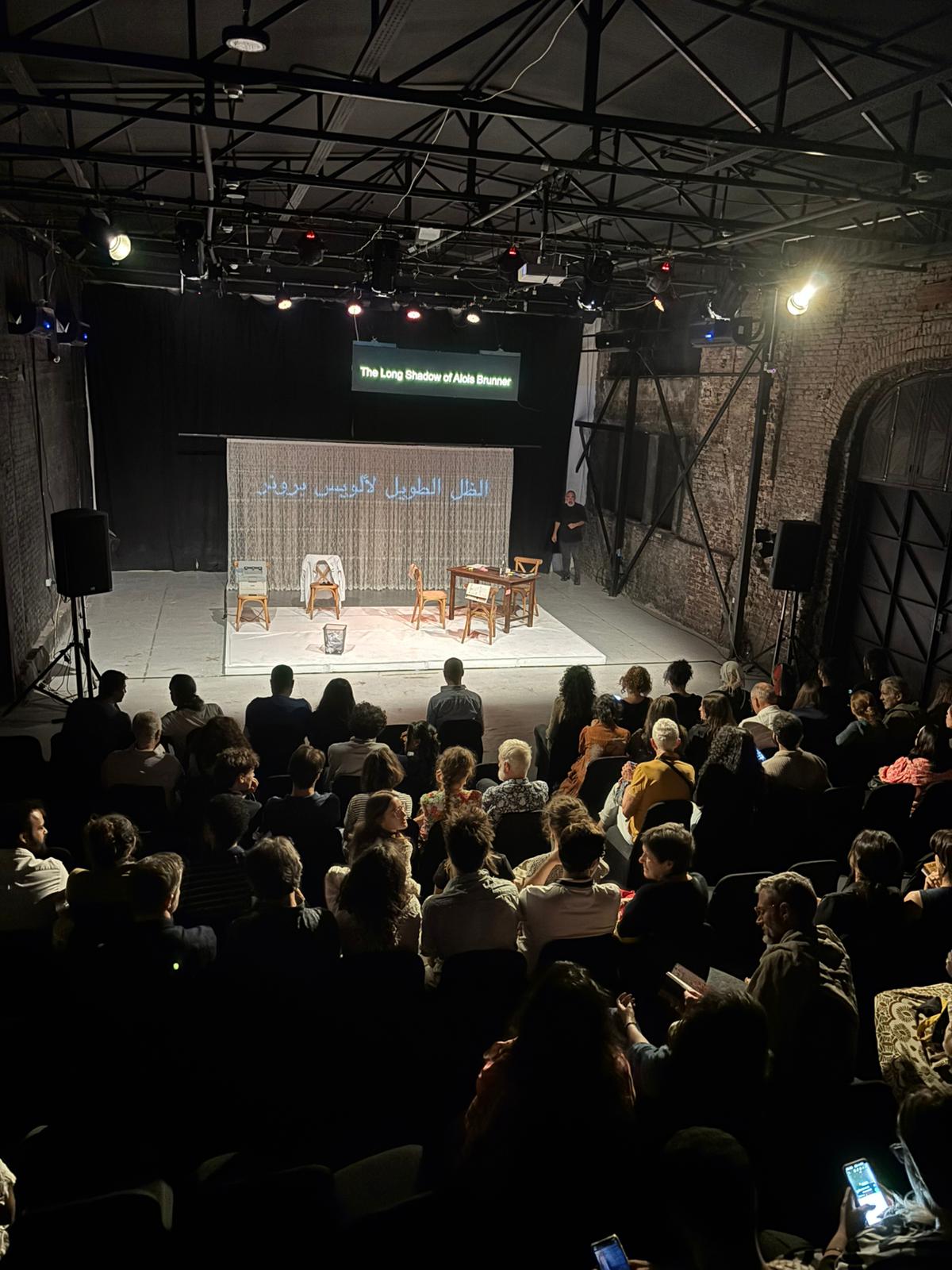
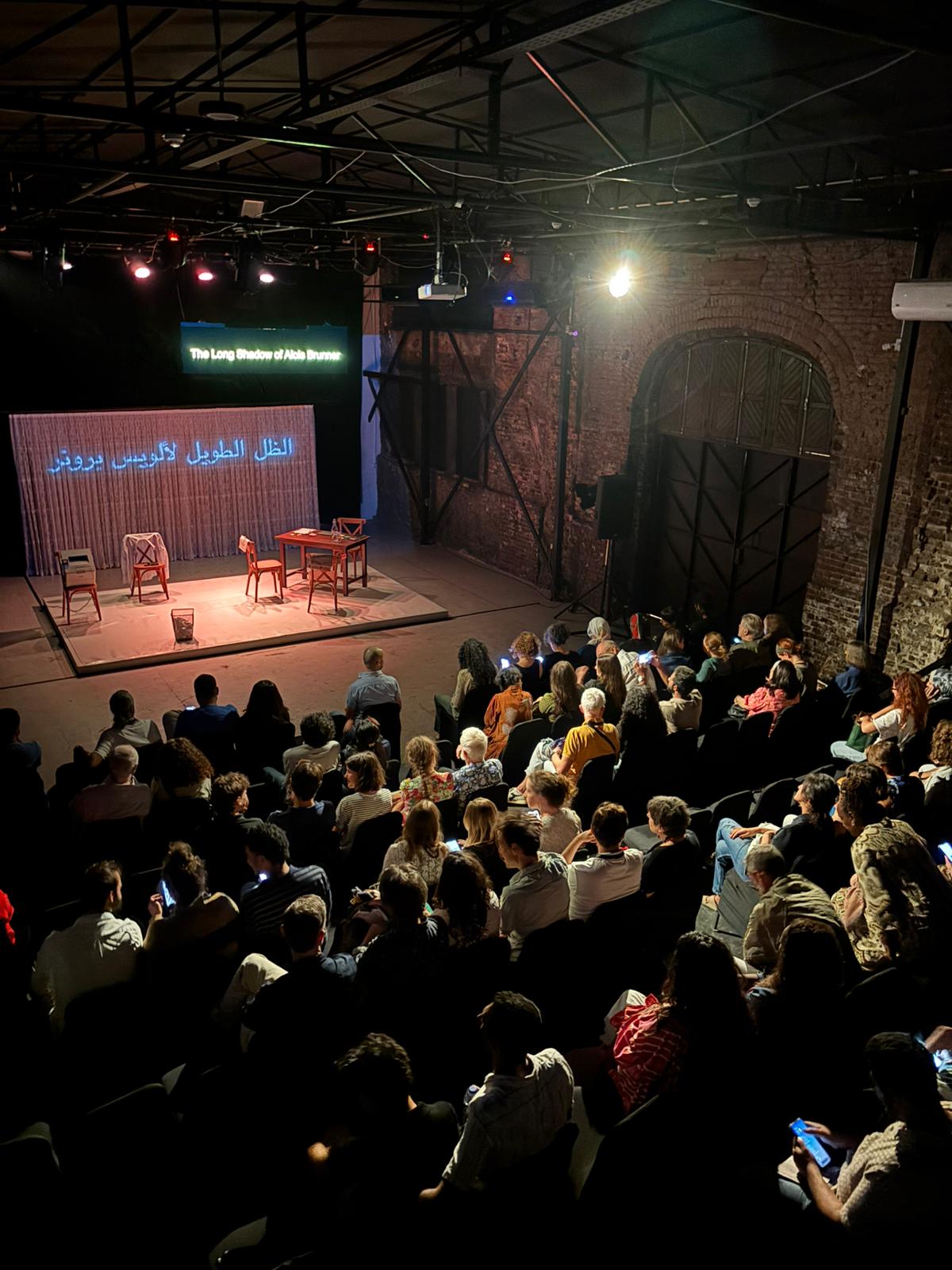
The Long Shadow of Alois Brunner crafts its theatrical language from a restricted set: a table, five chairs, papers scattered around the room, a printer, a wastebasket, and a backdrop curtain used as a projection screen, all placed on a low platform to define the space of the room, with two actors who appear to be in an interrogation room rather than on a stage, or the room where Mudar used to write. This reduction is not technical, but rather a theatrical choice; the scenography here is the ‘security apparatus’ itself, a cramped space resembling the basements of Damascus and its intelligence offices, where light does not reveal but rather haunts.
The lighting, with its sharp and smooth gradations, creates a constant atmosphere of surveillance. A spot of light precisely focused on the actor's face is enough to make the viewer feel that someone is interrogating this body, even as it speaks with great sincerity. The shadows are not a mere visual effect: they are the long shadows of Brunner that suffocate every scene.
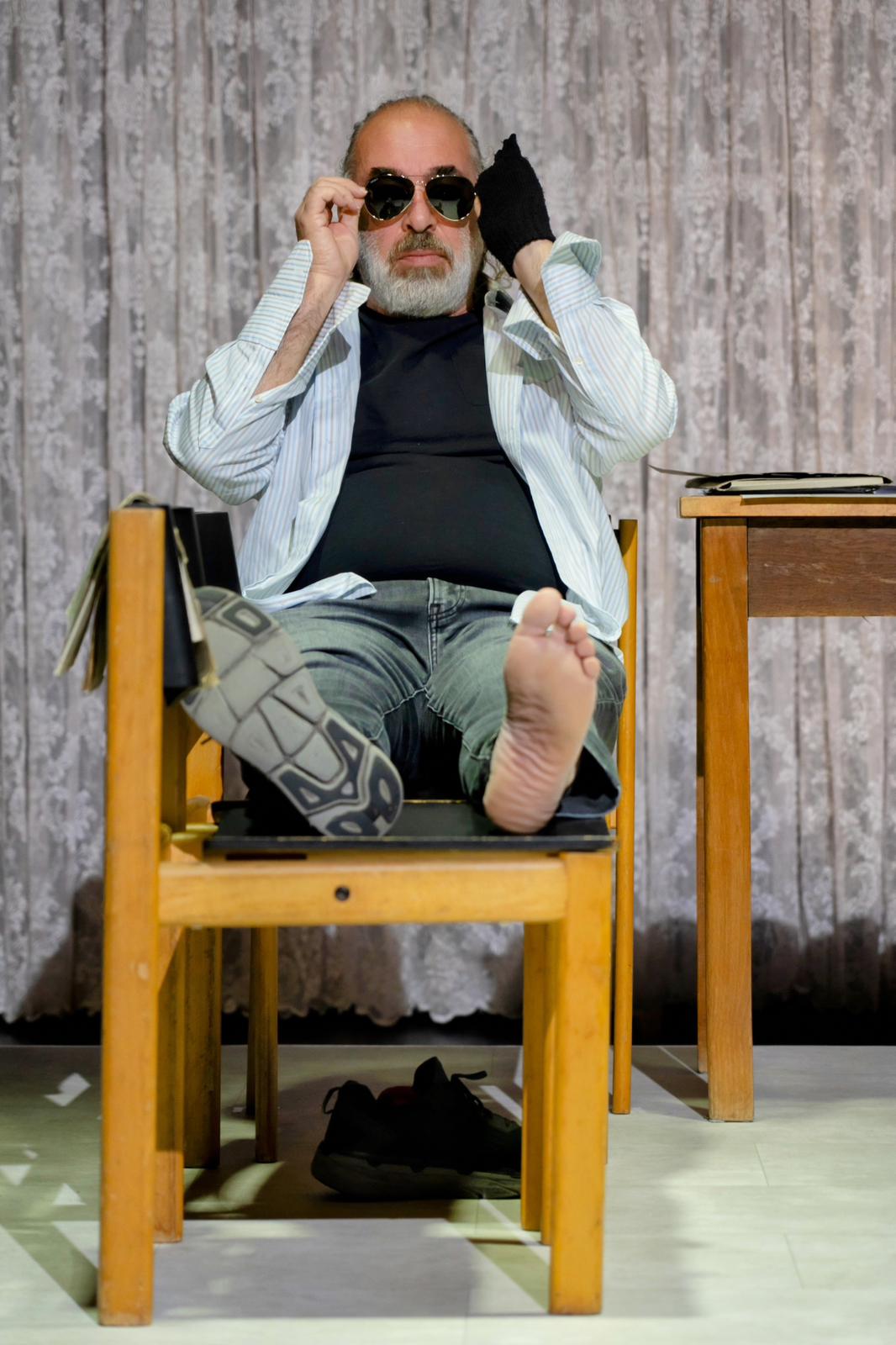
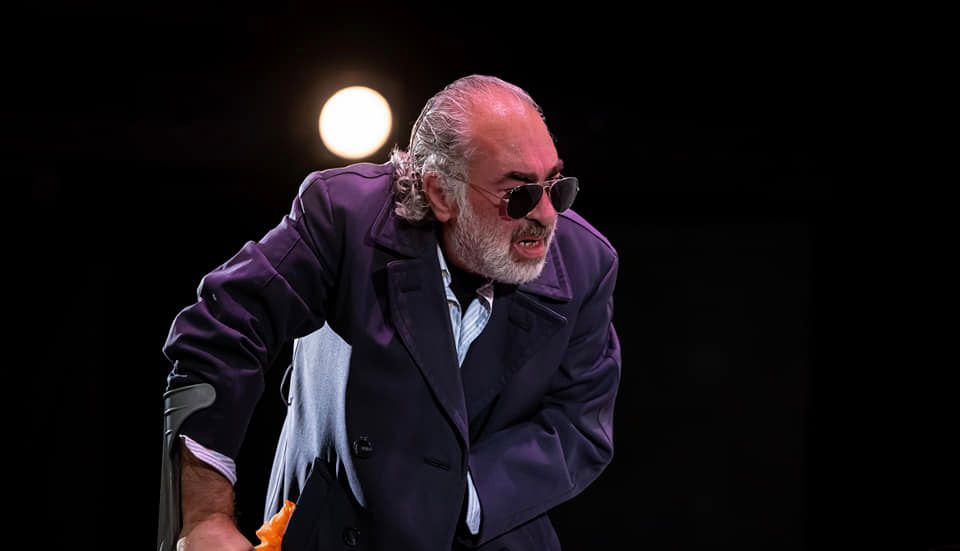
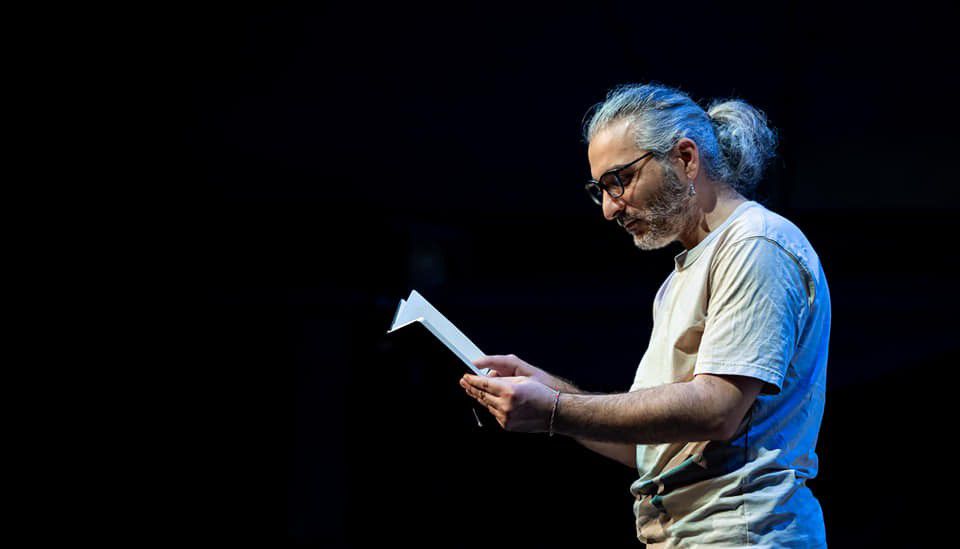
Mohammed Al-Rashi and Wael Qaddour do not play roles, but move between overlapping selves: the actor directly in front of us, the character trying to represent the trauma, and the victim or witness summoned from memory.
This slippage between layers of performance is remarkably smooth: a brief glance is enough to move from one level to another. The ability to listen, and the trembling of the body when a truth is mentioned, conveys sincerity that transcends acting and reaches the point of confession.
The rhythm is carefully thought out: the performance begins as a search for an absent text, then gradually escalates into a live confrontation with violence that cannot be acted out. The sudden breaks between scenes do not reflect a structural weakness, but rather mirror a traumatic memory: a memory that does not recount events in logical order, but rather throws us into the abyss without warning.
Even the backdrop, with names and a heavy archival apparatus, does not serve as a decorative background, but rather as a platform of accusation that pursues everyone, from Brunner to those who adopted his security legacy in Syria. It is as if the theatre here is attempting to rewrite the record, after the perpetrator remained outside the frame for decades.
This consistency between performance, space, light, and editing makes the show not only impressive to watch but also nerve wracking.
Conclusion as an act of resistance: testimony that does not allow oblivion to prevail
The Long Shadow of Alois Brunner reaches its climax when the conclusion splits into two parallel conclusions, preventing the story from being simply folded into a ‘theatrical ending.’ On screen, the names of Syrian political and security officials are displayed to demonstrate a direct extension of Brunner's legacy; a history that is still in progress, impossible to refine within the past. It is an ending that ‘reveals’ the truth rather than merely hinting at it.
But what happens next is even more radical: Mohammad Al-Rashi steps out of character and gives his personal testimony as a former detainee, as if we were witnessing another beginning to a performance that ended moments ago. Here we are not receiving a performance, but an imprint. The body becomes an indisputable document; a trembling voice, a sentence cut short for fear of completion, an involuntary bowing before a memory that does not allow the spine to stand upright. These are not technical elements, but scars presented as truth.
Here lies the cruel irony that the show presents us with: Brunner, the Nazi who sought refuge in Syria and was welcomed as an expert in building its security apparatus, became a shadow over all those who later sought refuge from that very same apparatus. Who remained from the ‘school,’ and who fled to Europe seeking asylum? The victims, like Muhammad, became refugees telling stories of a torturer who was himself a refugee in their homeland. What happened to Anwar Raslan, who interrogated Muhammad and then became the refugee on trial in Europe, reveals a reversal of roles: those who were once tried in basements became witnesses in courtrooms, and those who were once above the law became hunted by it.
With this parallel between the public naming of the torturer and the survivor's testimony, the show crafts a conclusion that cannot be closed. Justice has not yet been served... so the end is postponed. Brunner, physically absent, returns as an enduring political presence because his actions continue to have repercussions. The show borrows its moral logic from the judiciary: if the past is not judged, it will continue to judge the present. Thus, the conclusion becomes an act of resistance; resistance against forgetting, against embellishment, against submitting to the idea that time alone can heal wounds. Here, the wound remains in memory. Testimony is not a conclusion, but a postponed demand for justice.
Credits:
Writer: Mudar Al-Hajji, Director: Omar Al-Aryan, Actors: Wael Qaddour, Mohammed Al-Rashi, Dramaturgy and Research: Eric Altfurer, Design: Jonas Vogt, Sound and Music: Vincent Comar, International Producer: Eckhard Tiemann
About Maklouba Ensemble:
Founded in 2016, the Maklouba Collective brings together Syrian and international artists to create political theatre in Arabic. Based in Germany and working across Europe, productions explore issues of migration, asylum, and identity through daring theatrical experimentation.