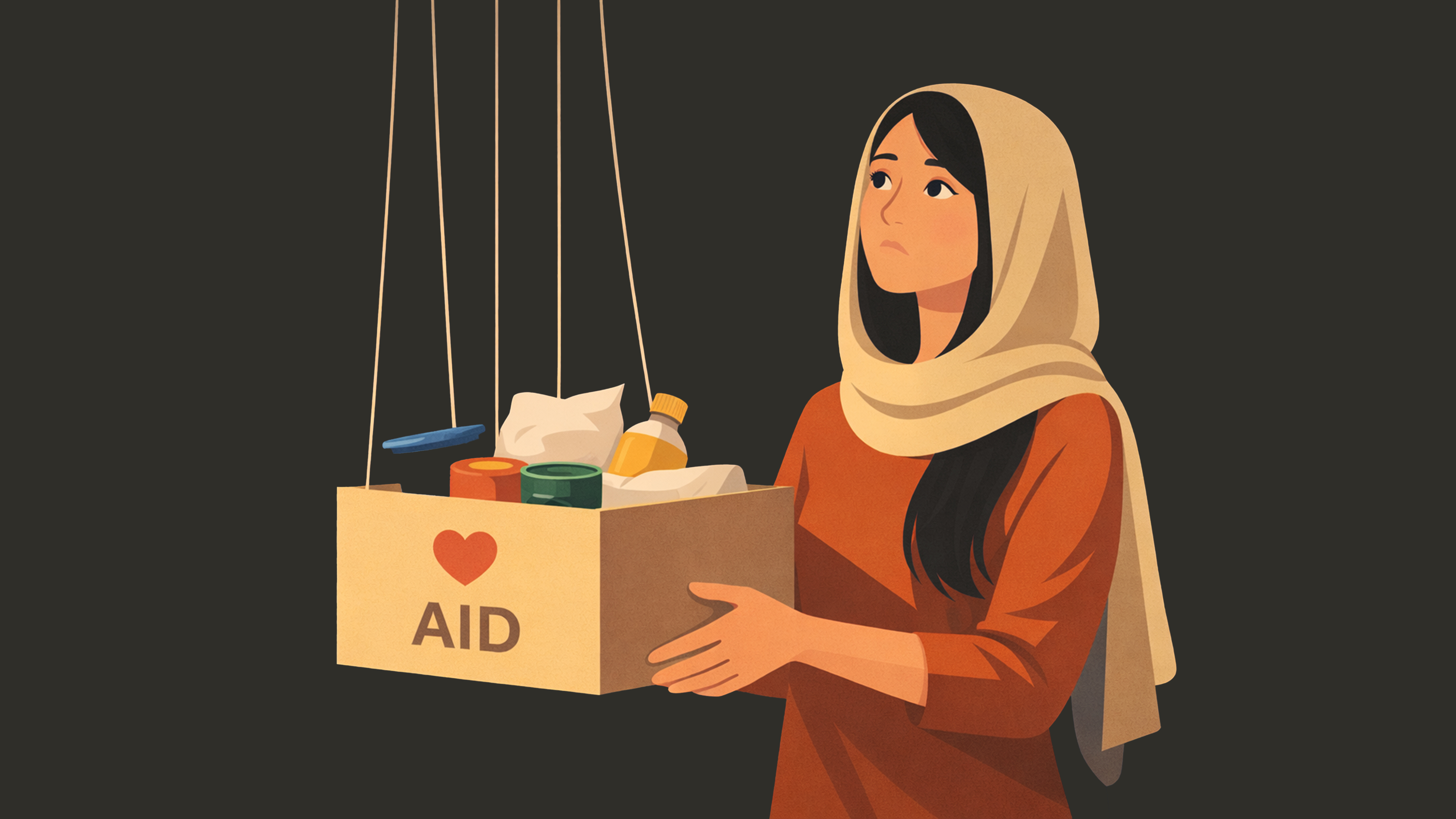

Gender and Corruption is a dossier monitoring the relationship between gender and various forms of corruption within the government and humanitarian sectors. Spanning the conflict years through the post-regime era, it chronicles the stories of women as victims, resistors, and at times, accomplices in corruption.
"Corruption, unfortunately, has become normalized as socially acceptable behavior in Syria. The corrupt official is seen as a 'facilitator' - someone who 'feeds himself and others' - and their beneficiaries are invested in keeping them in power. In exchange, this official turns a blind eye to the malpractice of their subordinates”. With these words, Safaa, 50, began her conversation with SyriaUntold, describing the inner workings of a government sector she has navigated for decades. Women, she explained, have been dragged into this 'quagmire', forced into complicity either to secure their jobs or to supplement their meager incomes. Those who resisted found themselves marginalized or dismissed.
Throughout her career, Safaa moved between several government agencies in Homs and Damascus, witnessing corrupt practices as prevalent among women as they were among men, varying by profession and job status. "For example, a debt office clerk's corruption might be limited to selling stamps to visitors at a higher price than their actual value”, Safaa says. “Although she doesn't earn huge sums, it is, in the end, one of the mechanisms of corruption". For Safaa, women tend toward 'petty corruption' because it is considered less risky than involvement in large-scale deals, a trend reinforced by the fact that high-level positions are often restricted to men. “These small sums are indeed bribery and corruption, but they do not excessively burden the public. The real problem lies in the large-scale bribes, like when the state discovered that 81 cars were distributed to members of the People’s Assembly who turned out to be deceased. They framed a low-level employee for it, while the truly corrupt individuals escaped unscathed”.
“Barrani” or no escape from bribery
At the beginning of her career, Randa witnessed corruption at the highest echelons of power, while lower-level positions remained strictly regulated, governed by professional commitment and oversight. A former employee at the Ministry of Economy, she describes the corruption of the Assad era as "sophisticated"; anyone seeking to bypass the law had to find a legal loophole, as regulations were clear: a law could only be repealed by another law, and a decree by another decree.
Even when conducting suspicious deals, maintaining a "legal cover" was mandatory. "When they wanted to remove me from the department I headed, they found no grounds related to my integrity, as required by law. Instead, they decided to dissolve the entire department. A director could only be dismissed for integrity issues or by abolishing their position - so they chose the latter". The true reason for Randa’s dismissal was her refusal to vote for Bashar al-Assad in the 2014 elections.

"Free speech is a mutual responsibility"
17 April 2026
Small-scale bribes were euphemistically termed "making ends meet" (tamshayet haal) and were viewed as essential for covering an employee’s basic cost of living. The term barrani - referring to "side income" or tips - became particularly widespread among civil servants who dealt directly with the public. Since citizens often paid fees or service charges, they would frequently leave behind small amounts as tips. Holding a position with access to this barrani became a coveted privilege that employees sought to maintain at all costs. Conversely, those who wished to avoid any suspicion of corruption tended to distance themselves from such roles.
This type of petty corruption became an entrenched mechanism to accelerate bureaucratic procedures. As Safaa, another woman working in the governmental sector as municipal employee in the Damascus countryside, observes: “Corruption is often driven by the public, who act as willing partners in entrenching these practices”.
Yet, she has observed a subtle gendered loophole. Because male employees are often more inclined to assist women, female applicants can sometimes bypass the bribery trap. Safaa is candid about her own tactics. She approaches official desks with elegant dress and a deliberate, 'excessive' politeness. It is a performance of social grace that officials mirror with kindness, allowing her documents to be processed—no bribe necessary.
Randa agrees with Safaa but offers a deeper analysis, drawing from her background as a leftist feminist who spent years researching women in the labor market. "There is a distinct difference in how women engage with corruption compared to men. Women are generally less receptive to bribes and more fearful of the consequences. They feel a heightened anxiety about being caught in the act of taking or giving a bribe. In our society, the imprisonment of a woman carries a lifelong stigma that would haunt her forever".
What drives women to reject bribery in a climate where it is practiced without shame, Randa concludes, is that women often possess a stronger moral compass; they strive to prove their worth in a workplace dominated by male competition and institutional hegemony.
Ghosts employees
Public sectors providing free services are not immune to nepotism and corruption, as shown by the experience of Sawsan, a nurse from Idlib who has worked in public hospitals for over 20 years. Speaking to SyriaUntold, she highlighted the regime’s deliberate neglect of the governorate, manifested in the shortage of equipment, lack of personnel, and the absence of effective oversight. These factors opened the floodgates for corruption, such as prioritizing patients with influential connections over those waiting their turn. Sawsan lacked the courage to openly protest these practices, yet they deeply troubled her and tarnished the humanitarian essence of her work. “Free medications” she recalls, “were only provided to those with connections or wasta within the hospital, rather than based on the patient's actual medical need”.
Both male and female employees participate in these violations alike, she asserts. Over time, Sawsan’s perspective on the concept of corruption has shifted; she once believed it only referred to large-scale theft, but she eventually realized it encompasses any exploitation of one’s position or workplace. "There was no clear or transparent recruitment system", the nurse adds. "This lack of transparency marginalizes true talent and prevents the existence of an accountability system for improper appointments".

The "Unregistered" in Syria
02 April 2026
In the process of selecting employees and filling vacancies, those who pay the most secure the job. Women, in particular, strive for appointments close to their homes. Shaza, who has worked in teaching since 2000, speaks with nostalgia about the enthusiasm she felt upon graduating from the Faculty of Education at Damascus University and starting her career in public education. She smiles sorrowfully as she recalls her grand dreams of contributing to raise a more conscious new generation, only to face frustrations from the very first moment.
"Hiring is about wasta, not grades", she asserts. “Connections secure prime local positions, while top-tier students without influence are either ignored or sent to the fringes”. Even worse is the 'attendance-only' culture, where employees sign in just to collect a paycheck. Lamia, a veteran of the state’s Radio and Television Authority, remembers a workforce of ghosts. Though thousands were on the books, few were ever seen. "Financial reports were full of strangers", she says, "Names that never matched the faces doing the actual work".
Lamia, a former program producer, says that, while women tended to justify their absences on the base of their commitments to family, childcare, or housework, men usually feel they don’t even need excuses, as they are often the primary salary providers for their families.
While the average salary for public sector employees on the eve of the regime's fall hovered around $20 per month, statements made by the Minister of Finance in the caretaker government, Mohammad Abazeid, in early 2025, revealed a staggering reality: only 900,000 employees were actually reporting to work, out of 1.3 million registered on the payroll. The Minister described in the same statement the 400,000 absent employees as "ghosts".
Fighting corruption
"If the confrontation is dangerous for men, what would it be like for women?" Sawsan explains that accusing women is far easier in a society that perceives them as vulnerable, and where family or tribal ties restrict their movement and limit their choices. For this reason, she never considered filing complaints or objections, despite all the rhetoric about ‘combating corruption’ and the existence of specialized authorities for that purpose.
"Anti-corruption oversight systems do exist, represented by oversight directorates, the Central Authority for Supervision and Inspection (CACI), and internal audit units within ministries” Safaa adds. “However, they do not take action unless a formal complaint is filed. Even then, if someone is arrested, they often walk free due to their connections. We know of a person who was jailed after being caught on camera conspiring with workers to steal scrap metal, yet he didn't spend more than a few days behind bars".
Shaza was occasionally forced to participate in "theatrical deceptions", asserting that the school’s condition was excellent and lacked for nothing whenever inspectors from the Directorate or the Ministry arrived during the era of the defunct regime. "If I hadn’t accepted that reality” she reflects, “it wouldn't have been easy for me as a woman to find another job, especially in our society, where alternative opportunities, like those available to men, are simply non-existent".
"Corrupt women are fought and publicly shamed far more harshly than their male counterparts. Randa cites several lawsuits filed against female lawyers involved in taking bribes related to detainees in the Counter-Terrorism Court, contrasting them with the fewer cases against male lawyers. “They are indeed criminals”, she explains, “but there is a prevailing sense that women lack protection, making it much easier to target and bring them down”.

Will the rain save us?
26 March 2026
Corruption in Syria is neither accidental nor a recent phenomenon; rather, it is the result of decades of systemic nepotism carried out in the name of the ruling authority and through proximity to its inner circles. Large-scale corruption was confined to high-ranking administrative officials and those overseeing public tenders. Safaa cites the case of a former governor of Rural Damascus, who maintained a private drawer filled with US dollars (at a time when possessing foreign currency was a criminal offense) and another for Syrian currency.
The British website The i Paper revealed that Assad and his relatives held £55 million (€66 million) in an HSBC account in London. Additionally, the Financial Times reported that the fugitive president transferred approximately $250 million to bank accounts in Russia between 2018 and 2019. Meanwhile, his wife, Asma al-Assad, provided a model for female participation in corruption and the illicit accumulation of wealth.
Safaa recalls a female director at a municipality whose corruption was so blatant it was said that “reehatha tala’at” (ريحتها طالعة)'her scent was out', a local expression for a public scandal that can not be ignored. Despite the stench of misconduct, she never faced a day in prison. She even maintained her post through the upheaval following the regime's collapse, shielded by connections in high places. Such patronage networks remain deeply embedded within the upper echelons of the administration, continuing their operations without interruption.
While Syrian men and women share the hope of halting the machinery of corruption that has consumed their country’s wealth, their efforts are stifled by economic hardships and accumulated administrative complexities. Randa laments. “Today, we are surprised by a lack of transparency and legal violations that reach the level of grand corruption. Yet, we only combat petty corruption because low-level employees are the weakest links in the chain. As long as we see grand corruption unfolding before our eyes, it remains difficult to maintain professional integrity and settle for crumbs under such dire conditions”.