 Light version
Inside a real estate office in the Al-Ziraa'a neighborhood, owner Hazem Hassan displays a copy of a property deed on the table in front of him. A client is opposite him, considering buying land in Slinfah, located 50 kilometers northeast of Latakia. The asking price for the property is $32 per five dunams (a dunam is 1,000 square meters). But the price is not the main concern for the client, an investor from Idlib. Instead, he is interested in the possibility of removing the joint ownership clause in the deed, the time and money involved in such a process, and the number of heirs involved in the ownership structure and their willingness to sell and transfer ownership. The office owner refused to provide further details for fear of competition for the same property from other buyers.
The real estate agent continues presenting offers to the client; a 24-dunum plot of land in the Al-Shaqifat area of Jableh, near the sea. Half of it is jointly owned (meaning two or more people own symbolic shares of the property, totalling 2,400 shares), and the other half is under adverse possession. He is asking $1.3 million, approximately $50 per square meter. Elsewhere in Latakia the prices can be higher. A 19-dunum plot of land in the southern Corniche area, the only remaining waterfront in Latakia, is listed on a specialized real estate website for single ownership at the astronomical price of $67 million. The price per square metre is $3,527.
City prices are up to 60 times higher than prices in the countryside. Geographical distance and increasing activity in the real estate market alone does not explain this price difference. The legal status of properties for sale does. There is a clear divide between common property, also known as possession (whereby ownership is obtained through long term contract investment, and transferred to private ownership, according to strict conditions specified by civil law), and individual ownership in a location of special value on a waterfront.
Several factors can contribute to price disparity, including investment demand, the prime location of certain properties, the importance of waterfront access and available infrastructure, and zoning regulations. The precise proportion of each factor in explaining this difference cannot be determined due to the accumulation of legal distortions in the country over decades. The legal characteristic most strongly associated with lower prices is shared ownership.
Do transfer costs in shared ownership depress mountain land values?
The plot of land offered for sale in Slinfah is classified as jointly owned. This term is defined by the Syrian Civil Code (Article 780 of Legislative Decree No. 84 of 1949) as follows: "If two or more people own a property without specifying their individual shares, they are considered joint owners, and their shares are presumed equal unless proven otherwise". This type of ownership enjoys strong legal protection when the property is registered in the permanent land registry (the green title deed), where registered rights are considered final and absolute and can only be challenged in cases of forgery, with the state fully guaranteeing the accuracy of the data. However, its drawback is the possibility of multiple partners sharing the same possession, i.e. the same plot of land.
The Syrian Civil Code stipulates that "no one is compelled to remain in joint ownership". If any partner (heir or buyer of a share) decides not to continue the partnership, the law grants them the right to request immediate partition, and the other partners have no right to object. As lawyer Roula Rajab from Jableh explains, "Joint ownership is widespread due to disputes among heirs, failure to transfer ownership, and errors in the land registry. These errors include discrepancies between names in the civil registry and the property deed, resulting from some documents relying on certificates from village headmen, for example, instead of the owners themselves, and from the property deed being written in a name commonly used by the public, rather than the one registered in the civil registry". The problem is exacerbated in areas north of Latakia, such as Qastal Ma'af, Salib al-Turkman, and Umm al-Tuyour, due to the presence of unregistered individuals (those without a civil registry record), the lawyer adds.
Likewise, there are areas where the demarcation and registration process for properties has not yet been completed, following topographic surveys. Regarding the rural areas of Jableh, for example, Roula explains, "The demarcation and registration process was completed in the areas of Daliya, Beit Aana, and its surroundings in 2009, and the lawsuits relating to the removal of joint ownership were concluded. However, in the coastal plain, such as the areas of Burjan and Kafr Debil (south of Jableh), there are problems with heirs based on joint ownership, the main reason for which is the unwillingness to pay the costs of transferring ownership, in addition to the problems of property division itself".
While the prevalence of this type of ownership varies across the Syrian coast, according to available indicators, the issue of shared ownership is particularly noticeable in the northern Latakia countryside, such as in the areas of Kirsana, Shabatliyah, and Qanjarah. "The inclusion of these properties under the umbrella of the urban plan, or its expansion, automatically means their prices will rise to astronomical figures due to their high tourism potential", says Samer Ibrahim, a former engineer with the Shabatliyah municipality, in a phone interview. Urban plans for towns and villages are typically revised every ten years and expanded to include new areas, so properties are left in their current shared ownership status. Samer added, "The anticipated expansion of urban plans may contribute to an increase in the expected value of some properties, which differs from the value associated with the existing legal status itself".
According to Roula, the rugged mountainous terrain makes expanding the holding impossible. "The mountainous nature and the narrowness of the plains have exacerbated the fragmentation of ownership, as dozens of heirs today share a few acres of land with very small common shares, making any attempt to invest in it practically impossible without the consent of all partners", she explained.
Who sells in the mountains? And who buys on the coast?
All these factors affect sales transactions and contribute to lowering land prices in the mountains. Qasim Ibrahim, a farmer from a village in the Banias countryside, tells SyriaUntold: "I inherited a three-dunum plot of land in the valley of the Joubar River (Banias River) from my father, but it's jointly owned by me, two brothers, and four cousins. We've been trying to sell it for years, but each time someone refuses, demands a higher price, or disappears to another province and doesn't deliver the notification. Although the land is far from the main roads, it's close enough to the river to build a cafe or rest area for anyone who wants to. In the end, I sold my share, a share of the property, for less than a thousand dollars. The buyer was a man from the area. He paid me in cash and asked me to go to a lawyer so I could relinquish my share. My son wanted to travel, and my daughters wanted to continue their studies. The land was useless to me. If the land were in the plain near the main road, we could have sold it for many times that amount, but the location and the joint ownership prevented all of that".
The problem of shared ownership extends to other situations, preventing purchases. Asaad, an employee from Aleppo who moved to Latakia several years ago, says: "I'm from the Aleppo countryside and a rural background, so I preferred to look for land to build a house on with a small farm around it. Land prices on the coast are cheaper, as everyone says, but the problems are more numerous. When I went to see several properties, I stipulated that the property be clear, meaning from a single owner, but this is rare, and those who know their property is clear in order to raise the price". After visits to real estate offices and promises from brokers, Asaad finally bought an apartment in the Sqoubin neighborhood of Latakia because it was privately owned and had a "green" title deed.
Qassem's case is not unique; many other landowners have sold their land at lower prices for reasons unrelated to shared ownership. In the Qadmus countryside, Muhammad Ghanem tells SyriaUntold he sold a ten-dunum plot of land on the main road because he saw it as an opportunity to earn some money after being dismissed from his public sector job. The 50-year-old former employee explains, "If I had considered investing in my land, I wouldn't have been able to get enough money for any project under the current circumstances. No one was willing to finance me, so I thought long and hard before deciding to sell and open a shop to support my family. What little money I have left will cover my daughter's travel expenses; she's currently in her fifth year of medical school".
These testimonies reveal another facet of the market: some new buyers are not always investors, but families looking for housing or farmland. Some buy in regulated areas, while others take risks in the mountains or on communal land. They constitute a significant segment of the market, and like investors, they try to pay less than the true value when the seller is desperate, or in market terms, when it's a "bargain".
Mechanisms of excretion: between law and reality
Despite the existence of a legal and administrative mechanism to remove common ownership in the Syrian countryside under Legislative Decree No. 166 of 1967, which allows the Ministry of Agriculture to issue periodic decisions to merge fragmented lands and redistribute them with a regular “green” title deed, the application of this mechanism on the coast (and in Syria in general) faces structural obstacles that make it slow and costly.
While official statistics accurately determine the percentage of shared ownership on the coast, available indicators paint a clear picture of the prevalence of this type of ownership in the region. Nidal Ibrahim, an employee at the Banias Finance Directorate, explained to SyriaUntold, "Currently, civil conciliation courts handle cases of dissolution of shared ownership, although we had specialized courts for this purpose several years ago. Shared ownership cases generally occur between areas within and outside the zoning and surveying boundaries of towns and villages, and they generally constitute a large percentage of the cases we deal with".
Nidal adds, "The administrative decision process for removing joint ownership takes a few months if all property owners agree to it, but this is related to the number of these owners and the property itself. There are many villages in the Banias countryside where joint ownership has been removed, but there are still villages that were not included in the real estate organization or places where sorting was difficult".
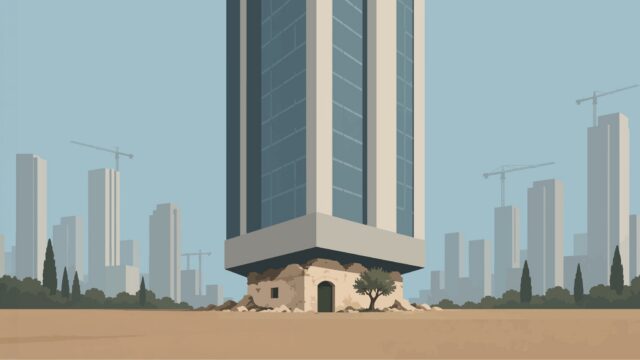
It’s a steal: first smart city is a super-deluxe war crime redux
17 September 2026
The biggest obstacle, according to the former employee, is 'establishing the litigation' in traditional lawsuits, which require naming every co-owner and heir as a party to the case. Along the coast - where many landowners are absent from their villages due to work, residence in other governorates, or personal disputes among relatives - serving legal notices becomes a protracted ordeal. Nidal confirms that lawsuits seeking to dissolve joint ownership have dragged on for years due to absent heirs and mounting legal fees, ultimately forcing many landowners to abandon the partitioning process or sell at a loss.
The lawsuits vary depending on the number of partners or heirs, and the matter differs from one property to another. The basic mechanism, as Nidal says, "is the consensual division between the partners, that is, an agreement outside of court. If that is not possible, the judicial division remains through a lawsuit to remove joint ownership. There is a legal distinction between division in kind: if the property is divisible without losing its value or benefit, the court actually divides it into separate parts, and each partner obtains an independent title deed, or division by sale (liquidation). If the property is not divisible, or if the division leads to a significant decrease in its value, the court orders it to be sold at public auction and the proceeds distributed among the partners according to their shares".
Nidal has over 20 years of experience in this area of law. He further explains that, “Even when the court decides to sell at public auction because the property cannot be physically divided, the owners face the problem of the official valuation, which may not reflect the true commercial value of the land, meaning a double loss: the loss of the land and the loss of its market value”.
In an interview with SyriaUntold, lawyer Roula Rajab attributed the continued communal ownership of land in the coastal mountains to the nature of inherited agricultural holdings, which sometimes amount to small plots of no more than 200 square meters. According to her, this means that "any attempt at real estate development in these areas runs up against a legal barrier that makes the subdivision process costly in terms of both money and time, which pushes foreign investors towards the organized lands in the coastal strip where individual ownership is readily available for immediate investment".
Despite the efforts of the General Directorate of Real Estate Affairs to automate records, which have so far covered approximately 996,000 properties nationwide, the completion of the digital real estate registry system remains a distant prospect. Efforts are still underway to archive around 24 million documents, with a storage capacity of nearly 47 terabytes, according to the Directorate's official website. The Directorate indicates that the identification and editing process has achieved a 99.61% completion rate, with work continuing on the remaining tasks. Currently, it is not possible to determine the percentage of shared ownership within this work, and even if this information were available, it would not alter the widespread nature and complexity of this issue.
Land owned by the state for 50 years without a project
In addition to the issue of shared ownership, there is another layer of complexity severely impacting the status of land on the Syrian coast: government expropriation decrees issued decades ago. These decrees originate from administrative and political decisions not directly related to inheritance or the fragmentation of land ownership, yet the impacts are similar to shared ownership, particularly in freezing the subdivision of properties. This has contributed to maintaining the status of many properties in shared ownership, pending settlements that have yet to materialize.
The issue of government expropriation along the coastline further complicates the legal status of land, particularly land adjacent to the sea, which is of significant investment potential. In 1975, Decree No. 2198 was issued, expropriating vast areas of citizens' land on the coast, specifically in the Latakia Governorate, under the pretext of public interest. This was followed by the Expropriation Law issued by Legislative Decree No. 20 of 1983, which effectively ended the remaining expropriations. Ayman Hamdo, a lawyer from Latakia, told SyriaUntold, "Nearly 50 years later, thousands of dunams of this land remain expropriated without any actual projects being implemented on them, depriving thousands of families of their livelihoods, rights, and the land they have inherited from generation to generation".
He gives an example: "The expropriation of the entire Umm al-Tuyur beach was carried out by forcibly seizing properties by the end of 2022, with compensation paid at the 1975 rate of 20,000 to 50,000 Syrian pounds per owner. This compensation was deposited in the Central Bank. At the exchange rate of that time, the amount was equivalent to 5,000 to 10,000 dollars". Other areas underwent the same experience, including Amrit in Tartus, al-Bassa in Latakia, and several coastal areas in Jableh, which were expropriated by the Ministries of Tourism and Defence.
This overlap between private property and areas designated for tourism or investment has frozen the subdivision of real estate and cemented its status as jointly owned, awaiting settlements that have not materialized for decades. Lawyer Ayman explains, "Many landowners have tried to reclaim their lost properties by exploiting a legal loophole in Syrian Expropriation Law No. (20) of 1983, which stipulates that if the expropriation compensation is not paid within five years of the expropriation decision, the decision is considered null and void, unless the project has been completed within this period. However, the state deposited the compensation funds into bank accounts". Lawsuits were filed to reclaim these rights, but the results, according to Ayman, have not yet met expectations.
The file of the frozen expropriation decrees (Decree 2198 of 1974 and Law 20 of 1983) remains suspended, in the absence of any official decision from the transitional government, except for the formation of committees to study the expropriation files in the Damascus countryside. There were initially promises to return the expropriated lands to former owners during the fall of the previous regime, promises that have not materialised.
While the people of the coastal strip are repeatedly calling for this file to be opened and for the lands that have not been used for public benefit to be returned to their owners, field reports document the ongoing suffering of the people of villages like Ibn Hani in the Latakia countryside for 50 years.
General discontent
The announcement of new investment and construction projects to be built on land subject to old expropriation decrees has sparked widespread protests and objections in several governorates. Samer Shaar, a schoolteacher and fisherman in his sixties who inherited three dunams of land from his father in the Ibn Hani area north of Latakia, which was expropriated several years ago by the Qatari company Al-Diyar, says: "Since the expropriation decree was issued in 1975, no project has been implemented on our land, and we have been prevented from building, expanding, or even renovating existing houses". The man, who was forced to sell two dunams of land he owned in another location at a low price to cover his children's school fees, adds: "We are trapped between an expropriation law that has ruined our lives and our need for work and land. I have five children who need work and money, and I have land that is useless". Samer now works fishing every day, waiting for the law to change.
Samer asks, "If the primary purpose of expropriation is to achieve public benefit (such as building schools, hospitals, or public roads), then why do we see the launch of massive real estate projects in partnership with foreign or local investors, such as the Abyat Hills and Sham View projects in the Qudssaya suburb of Damascus? Isn't converting people's land into luxury residential and commercial plots sold at exorbitant prices without granting us any rights an unjust dispossession of our property for the benefit of investment companies?" He points out that "the value of the compensation approved by the appraisal committees under the old laws, such as Expropriation Law No. 20 of 1983, has completely lost its purchasing power due to inflation and the economic collapse, as it was paid in Syrian pounds. So, if I wanted to buy an alternative property, would the amount I was given be equivalent to the price of a single block in these towers?"
Roula asks, "Why does the state grant broad powers to seize property without giving the owner the right to effective judicial appeal, especially since expropriation orders are often issued in a final and binding form?" Those affected by these expropriations had no option but to take to the streets. Various areas, such as Qudssaya, Muadamiyat al-Sham, al-Tall, and al-Layramoun in Aleppo, witnessed repeated protests where affected residents stopped excavators and bulldozers, demanding a halt to the land grabs and the resolution of legal disputes and property ownership claims on a case-by-case basis before any construction work begins.
In response, government agencies, particularly the Syrian Ministry of Public Works and Housing and the General Housing Establishment, are attempting to quell this discontent through various measures and justifications. A few days ago, the Ministry of Public Works issued a lengthy statement clarifying that the lands in question have been legally transferred to public ownership and registered in the names of public entities for decades, and that delays in project implementation do not invalidate the expropriation as long as the public benefit remains.
The Public Housing Corporation also announced plans to reopen applications for compensation for citizens who did not receive in-kind or housing compensation for their expropriated land. The Ministry announced the formation of joint offices with the governorates to receive documents and objections from landowners for legal review, emphasizing that "individual claims should not impede development projects aimed at addressing the significant housing shortage in the country".
While Damascus, its countryside and Aleppo, are witnessing escalating protest movements, the Syrian coast remains relatively untouched by these protests, for several reasons, perhaps the most prominent of which is that the expropriation issue on the coast is not yet linked to major investment projects that are actually being implemented on the ground, with the exception of some limited coastal projects. The residents are living in a state of waiting, amid promises of billions of dollars for tourism and real estate projects for which construction work has not even begun. However, with the arrival of major investment companies to the coast, and this coinciding with the existence of thousands of acres expropriated for decades without implementation, and with the continued freezing of lands in common ownership, the Damascus scenario may be repeated.