
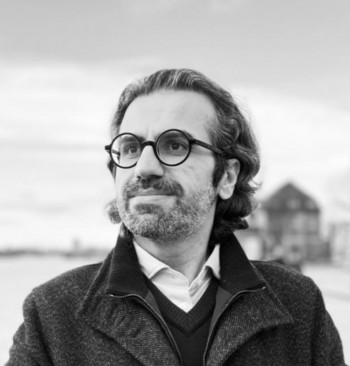
For our dossier on the first anniversary of the fall of the Assad regime in Syria, we interviewed writer, novelist, and cultural and community activist Samar Yazbek. After the fall of the regime, there were high hopes that it would be possible to avoid the inevitable sectarian clash. She talks about her return to Syria to contribute to civil peace before the setback and the shock of the massacres on the Syrian Coast (and later in Sweida), where her family and community lived. This was followed by more shock at the indifference and inaction of civil society organisations. Syrian victims are now only known as ‘Alawites’ or 'Druze' or ‘remnants’- as if the language of the dictatorship had not changed. This prompted her to continue advocating for victims and marginalised communities by organising (with other activists) what resembled an online demonstration entitled ‘Stop the abduction of Syrian women’, at a time when Syrian national identity seems to be facing a difficult test: it may not emerge alive, if it exists at all.
Samar Yazbek is a Syrian novelist, journalist and activist, born in Jableh in 1970. Yazbek is a prominent voice in support of human rights, especially women's rights. In 2012, she founded Women Now for Development, a non-governmental organisation based in France that aims to empower Syrian women economically and socially and to educate children. She has published many novels, including Cinnamon, Clay, The blue pen, and The wind adobe, and the reportage books In the crossfire, The crossing, and 19 Women: Tales of resilience from Syria. You can read more about her eventful career here.
(1) In Rania Stephan's documentary film In fields of words: A Conversation with Samar Yazbek, you talk about your loss of speech and your inability to write for a long time in the years following the Syrian regime's suppression of the peaceful revolution. Over time, you were able to recover and write again. As journalists, we read your long articles in the period following the fall of the regime, but then your articles became shorter, especially after the massacres in the Coast and Sweida. You also published a book entitled Your presence is a danger to your life: Voices from Gaza, which includes testimonies from victims from Gaza in Qatar to receive treatment. What about fiction writing? How were you in the first year after the fall of the regime?
At the height of the violence at the beginning of the Syrian revolution, with massacres and demonstrations, I saw with my own eyes how people were being killed. Questions arose in my mind, not only in a moral sense, but also in a technical sense: how can this violence be expressed? How can I understand what is happening? Literature does not answer questions, it generates them. We were in a state of shock. At the time, we thought it was the abyss, but later it became clear that the abyss was endless, as if we were in a world of darkness, a world of Ereshkigal. That is how I became truly speechless when it came to the novel. It was an expression of my inability to interact with the current situation in Syria, literally speaking. I began to explore the danger of speech and what it means to write about atrocities and tragedies. My writing actually decreased because the amount of violence was increasing, and I was documenting the massacres all the time. This was partly because I wanted to remain true to myself, as a person with multiple identities: a novelist, a writer, a journalist and someone involved in public affairs. This means not turning a blind eye to the suffering of others. This overlap of identities meant that I could not remain neutral, but at the same time, it killed the novelist in me for years.
This is where I began my project of memory, or the documentation of collective memory, a new form of narrative that later crystallised in projects such as In the crossfire, The crossing, and 19 Women: Tales of resilience from Syria, Your presence is a danger to your life: Voices from Gaza and two new reportage books currently in progress. Its organizing principle became clear: an attempt to understand what happened by going out into the field, talking to people, and getting them to talk. This became a major obsession for me, and the decline of literature was another form of exile, not in the geographical sense, but in the sense of exile from the self.
Later, I realised that what I was doing intersected with the project of the American writer bell hooks, which is personal-political, based on a theory that originated in the 1970s from a feminist perspective and was developed by hooks: she proposes that everything that surrounds our lives is political, but that the political is also aesthetic, as I see it. I personally focused on people's lives and documenting them through this system, and I embarked on what resembled a research process, as if I were an investigator.
Between 2014 and 2015, I fell ill and was unable to move for a period of time. Even my fieldwork became difficult, so I wrote a novel, my first after the revolution: Al-Mash'a (The blue pen) in 2016, followed by Maqam al-Rih (The wind adobe) in 2021, which is one of my favourite novels.
My enthusiasm was immense, and my excitement great, in the first year of the revolution, driven by our capacity for change. Those early months will remain my lost paradise, and so you will find that In the crossfire and The crossing were written in a novel style.
In 19 Women (published in 2017), Your presence is a danger to your life: Voices from Gaza (published in 2025), and the new book to be published later on the life of Sheikh Abdul Akram Al-Saqa, all these books were about people's lives and their personal memories, which I try to organise into a collective memory. I am part of it, the silent one behind the scenes who tries to understand the savage world through the lives of the heroes of my books!
(2) In the film, you also talk about ‘a pure coincidence that made us Syrians and witnesses to all this violence,’ and how ‘for the first time in my life, I fell in love with Syria’ after the outbreak of the revolution. Today, after the fall of the regime, how would you describe your relationship with Syria, and what does it mean to you?
There are constants in my relationship with Syria. I have not lost my Syrian national identity. Syria is where I come from, where I spent 40 years of my life before going into exile. My language, my family, my friends, my life's work, the opportunity to live with dignity among people I belong to, and who belong to me... Sometimes I wonder if I belong only to that human current, but somewhere, I think I am very Syrian and still am.
But I won't hide from you that my relationship with Syria is confusing right now. It seems to me like an open wound, and my hope that we will be able to restore it is dwindling day by day. I think many Syrians feel the same way. We are now in a very difficult, turbulent and critical moment, a moment of major global transformations, even in terms of concepts such as patriotism and nationalism.
(3) ‘I am obsessed with preserving memory to the point that I have become a graveyard’. This is a statement you made, collecting many testimonies from Syrian women and refugees during the years of the revolution, as we read in your books, in an attempt to preserve memory, but also to study the cycles of violence, to seek to dismantle evil, to examine the victims and the perpetrators, and to examine the responsibility of the system and of individuals. How do you view the violence and criminality that has occurred after the fall of the system? Are we dealing with isolated individuals, or cogs in a machine of oppression?
I always escape from my personal pain, and I do not wish to delve into it now. When the regime fell, I returned like many Syrians, with the intention of settling down. I observed how the violations began ten days after the fall, and how calls were made not to film the violations. I saw this as a call to kill, and a policy of incitement and random revenge was followed, instead of starting with a clear mechanism for implementing transitional justice.I documented the Hula massacre during the Assad era, and I returned and documented what happened to abducted women in Syria today. It was strange to follow and document the cases of two young women named Rawan, one during Assad's reign and the other during the transitional government, and find myself facing the same ‘system’ with one difference: kidnapping, rape and torture are now carried out on a sectarian basis and in a more brutal manner, whereas during Assad's reign they were politically motivated.
“Our struggle has been an unarmed, daily struggle”
27 March 2025
I documented how the new regime followed the same approach in dealing with victims, asking abducted women to appear on Syrian state television and repeat the same narrative, just as Bashar al-Assad's regime had done. It was the same mechanism, with the difference being the use of new digital technologies.
One could have dealt calmly with this transitional government if we had seen even a hint of good will on its part and if any criminals had been punished. However, its policy of impunity (for example, the Interior Ministry's statement that there have been no cases of women being kidnapped) and lack of accountability confirm to me that it is no different from the previous regime except in its choice of victims. In other words, you are not killed because you were with or against the previous regime, but because of your sectarian identity. Therefore, violence is linked to the system again, but perhaps the mechanisms are different.
The disappointments did not stop there. After the massacres on the Coast, I worked to document the stories of those who fled to Lebanon. I stayed for months following their stories of survival in northern Lebanon, and I saw these new victims, who were left alone on the streets, not even recognised as refugees, as I had done previously with Syrians in general in 2011. I asked civil society organisations linked to the revolution to support them, but was met with indifference and disregard, including from the organisation I had founded.
This indifference was a moral shock, tearing apart the last fabric that bound us together. I had never thought about the religious identity of the victims before! I did not expect that! The response was very weak, mostly from (former) opposition civil society organisations, even while the massacres were taking place. Women and children were fleeing to the forests in the mountains, and we couldn't even find milk and water to save them!
The transitional authority did nothing. I said from the beginning that they are different from us, but they are the de facto authority. They entered with an international arrangement and did not commit the massacres. Let's see what they will do. Our duty is to return and work with the people against the legacy of destruction left by the brutal dictator. Perhaps it was a naive political reading.
(4) During the Assad regime's massacres, against Ghouta for example, you predicted that we would never live normally again, that we would never be able to live a normal life, that the violence was so extreme that it would drive you mad... Do you think that Syrians really need a long time to get rid of the effects that the regime has left inside them?
When you observe the enormous divisions and rifts between Syrians, and the violent way they treated each other after the fall, with no apologies offered and no effort made by the other side to prevent the cycle of evil from repeating itself, you realise that we definitely need a long time to get rid of those effects. This has always been the case throughout human history, but now that it is being played out in public and in a direct manner, it is increasing and exacerbating the situation of violence and inciting it.
I see Bashar al-Assad's past crimes, and I predicted crimes in return after his fall, and I wrote about that in 2013. That is why I named my book The crossing and I said that Syria is open to nowhere land. But that did not stop me from saying, when it fell, let's see what this group that has come to power will do, even though we know their backgrounds.
Faced with this reality, one can start with oneself, not to remain silent about injustice and not to lose hope in defending the victims and raising their voices. Also, not to confront the evil that prevails now with its counterpart, and not to engage in the ongoing moral killing among Syrians since 2011, we can do a lot to get through this phase. We must bear in mind that we will never heal. I believe that by not perpetuating violence against others and not reproducing it in one way or another, and by helping others, we can neutralise this bloody period that is killing us all.
(5) In your text about the daily crimes committed against Alawites in Syria, you say, "The Syrians did not just overthrow the tyrant, they also overthrew the distorted image of themselves that had ruled them. When one group takes revenge on another, it is in fact taking revenge on its own oppressed self, which sees the other as a mirror of its weakness. The identification between the regime and the sect was not fate; it was a political construct painstakingly built by the Assad family over half a century, based on fear, hereditary succession and mutual collusion, until it became almost impossible to untangle the knot without tearing apart the entire social fabric". Did you have another scenario in mind for unravelling the knot you mentioned, despite its slim chances of success, before the massacres intensified in the spring of 2025?
I had no illusions that there would be no Alawite casualties after the fall of the regime. So when the ‘Deterrence of aggression’ forces entered the cities without massacres, I considered it a miracle and said, let's see what they will do now. I believe that the next phase will be one of frightening narrative conflicts between the defeated and the victorious. Instead of memory being an act of resistance for the sake of building the future, there will be conflicts similar to those that led to the collapse of Syrian national identity.
“We want to be part of Syria’s future”
19 March 2025
At first, I had what was perhaps an idealistic vision, which I call the right of intellectuals or the right of the country's children to dream of building their country. This is what I did in practice when I returned to the country after the fall of the regime and visited devastated areas such as Daraya and Jobar. I tried to build networks of civil peace between Idlib, Latakia, Tartus and Damascus. I visited villages and told people to turn over a new leaf. Contrary to rumours, the majority of Alawites were receptive to the new government at first. Nevertheless, I was not particularly surprised by the massacres on the Coast, as I am fully aware that sectarianism has been cultivated for nearly 55 years and will not disappear for decades, even after much work. But I am also fully aware that there is no real desire on the part of the transitional authority to work to limit it, based on what I have personally observed inside Syria, and what I continue to observe to this day. What is really happening is the destruction of what remains of Syrian national identity. That is why I was determined to keep the life of Sheikh Abdulkarim al-Saqqa, the enlightener, alive. I continued writing my book about him during this violence. I find him a role model for talking about moderate Islam in this bloody circus. I was influenced by his ideas and his non-violent and peaceful approach, and I learned a lot from his books and the lives of his students.
The authorities' insistence on denying the crimes committed and pursuing a policy of impunity, indiscipline and incitement has rendered all the projects that I and other Syrians returning to the country are thinking about futile.
(6) In a press interview about a year before the fall of the regime, you said, "The popular movement in various revolutions around the world is usually stronger than the movement of intellectuals. I do not hold intellectuals responsible before holding myself responsible. There were many intellectuals who stood with the revolution, but I expected there to be greater commitment beyond sectarian and class divisions". How do you feel now when you look back at their positions after the fall of the regime, especially with regard to the massacres that took place in the Coast and Sweida?
As I said before, I always hold myself responsible, which is the responsibility of every intellectual who is a wordsmith, because the evangelical role of the intellectual has fallen.
Before the fall of the regime, I was truly disappointed by many intellectuals, our friends with leftist backgrounds, who also belonged to minorities. Now I feel (mostly) deeply disappointed not only by the intellectuals of the majority, but also by my comrades in the ‘struggle’ with whom I worked for the past 15 years, within movements that produced feminist networks and relationships with activists, which made me feel enormously disappointed, not only because of their positions on the massacres in the Coast and Sweida and their unwillingness to see the violations, but also because of their defence of the regime, as if our mission was to eliminate the regime and bring in another.
After 15 years of massacres, and a year after the fall, with its rampant killings and massacres, there is a lack of awareness of the need to institutionalise a country where the law exists and people can exercise their rights through it. There is a reproduction of evil that must be discussed clearly and openly.
(7) In an article, you call for lessons to be learned from what Indian novelist Arundhati Roy wrote: “After a moment called ‘victory’, that moment when Syrians were left wondering who had actually won: the people or the language that reproduced the regime in new words and metaphors?” You warn of the danger of the revolution turning into a new myth - reproducing tyranny in symbolic form- and of revolutionary language becoming a discourse of exclusion when it monopolises the truth, before offering an amount of ‘advice’ to Syrian writers. What worries you, and makes you feel that we are going in the wrong direction in our cultural treatment of the dictatorial legacy of the past and our approach to the confusing moments of foundation?
I disagree with your description that we are living through confusing moments of foundation; these are moments of dismantling, perhaps, if the situation continues as it is.
In any case, many things worry me: the language we use with each other, our cultural and intellectual output, our relationships with each other as intellectuals, and our linguistic and intellectual laziness.
Major revolutions in history, such as the French and Bolshevik revolutions, have always reproduced the oppressive authorities they fought against, but they have nevertheless always achieved some gains. What really worries me about the Syrian situation is not only that we have not achieved any gains, but that we have regressed. I am concerned about our inability to produce a unifying cultural discourse that springs from the reality of the moment.
I do not want to criticise or lecture anyone, but rather to describe the facts. The language of revolution is now the language of dictatorship, which monopolises the whole truth, excludes others, attacks them, and even kills them morally and physically. To be honest, I feel as if I have returned to 2011.
(8) You consider that memory in literature is not a recollection, but rather an act of resistance against political oblivion. "In Syria, memory will not be merely an archive of suffering and massacres, but rather a new battleground for the legitimacy of power: who will be allowed to remember? Who will be forced to forget in the name of national reconciliation? Therefore, Syrian literature will have to transform itself from lamentation to resistance, from remembering the tragedy to exposing the mechanisms of its erasure”. Are you optimistic or sceptical about many people joining this cultural resistance after the moment of the ’victory of the revolution", which is now considered the end of history, after which all reasons for public action have fallen away?
I don't think the revolution has triumphed. Bashar al-Assad fled, yes, and I thought we would start the revolution after his escape, but I don't give myself the legitimacy to decide or give an absolute and definitive opinion on the form of cultural resistance. There is no cultural bloc that we can talk about clearly, or real knowledge of this cultural resistance, amid the fragmentation and turmoil we are experiencing.
I hope I am just being pessimistic, and that my expectations will be proven wrong, but I believe that the next phase will be one of frightening narrative conflicts between the defeated and the victorious. Instead of memory being an act of resistance for the sake of building the future, there will be conflicts similar to those that led to the collapse of Syrian national identity.
I attribute this to a lack of recognition of the other. Syrians do not read each other's cultural, artistic and intellectual works, given the violence and division that exists: first between those inside and outside the country, then between sectarian and nationalist identities, and finally between members of the supposed single, civil and democratic bloc.
I believe that intellectuals should strengthen their relationship with public affairs instead of turning away from them, using new tools, and insisting on the narrative of resistance through memory by searching for the truth, in accordance with the compass of justice, which does not lead us into a conflict of religious and sectarian narratives.
What did exile change in our narratives?
26 January 2021
I think we need time, perhaps years, for Syrian literature to pass through this phase. A different kind of literature may emerge, one in which these conflicts disappear in favour of the aesthetic value of literature and art, a literature that creates bonds of human and aesthetic empathy. The beauty of literature lies in this breadth and in opening a window for people to put themselves in someone else's shoes.
Therefore, returning to the topic of narratives, I found it difficult to distance myself from the quest for truth through my reportage books, while in literature I try to awaken metaphor, poetry and imagination, attempting to touch upon truth with precise and delicate tools, as imagination reproduces reality... Narrative is changing now with the change in human concepts as a whole after the digital revolution... We are facing open doors, not knowing what lies behind them.
(9) In addition to your journalistic and novelistic writing, you recently participated in a campaign calling for an end to the abduction of Syrian women, and your public activism has been well known since the outbreak of the revolution. How do you view community activism as a complement to resistance through literature, which is expected to achieve short-term results, compared to literary resistance?
I began following some cases of women being abducted in February 2025. Then I came across two incidents of women being abducted when I met refugees who had survived the massacres on the Coast in the Akkar Plain, even though I believed at the time that the perpetrators of the massacres did not target women.
Later, I realised that these deep wounds would not simply heal, but would have to be stopped, in the absence of transitional justice and a policy of impunity. I discussed with several groups what we could do. Given that we live in different places, I agreed with one of them to launch this campaign as an online demonstration, inviting everyone to join and record a video in support of it, to say that there are women who are being kidnapped and raped for sectarian reasons. Talking about the victims is the least we can do!
A group of volunteers are working day and night on the campaign, searching for the truth and saying that war crimes are being committed in the name of the revolution. Stop them for the sake of Syria's future. Kidnapping and rape are carried out on sectarian grounds, and the target group is mostly Alawite women. This is nothing new, as women's bodies have long been used as a tool of collective punishment and a symbol of control and humiliation of groups.
Everything the Assad regime has done over the past 55 years has been aimed at bringing us to this moment. When this regime protects criminals, covers up for them and denies their crimes, it is necessary to raise our voices and launch this online demonstration, which we have named the ‘Stop the Abduction of Syrian Women’ campaign.
I documented violations against women before Assad fled, and then documented them after his escape. There is a systematic process of repeatedly kidnapping and raping women, treating them as spoils of war. We have horrific testimonies that prompted us to start the campaign. We asked ourselves: How can we sleep while these crimes are happening, while girls are being violated and women are being kidnapped and raped in the name of the revolution?
My contribution in launching this initiative was a continuation of my previous role during the revolution. This is what I did when I founded the organisation Women Now in 2012. I visited Idlib repeatedly throughout the year to find out what women there needed. I travelled around the villages, firmly believing that our work must be with local groups and that we must break down the wall of fear and rebel against all forms of mainstream narratives. I lived among the people of rural Idlib, writing from the front lines and in hospitals, and we built cultural, educational and other projects. I founded Women Now in that leap year among those villages and among the people, and I remained there until 2013, when ISIS appeared and I was forced to leave due to incitement by sectarian intellectuals affiliated with the revolution.
(10) In light of the renewed horrific violence in Syria and Gaza, what keeps you getting out of bed every day, motivated to document, collect testimonies, and do public work? Have the events of the past year shaken your belief that it is still worthwhile? Or has it become a kind of painkiller, perhaps taken unconsciously to deal with feelings of helplessness and futility?
I set out to work on every book with the aim of giving victims a voice, ensuring that their pain is not ignored, providing an opportunity for human empathy, and completing my personal/political project through a collective memory based on human lives and working against the dogma and political slogans we have lived with all our lives. We are all powerless... Everything we do does not change reality much. However, we are faced with two choices: to do what we must, or to turn a blind eye and move on with our lives.
What makes me get out of bed every day is perhaps that hope for a better future for others, my sense of responsibility. I don't really think of any activity as a painkiller; I still believe in a little justice.
I care about individuals! The life of a single Palestinian means more to me than the slogans that have been said about Palestine for 70 years, and the life of a single Syrian means more to me than slogans of victory or defeat.
I feel that this is my only option. I live with my words, my projects and my books. My novel is my life and my existence, which I aspire to inhabit. I am currently exiled from it and trying to reclaim it, and I have no explanation for this.
I don't usually like to talk much and tend to work more. I like to disappear as a form of calm and systematic thinking, which is my way of working against the fluidity and vagueness of this time. But now I am talking to you, and I do not stop writing, because I feel the need to do so; because of the seriousness of speech and language, and also the seriousness of silence, which I find to be one of the expressions of language. I live in this sharp, contradictory and painful duality, which I call limbus! It is the essence of my life.
I am very cautious in this brutal moment we are living in, where no one wants to listen. I sometimes come out of my cave and speak, and I always write and take action as a form of resistance, which means, among other things, that we should not turn into predatory beings!