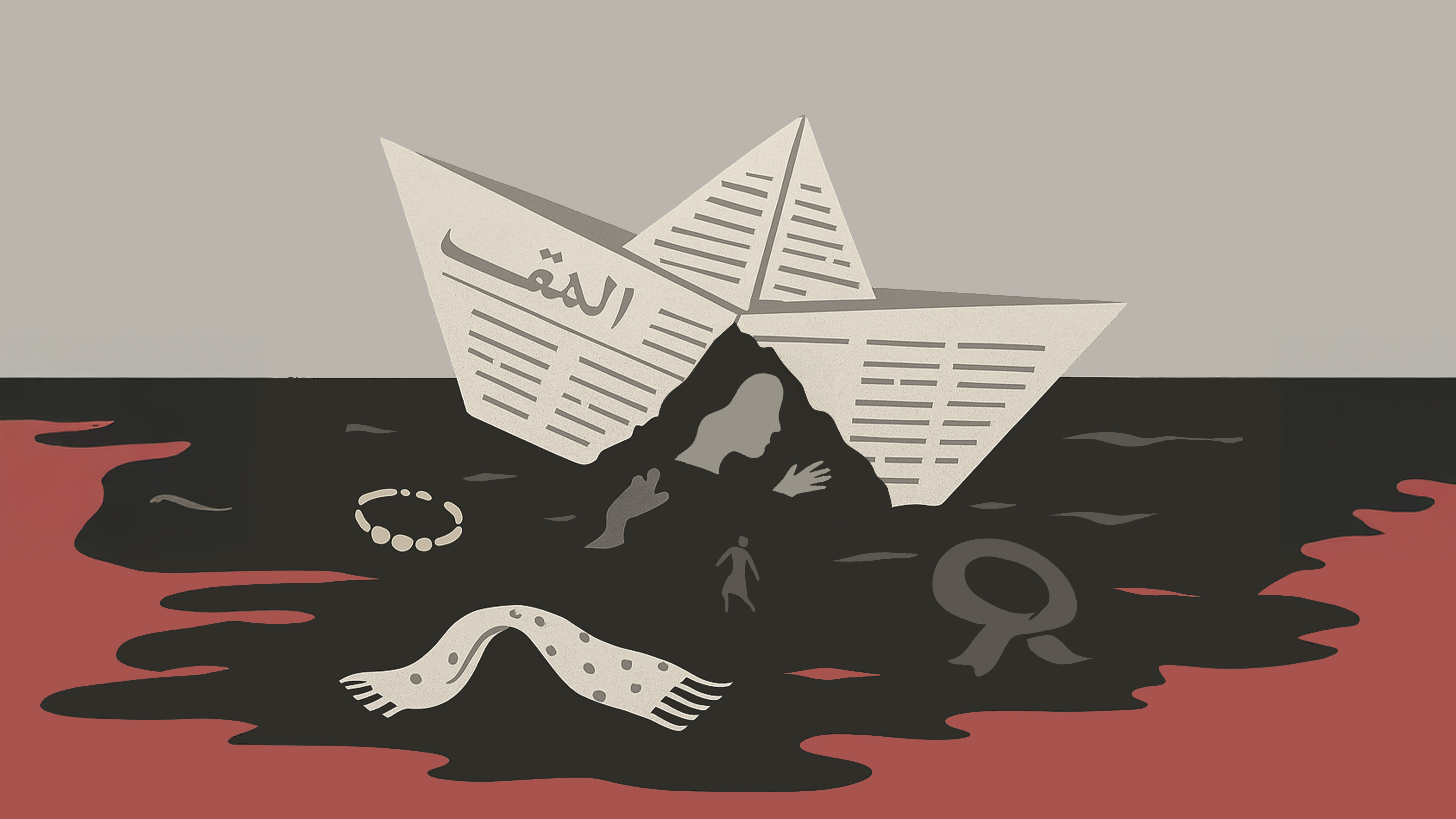
Syria has experienced one of the most significant shifts in global press freedom in recent years. According to Reporters Without Borders, the country rose from 177th place in 2025 to 141st out of 180 countries in 2026. This 36-place jump is the largest improvement worldwide this year and reflects the profound political rupture following the fall of Bashar al-Assad in December 2024.
The improvement spans several indicators, including reduced violence against journalists, the return of international media, and the re-entry of Syrian outlets that previously operated in exile. At the same time, Syria remains categorized by RSF as a country where the situation “freedom remains fragile”, underscoring how tenuous the situation is. Press freedom is expanding, but it is far from secured.
From state monopoly to fragmented media
Before 2011, Syrian media functioned as a centralized state system. Institutions such as the Syrian Arab News Agency (SANA), state television, and affiliated channels operated as extensions of the former regime and the cult surrounding the presidency. Journalism did not function as an independent field but as a communication arm of political power. This system relied not only on formal censorship but also on surveillance and direct intervention by intelligence services. Journalists learned how to anticipate restrictions before they were enforced, producing a culture of deeply internalized self-censorship.
The uprising in 2011 disrupted this top-down model. Media production became decentralized through citizen journalism, social media, and grassroots initiatives. Diaspora-based outlets such as Syria TV, Enab Baladi, Radio Rozana and Al-Jumhuriya emerged as key actors, verifying information, documenting violations, and building new professional standards. All of these media outlets had people working on ground in Syria and relied on their reporting and verifications of events inside the country. Other media outlets managed to operate mainly from inside Syria in areas outside regime-control such as Radio Fresh in Idlib and ARTA FM from Qamishli. Moreover, as the country became divided into pro-regime, Kurdish and rebel-held areas, the media came to operate within very different realities, catering to very different political contexts.
This political and media diversification produced fragmentation but also some examples of collaboration among media professionals as journalist unions and organizations emerged in the diaspora, aiming to foster a more independent media environment such as Syrian Female Journalists Network and Syrian Network for Media and Journalism. These initiatives would often cooperate with civil society organizations. Generally, social media platforms fostered polarized and siloed publics, while competing narratives emerged both between and within opposition groups. Media space became a contested field shaped by political affiliation, algorithms, and competing sources of authority.
After the fall: opening without guarantees
After the end of the al-Assad regime, the new authorities have pledged to support a free press and establish and uphold freedom of expression. More concretely, article 13 of the interim constitution from 2025 states that “the State guarantees freedom of opinion, expression, information, publication, and the press” (). However, even though this sounds reassuring, it is accompanied by article 23 that limits the same rights if needed to safeguard “public order”, “national unity”, and “public morality”. Wordings with disturbing similarities to well-known rhetoric from the past. Moreover, the bare fact that a Syrian Ministry of Information continues to exist is considered controversial. This institution has historically been an instrument of media control, and many Syrians question why it persists in a time that is hoped to be post-authoritarian. These developments exist without stable institutional foundations, making journalists and advocacy groups call for constitutional guarantees, including the right to access information. Thus, up until today, there has been no clear enforcement mechanism for press freedom, and protections of freedom of expression remain largely symbolic.
The lack of independent professional institutions is becoming acute. In February 2025, the transitional government dissolved the Syrian Journalists’ Union (SJU) and replaced it with a temporary council. This move was widely criticized as political interference and seen by many as a return to patterns associated with the previous regime. Alongside the Syrian Journalists Union, the Syrian Journalists Association (SJA) functioned outside Syria during the years of conflict and now maintains an active presence both inside and outside the country. However, the journalists we have talked to have not felt any significant support from any of these unions.
This void has left media legislation and regulation unchallenged in the hands of the authorities and thus weakening the legitimacy. Even though Syrian media actors have been discussing the drafting of a code of professional conduct, it was only the Ministry’s initiative to introduce guidelines for media behavior that led to actual action. In February 2026 the Ministry presented a new code of professional and ethical conduct for journalists and content creators. Officially aimed at strengthening media standards and safeguarding responsible freedom of expression, but criticized by media actors both for being the result of a closed top-down process without a genuine inclusion of relevant non-governmental stakeholders and for lacking independent mechanisms that oversee the implementation of the guidelines.
The criticism was sparked again in June 2026, when the Ministry circulated a video announcing, “six prohibited things” in media and publication. While several of the stipulations are recognized at large as necessary such as restrictions on incitement to violence, discrimination, hate speech, and violations of privacy, other restrictions such as on rumors that harm the national economy or on material that violate public morals have been widely criticized. Not least, for being framed in such broad terms that it leaves it up to the authorities how the restrictions should be interpreted and enforced.
Cabinet reshuffle and the politics of information
The fragility of the new government’s media policy became particularly visible when interim president Ahmad al-Sharaa carried out his first cabinet reshuffle on 10 May 2026. A central element of the ministerial reorganization was the appointment of Khaled Zaarour as the new minister of information, replacing Hamza al Mustafa.
The reshuffle took place amid growing public criticism of government performance and worsening economic conditions; however, Hamza al-Mustafa’s trajectory might also reflect a broader tendency. As former editor in chief of Syria TV, a diaspora-based outlet, his appointment in 2025 symbolized the incorporation of exile media actors into the state. Further, he is known to have close ties to Qatar, exemplified by his previous position at Syria TV, a media outlet owned by the Qatari media network Fadaat Media, chaired by Azmi Bishara. Khaled Zaarour, on the other hand, comes with an academic rather than media professional background and is considered closer to the Idlib inner circle. He holds a PhD in Islamic studies alongside degrees in the field of media studies.
Despite critical voices pointing out his limited qualifications, he was appointed Dean of the Faculty of Media at Damascus University in March 2025. The latest appointment to minister also sparked controversy including accusations of nepotism and worries that Zaarour represented a too conservative Islamic outlook. A journalist from Syria, who prefers not to be named, told us that he has little faith in the new minister and explained that “the shift is primarily to consolidate power close to the center of Ahmad al-Sharaa”. He sees the shuffle as a way to place religion more centrally in Syrian political life due to Zaarour’s background in religious studies. Another journalist we talked to stressed that Zaarour seems to be incompetent and that the shuffle was to increase the loyalty ties in the top of the leadership.
Thus, the removal of al-Mustafa points to the question of whether media actors (with strong Qatari ties) will have a place in the new Syrian media legal structures or if the power elite prefers to let closer allies in charge of media policy. More generally, it points to the question about how far from the inner circle political actors can be while holding powerful positions.
State media in transition
State media institutions are not disappearing but are reduced in number and are being reconfigured. Of the previous three state-ran newspapers only one, al-Thawra, remains just as Al-Ikhbariya was the only state tv- channel until the launch of al-Souriya TV in February 2026. The Syrian National News Agency, SANA, long associated with regime propaganda, was relaunched in August 2025 as part of a broader effort to reshape national media. However, in spite of promises of a more independent and critical style, the makeover remains superficial as SANA continues its previous uncritical reporting of politically sensitive topics. Rather the agency maintains state-loyal narratives emphasizing national unity and supporting political leadership. This has not least been visible during times of escalating conflict such as the massacres at the coast (March 2025), the deadly violence in the Sweida region (August 2025) and military clashes between SDF and the army around Aleppo (January 2026).
However, the lack of profound changes is not only a question about political will and ambitions, it is about the will and skills of the employees. 7,000–8,000 individuals are employed within state media institutions, including the ministry itself. Seen in relation to the limited number of state media outlets, over-employment is obvious. Nonetheless, it has been part of the new government’s strategy not to carry out large scale lay-offs, rather previous staff in senior or executive positions have been replaced by affiliates of the new political elite.
Thus, while official statements emphasize professionalism, modernization, and openness, continuity of previous patterns (and staff) remains visible in the actual media reporting and the function of media as a tool for shaping national identity persists. This raises broader concerns about whether state media reform represents a break with the past or a reconfiguration of existing structures.
One important change, though, is the entrance of Qatar-financed media into the Syrian media ecology. Most importantly Syria TV but also Al-Araby TV, Al-Modon newspaper, and al-Jazeera network’s social media-based channel, Syria Now (Suria al-Aan) have become popular media outlets with a strong financial backing. Based in Turkey, the former is by many almost considered to be the national TV station. Even though the direct link into the Ministry was weakened with the change of minister in May, Qatar’s influence in the current Syrian media landscape both financially and outlet-wise is undisputable and maybe the most profound structural change after 2024.
Rules on the ground: access, permits and restriction
One important change that the new government has introduced is to allow international journalists to once again report from Syria. Still, the opening is coming with bureaucratic procedures and other constraints. Journalists coming from abroad to work in Syria need to fill out an application in advance and await approval before arrival. The application includes providing personal and professional details, listing previous work and accounting for topics they plan to work on. If the application is approved the journalist will usually obtain a one-month permit yet sometimes the validity is shorter or in other ways restricted. If journalists want to renew their permits, they will have to leave Syria and repeat the application; a procedure that risks resulting in self-censorship. Not least because the red lines are unclear which could make journalists avoid reporting on sensitive topics so as not to lose their accreditation.
Also, for journalists working inside Syria, daily conditions remain highly untransparent. Permissions to work as a journalist are tied to the Ministry of Information and facilitated by personal connections. This creates unequal conditions. Journalists with strong networks or institutional backing face fewer barriers, while freelancers and independent reporters encounter greater restrictions.
At the same time, access on the ground is one of the most significant constraints. Regions such as the coastal areas in the northwest and around Sweida in the South remain difficult to enter and often require special permissions, which are inconsistently granted or enforced. Even journalists with permits are sometimes stopped at checkpoints or prevented from continuing their work.
Violence remains a risk. In July 2025 one journalist was killed while covering armed clashes near the southern Syrian city of Sweida and in February 2026 one journalist was murdered in his home. While no one has been held accountable for the killing, the journalist’s Alawi background and his critical coverage of the security situation in the country have nurtured speculations about the motive. The lack of an independent and transparent investigation of the killing has only strengthened the concern about the safety of journalists in Syria.
Invisible boundaries and self-censorship in a media landscape in flux
Despite the fact that there is more space for journalism than at any point in recent history, journalists operate within an environment shaped by uncertainty. The boundaries of acceptable reporting are rarely clearly defined yet widely sensed. This combined with the instances from the time of the al-Assad-rule and the (few) experiences from today with detentions of journalists, produce high levels of self-censorship. The journalists we have talked to tell us that they often navigate the field anticipating potential consequences rather than responding to explicit prohibitions. Furthermore, fear of potential changes of political red lines creates concerns over future consequences of current journalistic work.
Furthermore, coordinated online smear campaigns targeting journalists – not least female journalists – is used to silence critical voices. While this phenomenon is very different from previous types of censorship and suppression, the result is not that different. The online sphere is to a growing extent becoming an arena of deep fragmentation where dehumanization and sectarianism are flourishing and with little space for critical reflection within the particular echo-champers. Women, religious minorities and critics of Ahmed al-Sharaa are particularly vulnerable to online attacks and hate speech.
Syria’s rise in the RSF ranking reflects real and important change. Criticism of the authorities has become more visible and a much livelier and more inclusive debate is now possible. However, while criticism is more visible, it is unevenly distributed. Journalists with strong public platforms are better able to speak out, while others remain constrained by structural and political pressures. Structural constraints persist. Access remains restricted, legal protections are weak, institutional control continues, and journalists still face risks. The result is a paradoxical situation in which media space has opened, but without structural underpinning or political investment.
This raises a central question for Syria’s transition: how much critique is possible, and for whom.