
I saw you, Jafleh, out on the threshing floor,
Your cheeks, oh my eyes, like the radiant sun.
I asked you, my daughter, why is your hair uncovered?
She said: I am flushed with heat, seeking the breeze
(Tartus) Hajar Hassan, 75, chants these verses from the village of Hammam Wasel, in the Qadmus region of the Syrian coast. "The work was grueling", she says. "Our backs would arch and our hands would ache from cutting the clusters, but the singing eased the burden. We sang to forget the pain in our spines; we sang to make the day feel shorter. The voice would outpace the hand, and laughter moved in time with the knife".
As she harvests grapes from the mother-vine, a ritual repeated every year and inherited across generations, her daughter, Lama al-Mohammad, 45, works alongside her. Lama has shared in these rituals since childhood, through her youth, and into the present day.
“I grew up with these seasons”, Lama tells SyriaUntold. “As a child, I would follow my mother through the vineyards, carrying small baskets and listening to the mawwals before I could even understand the lyrics. As I got older, I began to harvest just like her, and I learned that the day has its songs, and the night has its own”.
She explains that “at night, when the Arak distillation (takreek) begins, we would gather for the evening sahras. Grills were lit, and the aroma of meat mingled with the scent of anise as the Arak glasses circled among the guests. There, the singing changes; it becomes slower, drifting toward Zajal and a deep, soulful yearning”. She then chants a fragment of what echoed through those gatherings.
Your eyes have drenched us in love, drenched us,
Your cheeks: I’ve seen no rose like them, so lush.
They said the driving force that held us,
Would fall silent, if her lashes struck like spears.
Oh my people, oh my kin...
Li li li yaba
Lama adds that these songs served as a bridge between labor and the night: between the grapes harvested under the sun and the Arak distilled by the fire. It was as if the voice itself traveled from the vineyard to the karka. "The day is for toil, and the night is for storytelling", she says. “A story that begins in the fields and does not end at the distillery”.
Once harvested, the grapes are crushed and placed in "large vats to ferment naturally for days or weeks" before they are ready for the takreek (distillation) process. This is explained by 50-year-old Mahmoud Barhoum, who spoke to SyriaUntold about the craft he mastered from his ancestors decades ago.

About Mila, who was killed but did not die, and Mira, who was not killed but did die
26 March 2025
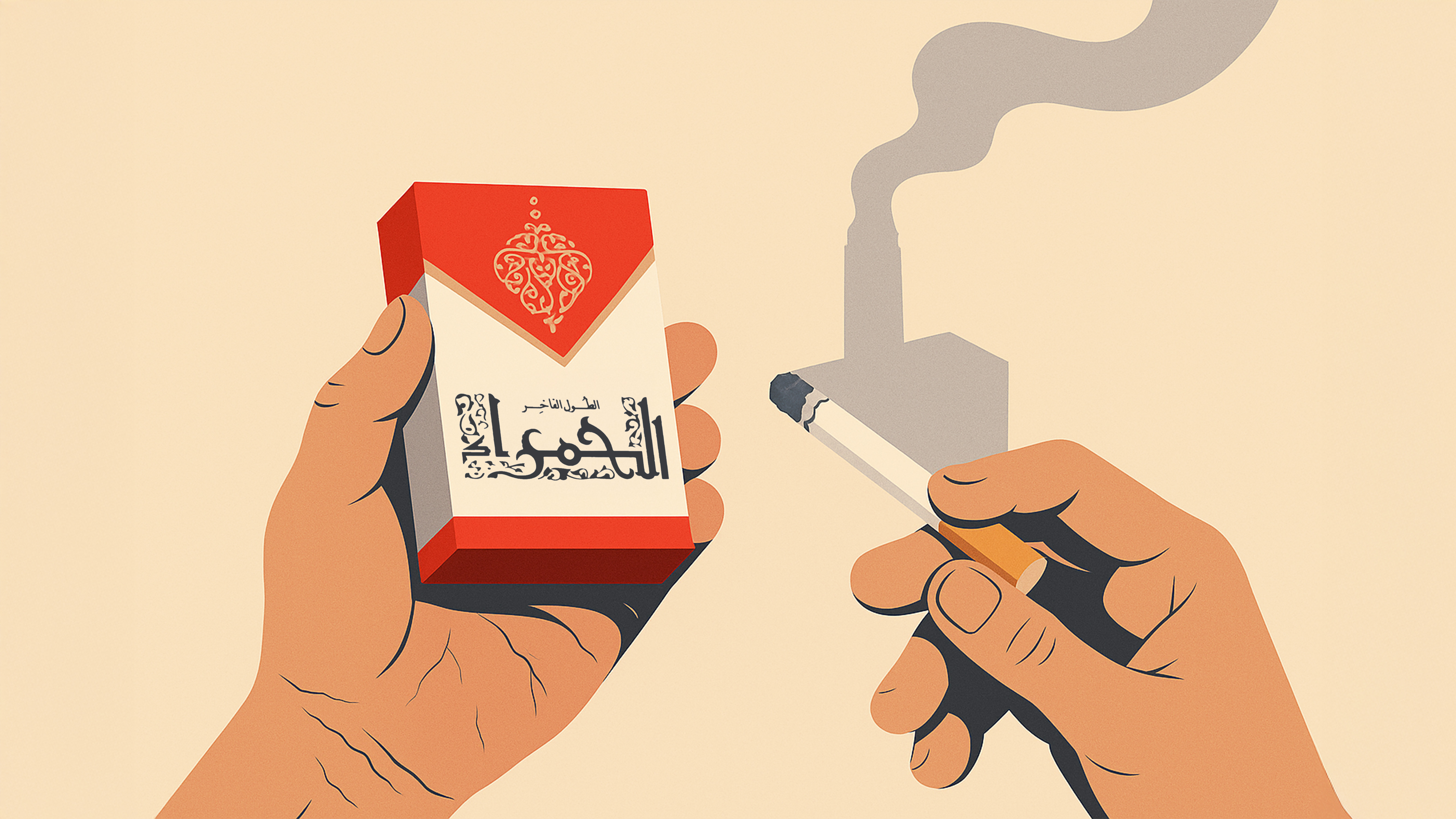
Today, this ritual is threatened by a decree from the Syrian Ministry of Finance. The decision sets the price of the "Tax Stamp" at 1,000 Syrian Pounds (equivalent to 100,000 pounds under the old valuation). Under this mandate, the Ministry will collect the difference between the old and new prices based on the updated rates. According to the Verify-Sy platform, this decision does more than just put "the cultural and social heritage we preserve at risk"; it also closes a "door of livelihood”.
“This tax might make continuing our craft nearly impossible", says Ahed Rustum, a vegetable trader from the village of Asqabuli in the Dreikish region. He grips his chair as he speaks, as if forcing himself to remain seated. The decision comes amidst a dire economic crisis in Syria, with its impact felt doubly in the coastal region. Here, the struggle is compounded by constant fear, dwindling job opportunities, and arbitrary dismissals from public sector positions, forcing residents to juggle multiple jobs, including the distillation of Arak.
Oh, mother of the side-locks, my eyes,
Oh, my lord... The strike of daggers is easier to bear,
Than the rule of a scoundrel over me.
Oh, mother of the side-locks, woe is me, my girl,
How sweet is the camel ride, If led by a young girl.
From the vine to the karka
The preparation for the takreek (distillation) begins the moment the grapes are harvested. "It happens in late August and early September, when the summer heat begins to mellow and the clusters are heavy with sugar", explains Barhoum via a WhatsApp interview.
It is a ritual that Hajar also describes with deep nostalgia during a phone call. "The grape harvest was a celebration for us, not just labor. We would wake up early, before sunrise, put on our work clothes, and walk to the vineyards filled with laughter. Men and women were in the fields from dawn, each knowing their role. I loved that gathering; seeing everyone together made me feel as if the entire village had become one single family”.
After the harvest comes the pressing and fermentation, as described by Salim Suleiman (a pseudonym, 63) in his home in a village near Dreikish, Tartus: "After pressing the grapes, we leave the juice to ferment in plastic jars or sealed barrels, kept away from the sun. After a month or so, once the taste becomes sharp and the aroma grows pungent, we know it’s ready for the karka". Ahed, his eyes crinkling with pride, confirms this: "Every season, I select the grapes with care and monitor the fermentation with my son step-by-step; any mistake ruins the quality".
Once fermentation is complete, the takreek (distillation) begins. The juice is transferred to the karka, which Barhoum describes as "an ancient distillation apparatus made of copper or metal. It resembles a large pot with a lid and a long tube that passes through cold water to condense the vapor.

Takreek (to distill) is a verb that does not exist in standard Arabic; rather, it was coined by the locals, derived from the name of the apparatus itself - the karka. With skin bronzed by the sun and calloused hands that move restlessly as he speaks, Salim says: "We never used to say we were 'cooking' Arak; we said we were 'takreeking' it. It was as if the word stood alone - a verb with its own unique timing and its own sacred laws.
After transferring the juice to the karka, "we light a low fire beneath it - never strong, for haste ruins the flavor", says Salim, leaning back against the wall. The distillation process then truly begins, a stage Barhoum describes to SyriaUntold in vivid detail.
"As the liquid heats, the alcohol vapor rises and then condenses back into a clear liquid, dripping drop by drop. At this stage, we add anise seeds to give the Arak its signature flavor. During the boiling, we seal the edges of the karka with wood-ash clay to prevent any leaks - specifically wood ash, so as not to taint the taste. What happens during takreek is not mere boiling; it is a meticulous observation of fire, sound, and scent. Too much heat spoils the flavor; too little stops the drip. When the Arak finally emerges from the tube, we collect it in glass bottles or clay jars to let it settle before it is ready to be served".
It is a moment Salim describes with anticipation, leaning forward: "Then, the true Arak begins to flow, drop by drop, clear as glass. We fill the first bottle and pause to taste. If the flavor is balanced, we continue. If we sense bitterness, we lower the fire or add a little water to the karka... The whole process is built on patience and long nights. We sit around the fire - one watching the drip, one tending the wood, and another telling tales of the old days". These gatherings, filled with joy and song, accompany the ritual of takreek and stretch long into the night.
Woe, oh mother of the side-locks,
Woe, my girl...
Oh, fire of my heart, blaze on,
Even water cannot put you out.
Salim describes a moment he calls "the most beautiful of my life". His eyes glisten with joy before he adds: "It was when we would add water to the glass and the Arak turned white. That was when the elders - my father, my grandfather, and my uncles - would laugh and say: 'Now, our son is ready'. It was never about getting drunk; it was the entire year’s toil distilled into that single bottle".
Salim, who insisted on remaining anonymous because he is a partner in a bar, fears harassment and harm if he were to speak under his real name.
More than just a drink
The grape harvest and the takreek of Arak are eternally entwined with various forms of folk song - Om al-Zulf, Ataba, Mijana, and Dal’ouna - and with the communal gatherings and ancestral tales preserved by oral tradition. It is a holistic ritual, handed down from fathers to sons and grandfathers to grandsons.
“The culture of distillation among families on the Syrian coast is not merely a culture of drinking", Barhoum explains. "It is a culture of seasons and gatherings. The family huddles around the fire to exchange stories, recounting the tales of our elders who taught us how to judge the heat of the flames by their sound, and how to distinguish fine Arak by its scent long before it touches the tongue. This knowledge isn’t found in books; it is an inheritance, passed from hand to hand and mouth to mouth, as an integral part of a rural life bound to the vineyards and their seasons. For us, takreek is not just the production of a beverage; it is how we preserve what our parents taught us - and how we hold onto a piece of their world.
Mahmoud Barhoum recalls how his father would constantly repeat a story about weddings in the rugged mountains (al-Jaroud). It was a scene etched so deeply in his memory that he refused to let it fade: not merely because it was a wedding, but because the sound was a collective proclamation of the entire village's presence. He says: "They would stand before the bride’s door, raising their voices to sing: 'Who is at the door? It is us at the door! Either we take our bride... or we break down the door!'"
In that era, the song was not a threat; it was a definition of the community. It meant: We are here together, we have come with one voice to open a new door. This scene, as Mahmoud views it today, mirrors what happens around the karka. People do not come alone; they arrive as a group. The ritual only truly begins when their voices wrap around the fire, through a story, a joke, or an ancient song. Just as the song preceded the bride’s entrance into her new home, laughter and conversation precede the first drop of Arak from the tube. In both instances, the door is never opened in silence, but by the voices of the people. The occasion is only recognized when it becomes a shared event, declaring: "We are here, together”.
The ritual of Arak distillation is inextricably linked to the folk songs and mawwals that accompany these gatherings, preserved through oral tradition for generations. The song "Om al-Zulf ya Moulaya" which locals chant during the takreek process, is deeply rooted in the land and the collective memory of its people.
In the shadow of corruption: women in government sector pay the heaviest price
05 May 2026
"Om al-Zulf" translates to "Mother of Beauty", a reference many believe points to Ishtar, the ancient Syrian goddess of fertility and beauty. According to linguistic references, the word "Zulf" is of Syriac origin, denoting things of exquisite beauty, such as embroidered garments or ornamentation. Meanwhile, "Moulaya" in Syriac signifies fertility, abundance, and fullness. All these meanings reflect the enduring legacy of Ishtar’s status among Syrians, connecting an ancient heritage of abundance to the modern-day ritual of the harvest.
Ancient Syrians celebrated the goddess Ishtar every spring, and many believe this tradition persisted through the various peoples who inhabited the region. Until recently, inhabitants of the Syrian coast celebrated the "Feast of the Fourth" (Eid al-Rabi') in April of each year. These celebrations were marked by rituals of Dabke dancing, the music of flutes and drums, and spirited duels of Ataba and Mawwal poetry.
Baking on the saj...
Baking on the saj...
With tattoos upon her chest,
Of rams and of sheep. Do not wed the fair one,
For the fair one is but a tease;
But the dark-skinned woman lifts the sorrow,
Even if she... belongs to the city.
Economy and ruined livelihoods
Most families who distill Arak on the Syrian coast may not rely on it as their sole source of income. However, it remains a vital secondary revenue stream in a country where Syrians are forced to juggle multiple jobs, following the folk proverb: "A pebble can prop up a heavy jar" (meaning every little bit helps).
"In our village, Arak isn't really sold in major markets", Barhoum explains. "It’s mostly kept for the household or given as a gift to relatives and guests. Any sales are limited - usually local or individual - and certainly not a large-scale commercial trade”.
However, not everyone shares Barhoum’s situation, especially those whose livelihoods are directly tied to the craft. Salim, his voice heavy with anger and eyes glistening with unshed tears, says: "This tax on alcohol is ruining my home. People have already started fearing the bars, and now they have to calculate the cost of the tax as well. Little by little, we are losing all our customers. My partner and I will be forced to close the bar".
The same struggle applies to Ahed, who arrived straight from work, wearing brown trousers and black boots, his hair tousled. "I don’t distill Arak just for the household or for guests; I do it for trade and sale. I produce premium, local Arak. For me, the karka isn't just an antique machine; it’s a tool of my trade. I’ve grown accustomed to its sound and its scent; I know exactly when the first drop begins and the last one ends. After distillation, I let the Arak rest before selling it, because the product's reputation is directly tied to its quality".
SyriaUntold conducted this interview with Barhoum shortly before the Damascus Governorate issued a decree on 17 March. The decision - which sparked widespread protests - restricts the sale of sealed alcoholic beverages to three predominantly Christian neighborhoods: Bab Touma, Bab Sharqi, and Al-Qassaa, and prohibits serving them in restaurants and nightclubs, allegedly in response to local community complaints. A later clarification was issued, exempting establishments with tourism licenses.
The impact of this decision is not merely economic, but deeply emotional. Lama says: "This year, I took part in the grape harvest. Like every year, we sang, we labored, and we rejoiced. But when I heard about the price hike on Arak, I felt something of that joy break. I’m already thinking about next year: will there still be evenings spent together? Will there be a fire for us to gather around? Or will the entire season turn into fear instead of song?"
Her mother, Hajar, adds with a heavy heart: "I have lived through many seasons. I’ve seen the harvest endure war, drought, and inflation. But for the first time, I feel the fire itself is threatened. I fear I might pass away without seeing my daughters and grandchildren sing as we once did, because this decision has made joy more expensive than we can afford".
Oh, mother of the side-locks, my eyes,
Oh, my lord... The strike of daggers is easier to bear,
Than the rule of a scoundrel over me.
Oh, mother of the side-locks, woe is me, my girl,
How sweet is the camel ride, If led by a young girl.