

This is the third of a four article series, examining the former Nazi personnel missions in Syria. It builds on the author's master's thesis, which contains the complete source documentation and archival references. Editorial supervisor: Sulaiman Abdullah
All rights reserved. Any form of copying, reproducing, or republishing of the text is prohibited.
***
Franz Rudolf Roestel arrived in Damascus in August 1949 at the moment Syria was sliding into a new phase of political upheaval. Only hours after he entered the country, President Husni al-Zaim was overthrown by Sami al-Hinnawi. Roestel, a former SS-Standartenführer and assault-gun specialist, had come through networks linked to the Gehlen Organization, Germany’s predecessor of the Federal Intelligence Service, headed by Reinhard Gehlen. His arrival signaled more than the recruitment of another foreign adviser: it marked Syria’s attempt to turn scattered postwar contacts into a more systematic programme of military modernization.
The two earlier missions under the leadership of Hyazinth Graf Strachwitz and Walther Rauff had disappointed Damascus. What Syrian officers now wanted was a cadre of specialists who could train, reorganize and professionalize the armed forces. The network that emerged drew in former Wehrmacht and Luftwaffe officers as well as (Waffen-) SS men. Its members worked in Damascus, Homs, Aleppo and Qatana, while recruitment extended across Germany, Austria and Switzerland.
From failed missions to military specialists with hidden roles
Roestel lived in Jisr al-Abyad (in Damascus Governorate). A few weeks after his arrival, he was summoned by Syrian General Staff Chief Anwar Bannud. Syria, Bannud reportedly told him, has had enough of unreliable advisers and needed professionals. Roestel was therefore asked to recruit military specialists and the auxiliary personnel required to support them since most of the previous advisers had been laid off.
Roestel accepted and became head of the third German military advisory mission. Appointed colonel in the Syrian General Staff, he was also charged with recruiting personnel in Austria and Germany. However, he had conditions - he wanted higher salaries for the mission members and the inclusion of a French officer known as Holm.
Holm, also known by many other names, but whose true identity has not yet been confirmed, was far more than the interpreter he was hired to be. A French national, former Vichy collaborator and SS member, he had been decorated as a paratrooper and was later convicted as a war criminal, but French authorities shielded him from prosecution in exchange for intelligence work in Damascus.
He was not the only one who held a dual role. Most of the German intelligence reports from the various agencies at that time were based on information provided by members of the mission (although some of them were returnees). This practice continued, as even the group around Alois Brunner and Franz Rademacher - which did not begin operating in Syria’s mukhabarat until after the last mission group had ended its activities - maintained “aggregate connections, directly or indirectly, with over half a dozen intelligence services”. In this regard, the findings must always be viewed with a certain degree of caution when a former SS officer, an adventurer, or a frustrated returnee reported on their work, their colleagues, and their perspective on developments in Syria.
In any case, Holm was officially attached to Roestel as a language liaison, but his influence quickly grew. He accompanied inspections, drafted plans for reorganizing the Syrian army and shaped documents that Roestel later signed as his own.
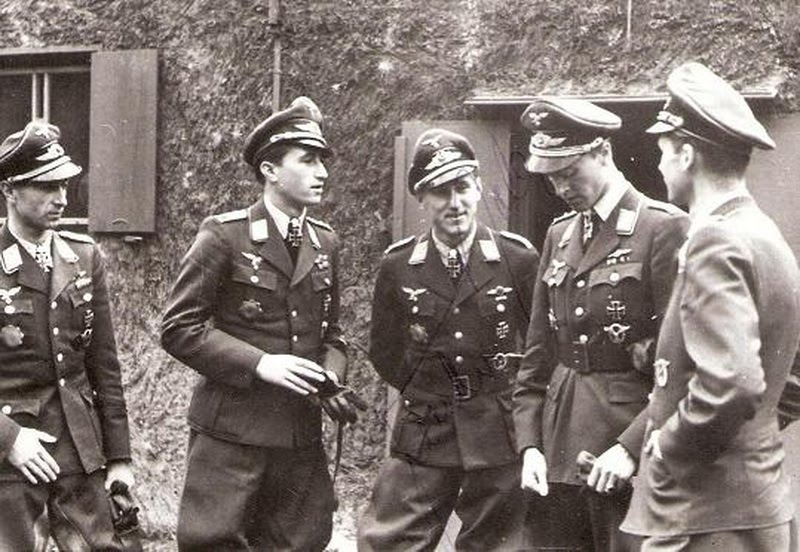
Holm focused on recruiting German experts for Syria, bringing Gerhard Schacht in again to organize recruitment in Germany, a work he did from 1948 to 1951. Schacht was a former paratrooper with the rank of a Major and a member of the Gehlen Organization since 1947 who later also joined the new German army, the Bundeswehr. According to a BND report, Schacht recruited 44 former officers from the army, air force and Waffen-SS. Holm, meanwhile, built a highly effective intelligence network headquartered in Zurich. Switzerland offered useful connections: Roestel had appointed former Luftwaffe Major Hartmann Grasser, a recipient of the Knight's Cross of the Iron Cross with Oak Leaves, to the air force group, one of several specialized working groups within the mission, where he was responsible for hunting tactics. And Grasser reportedly also knew the head of the Swiss political police.
Training, advising and building military structures
The air force group illustrates the mission’s range. Walter Schuck, a decorated fighter pilot, became a flight instructor. Gustav Ludwig Korff, a former Luftwaffe (German Air Force) staff engineer and electronics specialist, worked at Syrian air force headquarters, tested radio equipment and helped design a radar network intended to detect hostile aircraft, especially from Israel, while also passing on his knowledge as an intelligence officer. Others were posted across the country. Major Robert Olejnik trained personnel in Aleppo; Lieutenant Colonel Stams advised on ground organization; Captain Distelmeier supervised aircraft maintenance; Colonel Hardt trained the transport squadron; Major Schnetz worked on maintenance and laboratory questions.
The army group covered armoured warfare, training and engineering. Wolfgang Otto, a former SS-Hauptsturmführer, trained motorized reconnaissance units, advised on anti-tank warfare and helped establish an armoured school between May 1950 and July 1952. The Gehlen Organization assisted with his visa and later departure; he subsequently worked for the BND. Hans-Georg von Tempelhoff, a former major general, artillery commander under Erwin Rommel and specialist in chemical warfare, was officially employed as a commercial worker and technical adviser. In practice, he trained Syrian officers at the Military Academy in Homs.
Other advisers filled more specialized posts: Lieutenant Colonel Walleser supervised infantry training; the former SS-Hauptsturmführer Greilinger worked at the military sports school in Qatana; Major Klaus Messerer handled engineer training; Lieutenant Häfelein and SS-Obersturmführer Frank were attached to technical and vehicle-related tasks. Among the most important figures in this constellation was Rainer Kriebel, a former Waffen-SS Obersturmbannführer and Wehrmacht colonel.
The technical group added another layer: Dr. Schürenberg advised as a mineralogist and geologist; engineer Weitzenbeck worked on motorization; and Adolf Schreiber, formerly of the German Reich Air Ministry, became Shishakli’s personal adviser and chief engineer for arms and armaments. He also supervised the army workshops that revealed both a great deal of inconsistency in the armed forces' (technical) equipment and a shortage of military supplies.
“I want to turn Syria into the Prussia of Arabia”
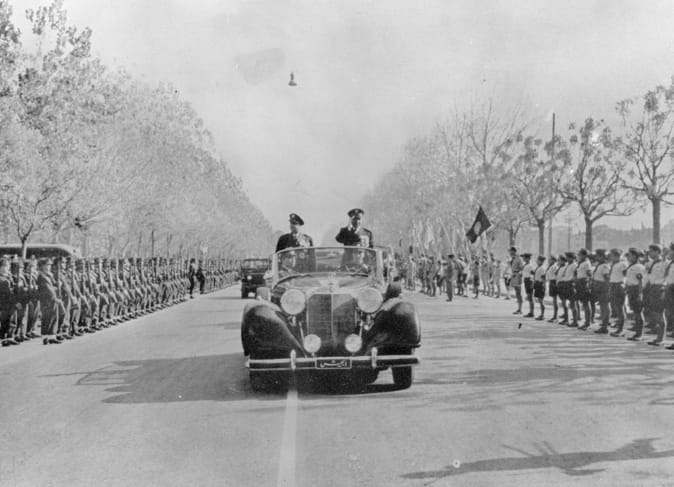
Hinnawi’s rule remained brief. Only a few months later after he had seized power, Adib al-Shishakly led putsch number three of that year. He, however, would stay for a few years and continued to hire and work with former Nazis and German military specialists. The symbolism was hard to miss: he reportedly drove through Damascus in a Mercedes said to have once belonged to Adolf Hitler and described his ambition as making Syria the “Prussia of Arabia”.
Military modernization was his priority, because in the Arab Cold War of the 1950s and 1960s, Israel was only one perceived threat; rival Arab states could appear just as dangerous. Kriebel’s early assignments reflected this regional logic. One of his first tasks was to draft a defence concept against Jordan, which Roestel later signed. By October 1950, Kriebel had also prepared a tactics course for Syrian officers and delivered several lectures.
This work coincided with Syria’s formal military planning. In March 1950, the Syrian General Staff brought Roestel, Holm, and five other Germans ("the constructive forces of the mission," who, apart from the planning, however, lived in complete seclusion) together in a Technical Commission and tasked them with drawing up a three-year military plan. The plan ultimately “met the demands of the Ministry of Defence”, tasking the group to seek additional German army and air force officers, technicians and assistants to replace the French personnel who had continued to train Syrian forces. The financial terms made the offer attractive. A colonel was to receive 1,200 Syrian pounds per month, a captain 800 - roughly twice the pay of Syrian officers of comparable rank.
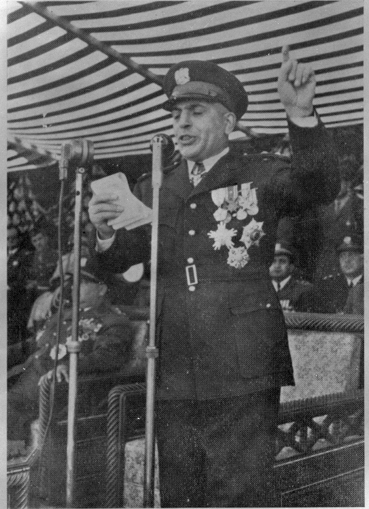
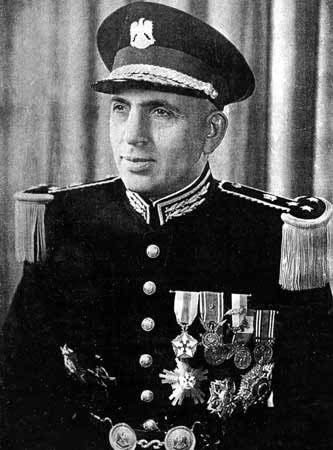
Kriebel vs. Roestel
Internal conflicts between mission members were as common during the third mission as the ones before. The decisive one, however, was the struggle between Roestel and Kriebel.
While Roestel’s circle included mainly former SS members, some of whom had strong reasons to avoid prosecution in Europe, around Kriebel, by contrast, former Wehrmacht officers were more prominent. The SS men rather tried to build transnational networks with former comrades, the former Wehrmacht officers were mainly financially motivated and loyal towards Syria as well as Germany, hoping to, one day, go back to their country. Tilman Lüdke, senior researcher at the Arnold-Bergstraesser Institute, therefore describes this group as the mission’s “professional backbone”.
After the coup, Roestel and Holm travelled to Switzerland to recruit additional personnel and take leave. Kriebel used Roestel’s absence to strengthen his own position. According to the Friedrich-Wilhelm-Heinz-Dienst (FWHD, one of Germany’s intelligence services at the time), he provoked a serious dispute between Roestel and the Syrian defence minister, damaging Roestel’s standing with the government beyond repair. Kriebel’s own posture remained ambivalent. In a letter to the German Foreign Office, he floated the idea that Roestel might one day become German ambassador to Syria. In the same breath he wrote: “One may approve of it or not, the Arabs, and especially the Syrians, are still today devoted to Hitler with admiration”.
By October 1950, Roestel had lost. Kriebel replaced him as head of the mission. The CIA suspected that Syrian authorities wanted Roestel removed because they considered him an American agent. FWHD reports, by contrast, emphasized Kriebel’s maneuvering and his efforts to force Roestel aside.
At the end of October, Syria ordered Roestel and his staff to leave. Syrian military police arrested several men, searched their homes, confiscated official and private papers and passed them to the Deuxième Bureau. This showed that Roestel had kept a large number of the mission’s documents out of sight, including papers produced by other members of the team. Those documents offered clear evidence of their professional expertise - and may have posed a threat to Roestel’s own standing. Keeping them back also gave him another advantage: as in the case of Holm and Kriebel, he could present the work of others as his own and take credit for what they had accomplished.
The detainees were later released, their belongings returned, and Syria honoured the remaining contractual obligations. But the removals did not pass unnoticed. In the Syrian parliament, deputies criticized the personnel changes as “unnecessary and detrimental to Syria’s interests”.
Another coup, another mission, another failure
The German mission was by no means a simple case of foreign experts moulding a passive Syrian state. Local officers had their own interests and calculations. They decided whom to hire, promote, dismiss and, when necessary, arrest. German expertise was useful only insofar as it helped strengthen the army, consolidate political power or respond to a region marked by coups, rivalries and uncertainty. Rather than simply following German instructions, the Syrians deployed the advisers when and how it suited their own purposes - a pragmatic calculation of costs and benefits.
Yet this did not mean that the Syrian military was a stable, professional institution guided by clear strategic thinking. Successive governments wanted modern armed forces and an effective intelligence apparatus. At the same time, officers sought to preserve the established and mainly French structures in which they had been trained, even as domestic and regional politics became increasingly unstable. From the 1948 Palestine war into the 1970s, the Syrian army had more than a dozen chiefs of staff. Coups meant that changes at the top often came through abrupt dismissals rather than orderly handovers. At times, these transitions were violent. They also disrupted the German advisers’ work, repeatedly forcing them back to the starting point.
In addition, Western intelligence agencies opposed to the German military presence in Syria reportedly attempted to discredit the advisors by questioning their political loyalty. Syrian authorities were informed that some of the German officers were actually communist agents who had been deliberately infiltrated into the Syrian armed forces to conduct espionage. To this end, they bribed officials of the Communist Party of Germany to produce forged documents purporting to prove the alleged party affiliation of specific German officers. These accusations carried potentially serious consequences and also undermined the reputation and credibility of the German military mission in Syria.
Political pressure from outside the mission was only one of the difficulties the advisers encountered. Their work was also shaped by tensions among the members of the mission itself, and expectations that often proved difficult to meet. Language barriers hampered training, even when interpreters were present. They spoke French or Arabic but lacked the necessary military vocabulary in both their native language and the language they had learned. Disputes over pay, lack of decision-making authority, limited influence, friction with Syrian colleagues and an unfamiliar social and cultural environment added to the strain.
Reports from Roestel’s circle went further, alleging that there had “occasionally even been murders ordered by Syrian officers, because the Syrians felt that their dominant position was threatened by the German officers”. One account cited a man named Wasser or Nasser, said to have held a senior role in the Syrian air force command and reportedly killed during a night flight. The report described his death as murder, possibly carried out through sabotage.
By the end of 1950, Holm and G. Schacht had also fallen out. Holm allegedly tried to have Schacht arrested and then killed. Communication between them broke down, and Schacht subsequently ended his work as a recruitment specialist.
The mission’s character began to change with the arrival of Rainer Kriebel. He would lead it for more than five years, the longest tenure of any mission chief, and oversee what proved to be the last of four German military missions in Syria.
References: