

This is the last of a four article series, examining the former Nazi personnel missions in Syria. It builds on the author's master's thesis, which contains the complete source documentation and archival references. Editorial supervisor: Sulaiman Abdullah.
All rights reserved. Any form of copying, reproducing, or republishing of the text is prohibited.
When Rainer Kriebel, a former Wehrmacht colonel and Waffen-SS Obersturmbannführer, took charge in October 1950, Germany’s military advisory effort in Syria entered its fourth and final phase. Lasting roughly five years - longer than any of its predecessors - it offered the best opportunity yet to leave a lasting mark on the Syrian armed forces. The mission benefited from the relative stability of Adib Shishakli’s dictatorship and from work the Syrian leader reportedly praised as having been carried out “to our complete satisfaction”. Yet Kriebel inherited a fractured construct marked by disappointment, rivalries and chaos. Kriebel soon gained unusual access. In 1951, he reportedly persuaded Shishakli not to attack Israel and proposed instead a belt of civilian defence villages along the border. West German officials were aware of his reach. Hans Globke - himself burdened by a dark Nazi past and by then serving as West German Chancellor Konrad Adenauer’s right-hand man - wrote that Kriebel had discreetly advanced German and wider Western interests. According to Globke, Kriebel did so by discouraging renewed war with Israel and resisting a Syrian pivot toward the Eastern bloc following the ouster and arrest of Maarouf al-Dawalibi’s government, which lasted just 12 hours before Adib Shishakli toppled it.A 1951 intelligence assessment similarly noted that the advisers had been urged to moderate Syrian policy on Palestine, though it conceded that Germany no longer exercised control over them.
An ambitious blueprint for a fragile army
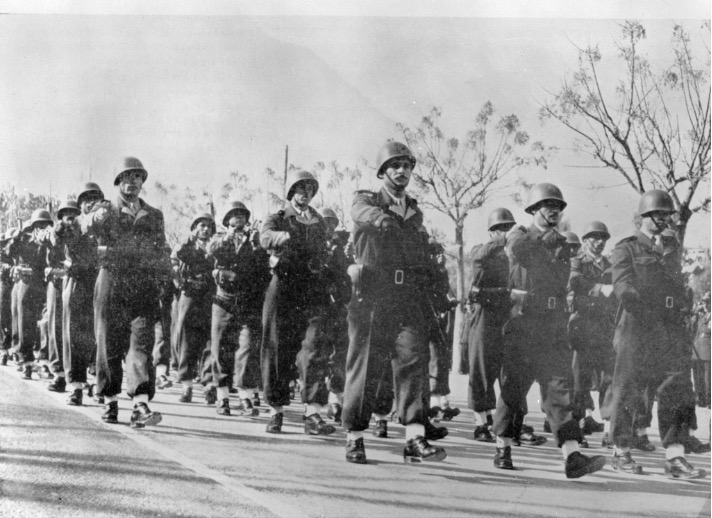
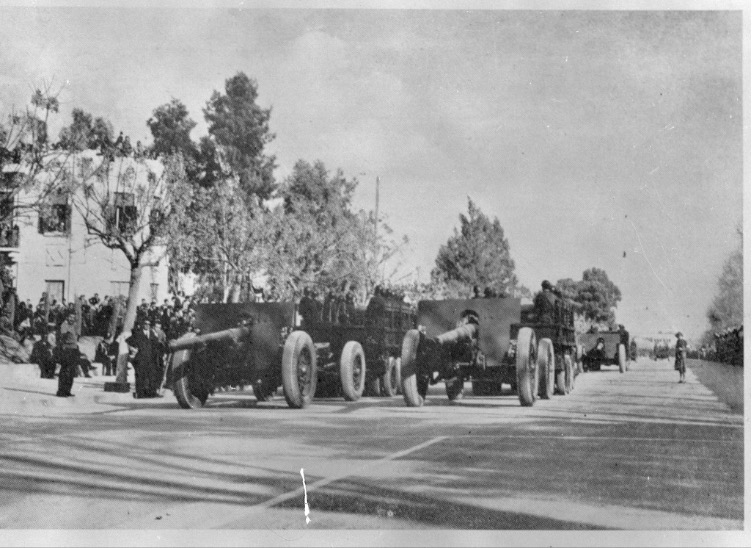
The formal brief was demanding. A three-year plan called for the army to grow from about 35,000 to 85,000 personnel, build a motorized brigade at its core, standardize equipment and training, and reorganize the air force. The Germans found units still using an ageing assortment of German, British and Italian weapons from the 1940s. The projected air arm was to field three fighter squadrons and one ground-attack unit. Since, as a group independent of any state, they could not draw on the written principles of an existing army, they had to draw “from their personal memories and experiences”, as former Wehrmacht Colonel Georg Gartmayr put it. Kriebel led roughly 20 advisers in 1950; about a quarter had served in the Waffen-SS. Officially, they were civilian employees of the Syrian Defence Ministry. They worked at army headquarters from 9am to 2pm and earned between 800 and 1,200 Syrian pounds - always double the amount of a Syrian officer with the same rank. Their private one-year contracts renewed automatically unless either side objected and included a return ticket and departure bonus. On paper, this made them look like ordinary foreign specialists. Their biographies told a darker story. Although former Wehrmacht and Waffen-SS personnel did not share a single political agenda, their presence inextricably linked Syrian state-building to a postwar market in military expertise - one shaped by displacement, de-Nazification, and the Cold War.
‘Experts’, rivals and institutional resistance
Kriebel was joined at the top by former Wehrmacht generals Heinz Heigl and Hans-Georg von Tempelhoff. Heigl trained soldiers at the sports and commando school in Qatana. With diplomatic status and contacts among Western powers, he was expected to help contain Soviet influence. Yet the mission remained riddled with intrigue. Heigl and Weitzenbeck were accused of denouncing colleagues and spreading rumours to shore up positions weakened by their own “limited ability”. Georg Gartmayr, who came to Syria in August 1951 and was described as Kriebel’s deputy, advised on mobilization and organization from 1951 to 1955. He became head of mobilization in autumn 1951 despite admitting gaps in his practical experience. In his military diary, he complained that the concept of 'tactics' was virtually unknown - and that introducing even a basic course on the subject met with widespread bewilderment and pushback rooted in misunderstandings. He wrote that basic military training was “utterly repugnant to the Germans and, in fact, useless”. Outside the core mission, Walter Weiß, Moritz Bremer and Hans Möhr continued working with Syrian aviation while keeping clear of its disputes. Meteorologist Dr. von Bezold, Distelmeier and chief engineer Schreiber stayed with an air-force group whose importance had already declined. The deeper problem was institutional. A reservist could take at least four days to reach his unit. During a 1951 inspection of the military academy in Homs, Kriebel, Joachim Tzschaschel, Gartmayr and an officer named von Vogel found that recruits entered after secondary school and graduated as officers after 18 months - without weapons training, which came later at specialist schools. Gartmayr complained that tactics were scarcely understood and that plans to teach infantry-battalion tactics met astonishment and resistance: “The French eggshells still cling rather firmly”. Recruitment and discharge continued throughout the year, making stable course groups impossible. Translation posed another obstacle. Interpreters Karl Stowasser, Dr. Kräftner and a Syria-based Mrs. Müller lacked military backgrounds, forcing Kriebel and Gartmayr to translate a mobilization study into French themselves.
Hafez al-Assad’s German instructors
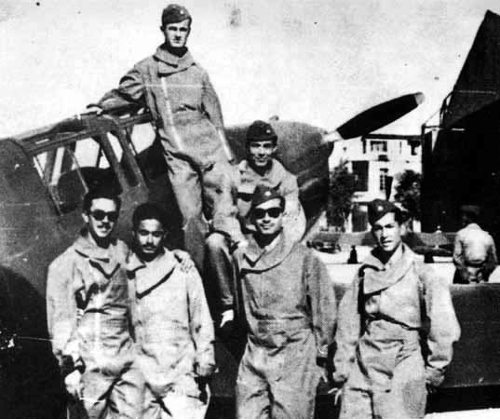
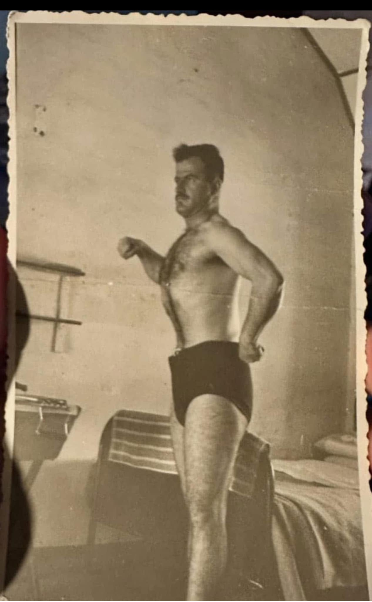
Joachim Tzschaschel, a former brigadier general who had served on the Wehrmacht General Staff late in the Second World War, ran tactical courses and artillery training. In his memoir, he portrayed his Syrian years as a prelude to his later Bundeswehr career. Kriebel, an acquaintance from the Eastern Front, recruited him in June 1950. Tzschaschel later stressed the attraction of foreign experience and language learning and described work on operational planning, combined-arms courses and organizational schemes. Although he could not verify it afterward, he writes that Hafez al-Assad was said to have been among the participants of his courses. In theory, it’s possible since Assad trained at the Homs military academy and the central flying school in Aleppo between 1952 and 1955. While this remains unclear, Assad himself confirmed he had been taught by Germans. During his formation, he was selected for advanced training at the Mezzeh military base, where members of the German mission trained him: "He recalled how one morning a German instructor who was teaching him to fly the Fiat-59, a propeller-driven fighter, said to him: ‘Hafez, we’ve both had breakfast. Let’s see who can make the other lose first’. So they took off and, simulating a dog fight, chased one another across the sky”.
The German Week: Hjalmar Schacht’s visit to Damascus
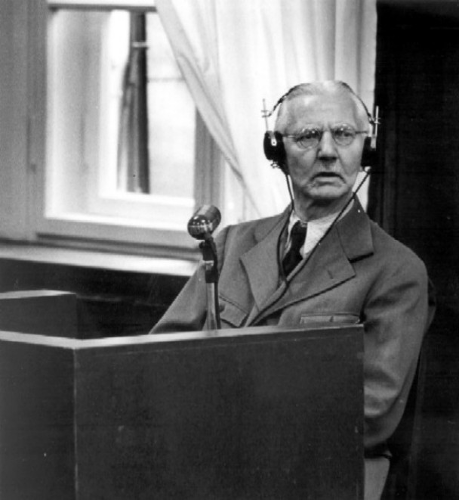
Syria’s finance and economics ministries consulted Hjalmar Schacht, Hitler’s former economics minister and Otto Skorzeny’s father-in-law, who had been acquitted at Nuremberg in 1946. Schacht and his wife received an official welcome during a 1952 so-called “German Week”. Der Spiegel reported bouquets, honour guards and a three-hour audience with the head of state. Schacht proposed financial and economic reforms, including a state national bank and major irrigation works. Accounts diverge: Tzschaschel said the irrigation plan was poorly received and Schacht was coolly dismissed, while Schacht’s biographer described a successful visit that produced further commissions. The turmoil surrounding the visit surfaced dramatically the next day. Adnan al-Maliki - who had shared coffee with Schacht and others and who was himself sympathetic to the Germans in general - was arrested with roughly a dozen senior officers accused of plotting a coup. Schacht later joked that an arrest immediately after their meeting might have produced the headline “Schacht Finances Military Coup”. Shishakli answered the alleged conspiracy with another round of repression. His police chief, Ibrahim al-Husseini, reportedly advised by former Gestapo personnel as well, placed another 200 alleged opponents in protective custody.
Shishakli’s remaining opponents are said to have turned to the words of the Arab poet Abo al-Alaa al-Ma’ari (أبو العلاء المعري), written a thousand years earlier:
جلوا صارماً وتلوا باطلًا
وقالوا: صدقنا؟ فقلنا: نعم They drew a gleaming sword and spoke falsehoods,
they said, “We speak the truth”, and we replied, “Yes”.
Missile programme
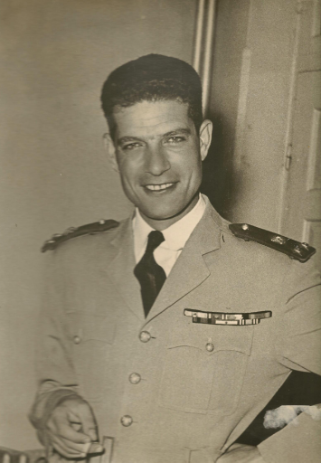
Alongside the advisers operated a second German team of similar size. Led by Hermann Hemesath, it officially pursued Syrian industrialization but in practice worked on arms production and a missile programme. The group developed missiles derived from BMW designs. Meanwhile, between January and March 1951 alone, the West German chemical industry supplied Syria with raw materials for ammunition production worth 250,000 DM, thereby profiting from the arms buildup against Israel. Its members included Peter Nauschütz, Wilhelm Wessel, Otto Cerny and Hans Georg Mebus. Nauschütz, who had worked on the unrealized ENZIAN surface-to-air missile, designed a remote-controlled anti-tank missile in Syria between 1951 and 1954. Hunt says Wessel, formerly of BMW, supervised the team; Cerny arrived only in 1956 and later worked for the US Army. In 1952, the Syrian consulate in Bonn also sought retired railway specialists. Among those recommended was Franz von Kappen, an SS major experienced in moving maritime freight by rail - evidence of continuing links between the two countries’ transport ministries. Missile research, ammunition precursors and railway logistics show that Syrian officials were looking beyond instruction toward the industrial foundations of military power. Yet ambition again collided with institutional weakness. Wartime designs promised a technological shortcut, but factories, testing systems, trained personnel and sustained funding were indispensable. Surviving accounts identify people and projects more clearly than they document operational results. The programme’s importance lies as much in what it reveals as in what it produced: expertise developed under the Nazi regime survived defeat, crossed borders and found new markets in the postwar world - but luckily, oftentimes didn’t work out.
The Mission ends, the network survives
The mission members generally maintained an almost friendly relationship with the highest levels of government: joint lunches, receptions, and celebrations - even though the mission’s prospects for success were generally slim and had completely vanished by the end. At one of these lunches with Shishakli and six other officials, Shishakli expressed, “as always […] high regard and sympathy for Germany”. This sentiment was also reflected among the general population. However, that soon changed. The 1952 Luxembourg Agreement, under which West Germany promised Israel 3.45 billion DM in reparations, strained German-Syrian ties. A Syrian-led Arab delegation had warned Bonn of the diplomatic consequences. Kriebel believed that officers officially dismissed for financial reasons were, in fact, casualties of the agreement. Even so, most remaining contracts were renewed in October 1953. The political ground shifted. Shishakli resigned and fled Syria in February 1954; his government soon collapsed. Four governments came and went in 1954 alone. Political turmoil, border tensions and internal feuds repeatedly pulled Syrian officers away from training and planning. Gartmayr’s diaries showed his frustration: progress remained slow, he wrote, and there was still an infinite amount of work to do. “Staying any longer means wasting time, whether for military reuse or for permanent reassignment elsewhere”. The founding of the Bundeswehr in 1955 offered a way home and by 1956 the mission was already a thing of the past. Meanwhile, Syria had distanced itself from the Western bloc and secured new support from the Soviet Union. In the mid-1950s, it received arms shipments as well as military and economic aid. Soviet technicians and military experts traveled to Syria, and Syrian soldiers went to the Soviet Union for technical training in the use of Soviet weapons and other equipment. The Israeli Military Intelligence Directorate (AMAN) reported the following in 1957: “This stage included almost total severance from Western instruction (ending the contracts with the German experts in Syria) as well as the absorption of delegations of experts, advisors and instructors to all land forces in Syria itself, in parallel with relative expansion of the number of Syrians undergoing training in Eastern bloc countries”.
The German missions in perspective
The Soviet turn closed the chapter of formal German military assistance and with it almost a decade of active recruitment of former Wehrmacht and SS officers. It did not, however, end the presence of Nazi-linked Germans in Syria. The next chapter would belong to Alois Brunner and many other prominent Nazis who were mainly active in the international arms trade. Yet Brunner alone remained in the country until his inglorious death in 2001. Hence, every Syrian government, except for the current transitional government, from independence to Bashar al-Assad’s rule offered Nazis a safe haven and, in most cases, a paid all-inclusive employment that also allowed them to retain their military ranks. "At least 120 individuals linked to the Nazi apparatus can be traced to Syria, yet Alois Brunner is the only one to have entered collective memory - and even his story is more often told through rumor than historically reconstructable fact. Meanwhile, the four German military missions remain largely unknown in both Syria and Germany. Their obscurity, however, should not be mistaken for a lack of influence. "Compared with France and the Soviet Union, the Germans played a relatively minor role. They were certainly not essential to building the repressive security apparatus that would later displace millions, kill hundreds of thousands, and forcibly disappear tens of thousands more. Nor, as history has shown, was any 'external creativity' required to invent dozens of torture methods. Yet they did contribute. Their recruitment was just one of several avenues Damascus pursued to build its military and security capabilities. The government had initially requested military experts from the United States, Sweden, and Switzerland - all of which declined. German officers were neither Syria's first nor its only choice, but those refusals made them an increasingly attractive option. Their work extended well beyond advice. Mission members appear to have served in virtually every military context and parts of the intelligence services, as combatants in the 1948/49 war, flight instructors, interpreters, camp personnel, trainers and advisers, security staff and drivers, but also in developing torture methods. Syria apparently seemed very satisfied with them overall. Siegfried Keil, a member of the first mission, reportedly received a medal for bravery; Kriebel and Heigl were decorated for exceptional service to the Syrian nation. These honours did not make the Germans indispensable or give them a secure position. Syrian governments valued the relationship but were unwilling to appear dependent on it. To their advantage, they could draw on a large pool of compromised recruits: former Nazis held as prisoners of war in Europe or living under assumed identities, many of whom were looking for a way out. Unlike an officially dispatched state mission, these men were relatively cheap and could readily be replaced. The conditions of their employment reveal the limits of that welcome. Short-term contracts and high turnover kept the missions chronically unstable, while arrests, house searches, and the seemingly arbitrary use of torture demonstrated how little protection close ties actually afforded them. Syrian governments were neither willing nor politically or militarily able to overlook misconduct simply for the sake of friendship. Their treatment of the Germans also reflected a persistent fear of losing power to outside forces, both in terms of domestic politics and the Cold War in a broader sense. The missions thus reveal not only how Nazi-era expertise found a new market after 1945, but also how Syrian rulers used (and didn’t use) it on their own terms.
Assessing their true impact on the development of Syria's security apparatus, however, remains hampered by a lack of access to Syrian archives - as well as firsthand accounts from surviving Syrian officers, colleagues, and neighbors of the Germans. Following the fall of the Assad regime, this chapter of Syrian-German contemporary history can finally be examined from a Syrian perspective, provided enough records have survived both the passage of time and the regime's collapse - and are made accessible for future research.
References:
[1] Shishakli, quoted in Der Spiegel 1952
[2] U. Becker, “Nazis am Nil: Die westdeutsch-ägyptischen Beziehungen der Nachkriegszeit im Schatten des Nationalsozialismus” (Göttingen: V&R Unipress, 2024): 84
[3] Globke, quoted in Becker 2024: 420
[4] FWHD 1951, quoted in E. Schmidt-Eenboom, “BND: Der deutsche Geheimdienst im Nahen Osten: Geheime Hintergründe und Fakten” (München: Herbig, 2007): 191
[5] BArch BW 9/2144: 76
[6] Schmidt-Eenboom 2007: 193
[7] BArch N 567/6: 50
[8] Becker 2024: 419; J. Tzschaschel, “Zeitzeuge in Bagdad, Algier, Saigon: Erinnerungen eines deutschen Militärattachés” (Frankfurt am Main: Haag + Herchen, 2000): 13
[9] C. Chen, “Former Nazi Officers in the Near East: German Military Advisors in Syria, 1949-56,” The International History Review 40, no. 4 (2018): 738; A. Cropp, „Die Deutschen sind uns am liebsten“ (1953), Nr. 1953/12: 23; Tzschaschel 2000: 15
[10] Chen 2018: 738; Schmidt-Eenboom 2007: 192f.
[11] A. Hagemann, “Die Straße der Störche: Deutsche und österreichische Militärexpertise in Syrien und Ägypten und die Antwort Israels (1947-1967)” (Darmstadt: wbg Academic, 2023): 84f.; BArch N 567/6: 12f.; BArch BW 9/2144: 72
[12] BArch BW 9/2144: 96
[13] BArch N 567/6
[14] ibid. 5
[15] Cropp 1953: 22; A. Cropp and J. A. Elten, “In Allahs Hand: Eine abenteuerliche Orientreise im Auto” (Wien: Ullstein, 1956): 48; BArch BW 9/2144: 72, 76
[16] BArch N 567/6
[17] ibid.: 4f.
[18] ibid.: 5f.; Cropp 1953: 22; Tzschaschel 2000: 15
[19] Cropp 1953: 22; Chen 2018: 745
[20] Tzschaschel 2000: 11
[21] ibid.: 12, 14
[22] P. Seale, “Asad of Syria: The Struggle for the Middle East” (Berkeley: University of California Press, 1989): 39
[23] ibid. 50
[24] J. Weitz, “Hitler’s Banker: Hjalmar Horace Greeley Schacht” (Boston: Little, Brown and Company, 1997): 1, 337; Der Stern 1953: 2
[25] Der Spiegel 1953
[26] Becker 2024: 524f.; Hagemann 2023: 115
[27] Tzschaschel 2000: 13f.; Weitz 1997: 337
[28] Der Spiegel 1953
[29] Becker 2024: 419; Weyer 1993: 192
[30] Schmidt-Eenboom 2007: 99, 195f.
[31] J. Weyer, “Akteurstrategien und strukturelle Eigendynamiken: Raumfahrt in Westdeutschland 1945–1965” (Göttingen: Schwartz, 1993): 192; Hagemann 2023: 88
[32] L. Hunt, “Secret Agenda: The United States Government, Nazi Scientists, and Project Paperclip, 1945 to 1990” (New York: St. Martin’s Press, 1991): 191
[33] Schmidt-Eenboom 2007: 196f.
[34] Weyer 1993: 192; Hagemann 2023: 88
[35] BArch N 567/6: 12
[36] Hagemann 2023: 39, 91
[37] R. Ziadeh, “Power and Policy in Syria: Intelligence Services, Foreign Relations and Democracy in the Modern Middle East” (London: I. B. Tauris, 2011): 1
[38] Tzschaschel 2000: 13; K. Pollack, “Arabs at War: Military Effectiveness, 1948–1991” (Lincoln: University of Nebraska Press, 2004): 458
[39] BArch N 567/6: 7-23
[40] Schmidt-Eenboom 2007: 193; BArch N 567/6: 48
[41] AMAN 1957, as quoted in Y. Even, “Two Squadrons and Their Pilots: The First Syrian Request for the Deployment of Soviet Military Forces on Its Territory, 1956” (Woodrow Wilson International Center for Scholars, 2016): 4